
A budget recording studio is worth it - in the right circumstances. In the UK in 2026, affordable recording studios typically charge between £15 and £40 per hour, and that price range suits demos, acoustic recordings, beginner sessions, podcasts, and voiceovers well. For commercial releases or complex multi-track productions where acoustic precision and engineer expertise are non-negotiable, it is not the right call.
That is the short answer. What follows is the full picture: exact price tiers, a three-way comparison, a quality checklist, a genre suitability guide, and a decision framework to help you walk away knowing exactly what to book.
UK Recording Studio Price Tiers in 2026
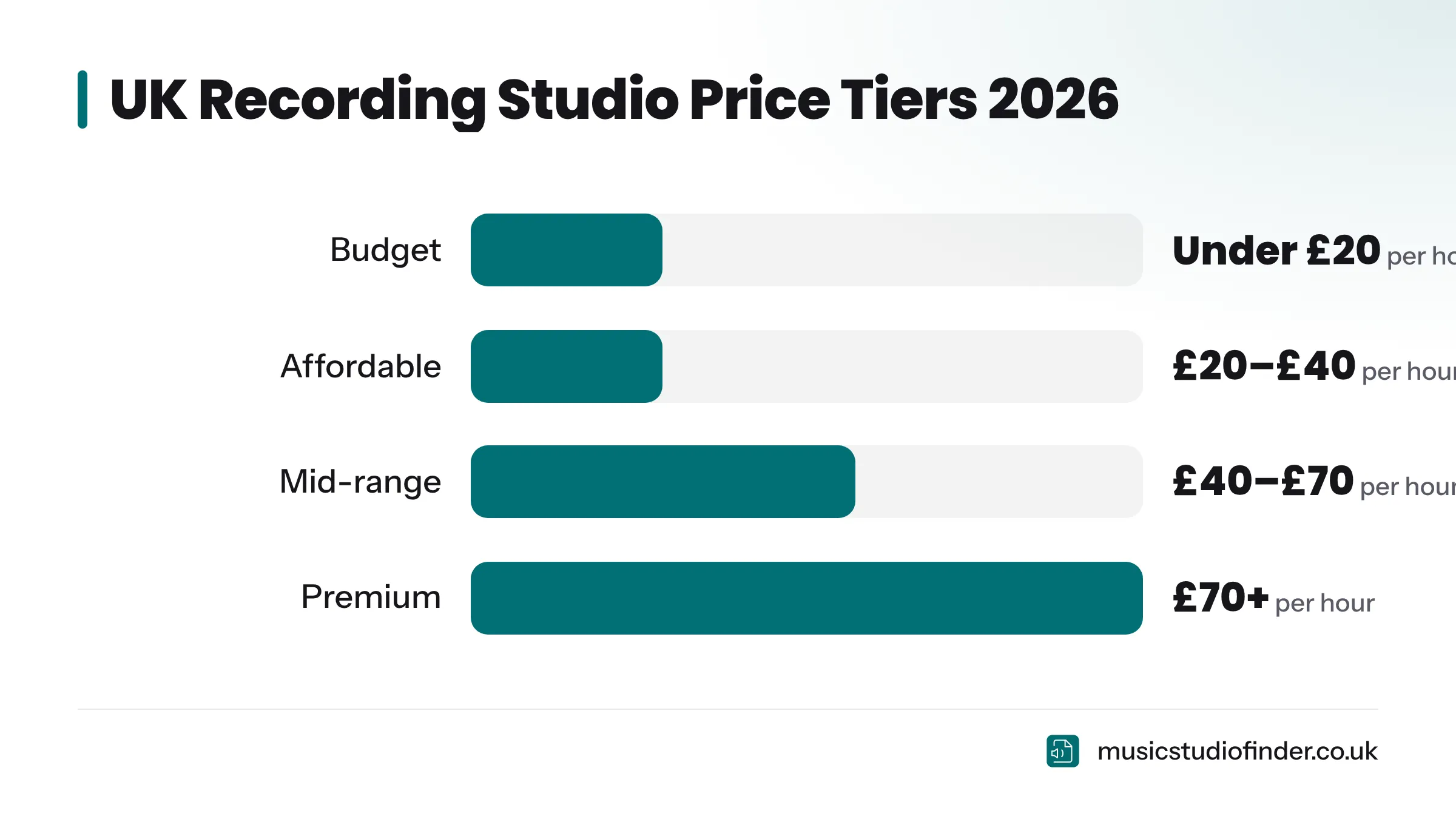
In the UK market, "cheap" is relative - but there are clear price bands most independent musicians recognise. Where a studio sits in that hierarchy tells you a great deal about what you can realistically expect from a session.
For a deeper look at what drives those differences, the Music Studio Finder guide on why recording studio prices vary so much breaks down the key factors clearly.
| Price Tier | Typical Hourly Rate | What's Usually Included | Best For |
|---|---|---|---|
| Budget | Under £20/hr | Basic room hire, basic equipment, self-operated | Rehearsal recordings, rough demos, podcasts |
| Affordable | £20–£40/hr | DAW, condenser microphone, often an engineer | Demos, singer-songwriter sessions, voiceovers |
| Mid-range | £40–£70/hr | Treated room, qualified engineer, mix consultation | EPs, indie releases, small band recordings |
| Premium | £70+/hr | Full production suite, senior engineer, SSL or analogue desk | Commercial releases, label submissions |
For a full breakdown of current UK studio rates - including day rates and package pricing - the recording studio cost UK guide on Music Studio Finder covers it in detail.
Most musicians asking whether a cheap recording studio is worth it are thinking about the £15–£40 range. That is the tier this article focuses on.
Price Is Not a Reliable Measure of Quality
Here is what most people miss: a studio's hourly rate does not reliably predict the quality of your finished recording. A £25/hr studio in Manchester or Glasgow run by an experienced engineer in a well-treated room can outperform a £60/hr London studio running outdated gear in an acoustically bare space.
What actually determines quality is the acoustic treatment, the signal chain - how your sound travels from microphone through preamp and into the digital audio workstation - and the expertise of the engineer. Price sets a floor on what equipment a studio can afford, but it does not guarantee how well that equipment is used.
When a Budget Recording Studio Session Makes Genuine Sense
Recording a Demo or Rough Cut
A demo does not need to be a finished, mastered product. It needs to communicate your song's potential to a manager, label, or collaborator. For that purpose, a well-recorded demo from a £25/hr studio is entirely sufficient. The goal is clarity, not perfection.
Many successful UK artists have used low cost recording studios at the demo stage - not because they could not afford more, but because a demo's job is to sell the song, not the production.
Learning the Studio Process as a Beginner
If you have never been inside a professional recording environment, spending £70+ per hour while you learn the basics is an expensive education. A budget studio gives you the chance to understand mic placement, headphone monitoring, and communication with an engineer without the financial pressure of a premium room. The beginners guide to using a professional recording studio on Music Studio Finder is worth reading before you book your first session.
Acoustic or Minimal-Arrangement Music
Acoustic guitar and vocals, stripped-back folk, classical solo instruments, spoken word - these formats have modest technical requirements. A clean condenser microphone, a quiet treated room, and a decent preamp are genuinely all you need. Budget studios frequently deliver exactly that. You do not need a Neve console and a £150/hr engineer to capture a singer-songwriter in full.
Occasional Recording Without the Home Studio Investment
Building a credible home recording setup costs real money. A Focusrite audio interface, a condenser microphone, studio monitor speakers, acoustic panels, and a DAW licence can easily total £600–£1,500 before you have learned to use any of it. For a musician who records occasionally, booking an affordable recording studio on demand is often smarter economics than building a home rig.
Podcasts, Voiceovers, and Spoken Word
Podcast episodes, audiobook chapters, ADR for short films, corporate voiceovers - these are all excellent use cases for a budget studio. The acoustic requirements are simpler than music recording, the sessions tend to be shorter, and mixing post-production rarely demands a senior engineer. Studios like Offbeat Recording Studio Edinburgh specifically cater to this kind of session at accessible rates.
When a Cheap Studio Becomes a False Economy
Knowing when to spend more is as important as knowing when to save.
Commercial Releases and Label Submissions
A single or EP going to playlist curators, radio programmers, or A&R teams will be compared directly against tracks recorded at mid-range and premium facilities. The quality gap becomes audible at that level. If the release matters commercially, the studio budget should match that ambition.
Complex Multi-Track Production
Recording a full band live, layering brass sections, producing hip-hop with 40+ tracks, or working with orchestral arrangements - these all require serious signal routing, multiple high-quality microphone positions, and an engineer who can manage a complex session. Budget studios typically have one or two microphone inputs and a modest monitoring setup. That is not the right tool for the job.
Rooms Without Proper Acoustic Treatment
This is the single biggest dealbreaker. A cheap room without acoustic panels, bass traps, and proper diffusion will introduce room resonance into your recordings that no amount of post-production can fully remove. A £15/hr session in an untreated room can cost you more in mixing and mastering fees - or simply produce unusable results.
No Qualified Engineer on Hand
Operating a DAW is not the same as engineering a recording session. An engineer shapes the tone, manages the signal chain, identifies problems in real time, and helps you get the best performance out of yourself. If a cheap studio offers only room hire with no engineer, you are paying for a treated room to operate yourself - which may or may not be what you need.
Cheap Studio vs Home Recording vs Premium Studio
This three-way comparison is the clearest way to see where budget studios sit relative to your other options. The recording studio vs home studio guide covers this debate in full, but here is the essential breakdown.
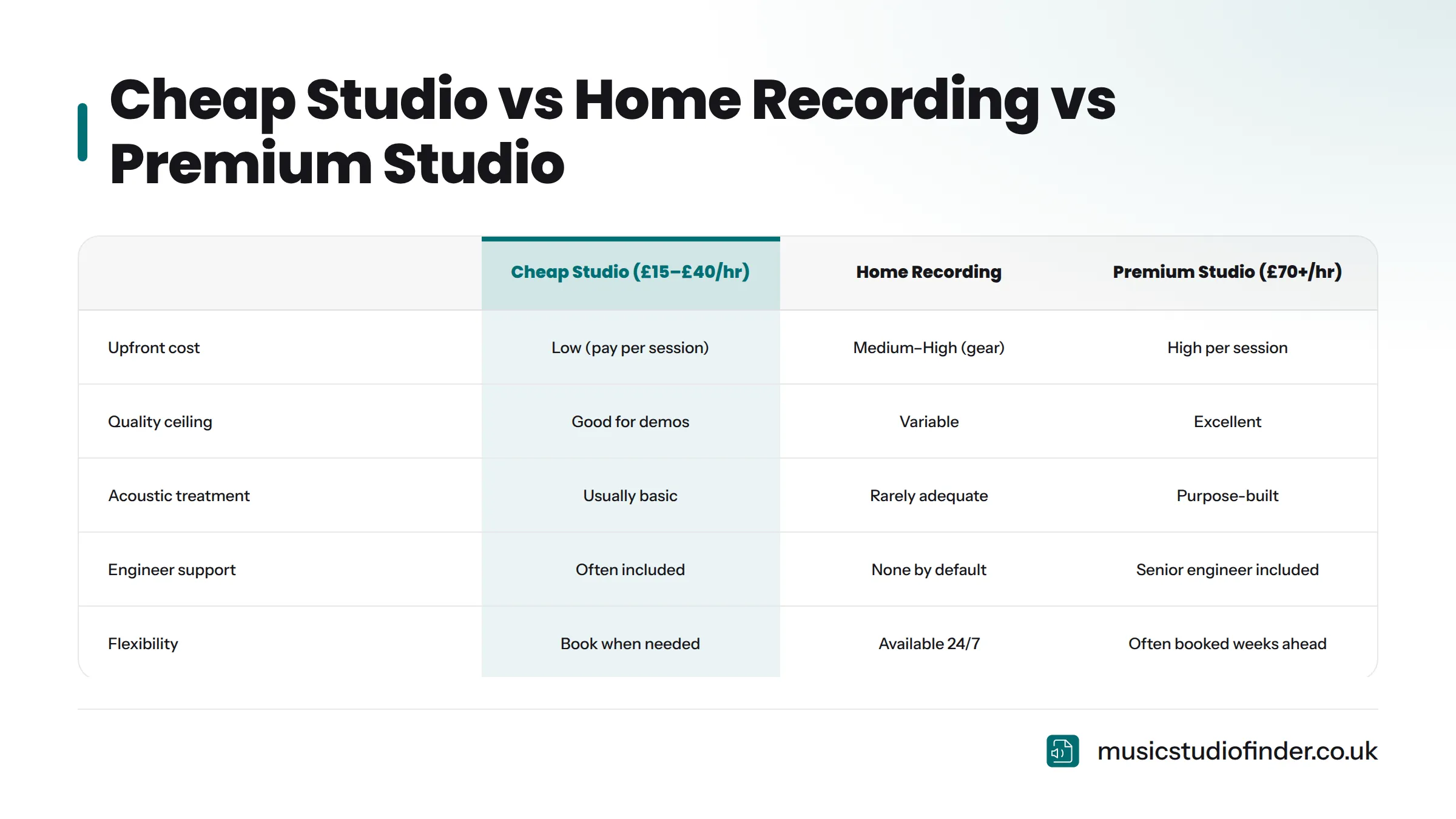
| Criterion | Cheap Studio (£15–£40/hr) | Home Recording | Premium Studio (£70+/hr) |
|---|---|---|---|
| Upfront cost | Low (pay per session) | Medium–High (gear investment) | High per session |
| Quality ceiling | Good for demos and acoustic work | Variable (depends on gear and room) | Excellent |
| Acoustic treatment | Usually basic - verify before booking | Rarely adequate without investment | Purpose-built, professional |
| Engineer support | Often included at entry level | None unless you hire separately | Senior engineer included |
| Flexibility | Book when needed | Available 24/7 | Scheduled, often booked weeks ahead |
| Suitable genres | Acoustic, folk, pop vocal, podcast | Electronic, hip-hop, solo production | Full band, orchestral, commercial releases |
| Best for | Demos, beginners, podcast, voiceover | Bedroom producers, electronic artists | Commercial releases, label submissions |
Where a Cheap Studio Beats Home Recording
A budget studio wins when your home environment is acoustically poor - a reflective bedroom, a noisy flat, or a room near a busy road. It also wins when you need an engineer's ears, when you are recording acoustic instruments that require proper microphone placement, or when you want a focused creative environment away from domestic distractions.
Where Home Recording Beats a Cheap Studio
If you produce electronic music, work primarily with MIDI, or already own a decent audio interface and treated space, home recording may genuinely beat a budget studio on output quality. You have unlimited time, no booking pressure, and total creative control. The recording studio vs home studio decision really comes down to your genre, your gear, and your room.
When to Invest in a Premium Studio
Spend more when the stakes are higher. A commercial single, an EP for a record label, or a live album deserves the best room you can afford. The recording studio prices UK guide has current benchmark rates to help you plan a bigger session budget.
How to Tell If a Budget Studio Offers Real Value
Before you transfer your deposit, run through these checkpoints. The what to look for when booking a recording studio guide goes deeper, but here is the essential checklist.
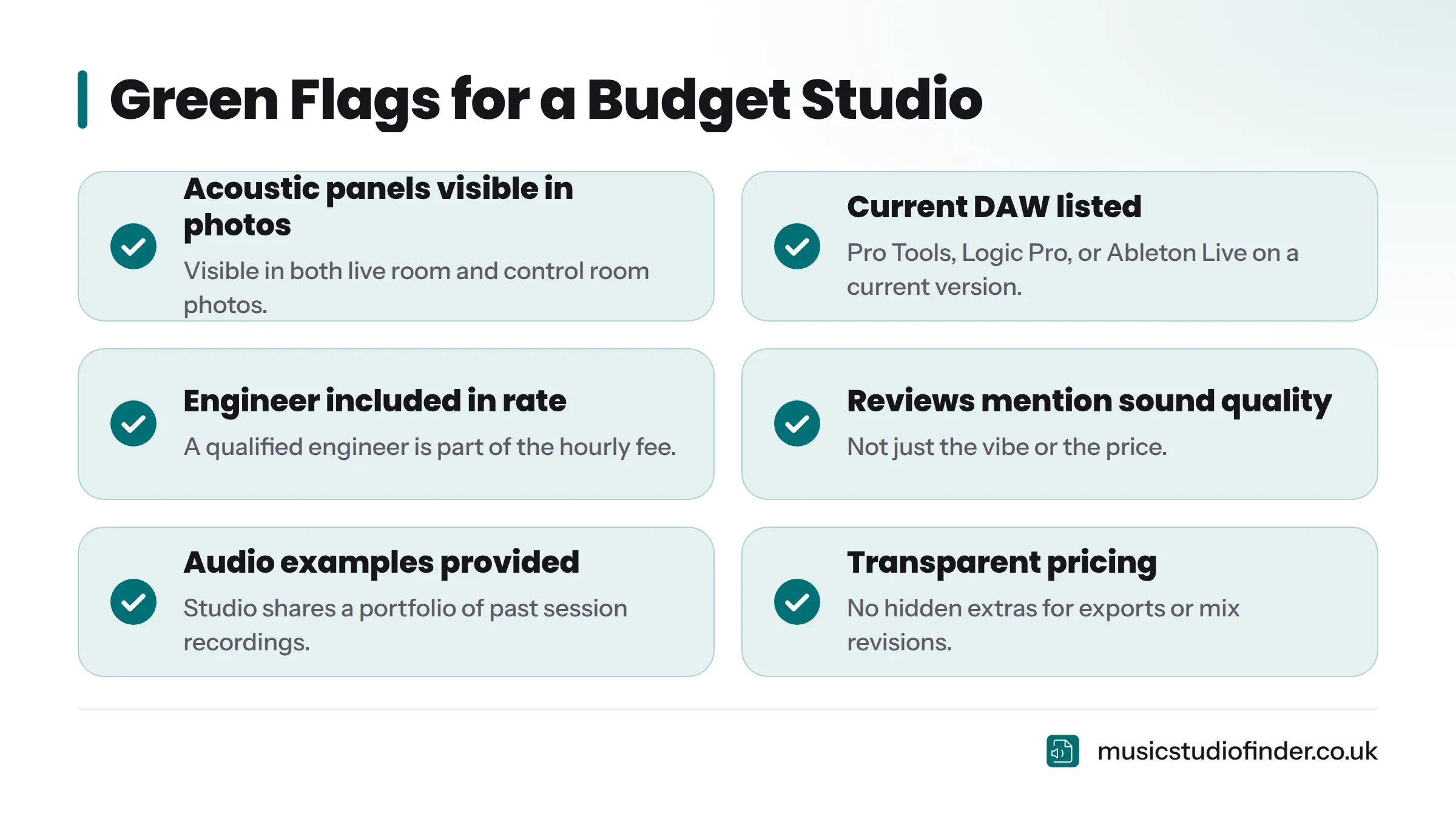
Green flags - book with confidence:
- Acoustic panels are visible in photos of the live room and control room
- The studio lists its DAW (Pro Tools, Logic Pro, Ableton Live) and it is a current version
- A qualified engineer is included in the hourly rate
- Online reviews mention sound quality positively, not just the vibe or the price
- The studio provides audio examples or a portfolio of past sessions
- Pricing is transparent with no hidden extras for export files or mix revisions
- The studio is willing to let you tour the room before booking
Red flags - approach with caution or walk away:
- No acoustic treatment visible anywhere in photos
- Equipment list is vague or outdated (references to gear from over a decade ago with no upgrades mentioned)
- Room hire only, no engineer included, and no option to bring your own
- No audio examples or testimonials from past clients
- Hidden fees for bounce files, track exports, or additional takes
- No information about whether deposits are refundable if you cancel
- Rates that seem impossibly low (under £10/hr in a major UK city usually signals a problem)
The what makes a recording studio professional article on Music Studio Finder explains what standards a genuinely professional room should meet, even at the budget end of the market.
What to Expect from a Cheap Studio Session
Setting realistic expectations before you walk in saves frustration and helps you get more from your time.
Sound Quality: What's Realistic?
From a good budget studio in the £20–£40/hr range, you can realistically expect a clean, well-balanced recording that is usable for demos, online releases, and streaming. What you are unlikely to get is the depth, warmth, and three-dimensional quality that comes from a premium room with an analogue signal chain and a Neve or SSL mixing desk. That gap is real - but it is not always relevant. A Spotify listener streaming your demo does not need Abbey Road-level production to connect with your song.
The Audio Engineering Society sets internationally recognised standards for recording quality, and many budget UK studios meet those standards for basic tracking and mixing work.
Session Length and Track Count
At budget rates, most engineers will expect you to record one to three tracks in a two-hour session - assuming you arrive prepared. Spending a £25/hr session on mic setup, tuning, and arrangement decisions is expensive inefficiency. Understand how many hours to book in a recording studio before you arrive. It will save you money and stress.
Mixing and Mastering - Is It Included?
This is where budget sessions most commonly catch musicians off guard. Many cheap studios charge for recording time only. Mixing and mastering - the processes that turn raw takes into a finished, polished track - are frequently separate services with separate fees. Always confirm what is included when you hire a recording studio before you commit to a booking. Ask directly: "Does your hourly rate include a mix? Is mastering available, and what does it cost?"
How to Get the Most Out of a Budget Studio Session
Preparation is the single biggest multiplier of recording studio value for money. Here is how to make every pound count.
-
Rehearse until your parts are airtight. Studio time is not rehearsal time. Arrive knowing your song inside out - melody, chord changes, lyrics, and dynamics. Every minute spent relearning arrangements in the studio is a minute you are paying for.
-
Arrange your song before you book. Know exactly which instruments you are recording, in which order, and what the final track count will be. Share this with the engineer in advance so they can prepare routing and microphone positions.
-
Book off-peak hours for lower rates. Many UK studios offer reduced rates on weekday mornings or late evenings. The how to save money on recording studio time guide has specific tactics for getting cheaper slots without sacrificing quality.
-
Bring reference tracks. A reference track is a commercially released song whose sonic qualities - tone, balance, energy - you want your recording to resemble. Play it to your engineer at the start of the session. It aligns expectations and saves time.
-
Agree on deliverables before the session starts. How many takes will you get? Will the engineer provide a rough mix on the day? Will you receive WAV files or only MP3s? Clarify everything upfront so there are no surprises at the end.
-
Ask about mixing and mastering costs before you commit. A £20/hr recording that leads to a £150 mix fee per track is not necessarily the bargain it appeared. Factor the full cost into your budget from the start.
Detailed preparation advice is available in the how to prepare for your first studio session guide on Music Studio Finder.
Is a Cheap Recording Studio Worth It for Your Genre?
Genre matters. The suitability of a budget studio varies significantly depending on how complex your recordings are and how much the room's acoustic character contributes to the final sound.
| Genre | Cheap Studio Suitability | Notes |
|---|---|---|
| Acoustic / Folk | Excellent | Minimal arrangement; benefits from a treated room and a good condenser mic |
| Singer-Songwriter | Excellent | Voice and guitar or piano - straightforward to record well on a budget |
| Podcast / Voiceover | Excellent | Simple signal chain; no musical arrangement complexity |
| Hip-Hop / Rap | Good | Vocal booth and basic beat playback is usually sufficient; production is often done separately |
| Indie Rock | Moderate | Full band recordings need multiple inputs; check the studio's capability before booking |
| Electronic / EDM | Moderate | If your production is DAW-based, home recording may serve you better |
| Full Band / Live Sound | Poor | Live band recording demands multiple high-quality microphone positions and a larger control room |
| Commercial Pop | Poor | The production standard expected at this level typically requires a mid-range or premium studio |
Should You Book a Cheap Studio or Record at Home?
Here is a practical decision framework. Work through these questions in order.
Question 1: Do you own usable recording gear? If no - book a studio. Even a budget studio beats recording into a laptop microphone. If yes - move to Question 2.
Question 2: Is your recording space acoustically treated? If no - book a studio. Room acoustics affect every recording. An untreated bedroom introduces reflections and bass buildup that damage recordings at the source. If yes - move to Question 3.
Question 3: Do you need a live engineer? If yes - book a studio. An experienced engineer's real-time decisions are difficult to replicate alone. If no - move to Question 4.
Question 4: What is your release goal? Demo or personal use - home recording may be entirely adequate. Online release, streaming, or pitching to labels - a cheap studio session usually produces a more credible result. Commercial release - consider a mid-range or premium studio.
My honest opinion: if you are an electronic producer or bedroom artist working primarily with MIDI and virtual instruments, home recording often wins. If you are recording acoustic instruments, vocals, or a live band, even a modest studio with proper acoustic treatment and a skilled engineer will almost always outperform a home setup at the same price point.
How to Find a Good Cheap Recording Studio in the UK
Finding a genuinely good budget studio requires more than a quick search. Price alone will mislead you. Here is what to do instead.
- Use Music Studio Finder to search studios by location, price range, and equipment. It is the UK's leading studio discovery platform, and listings include photos, gear lists, hourly rates, and reviews - everything you need to compare studios before you book.
- Read reviews carefully. Look for mentions of sound quality, the engineer's manner, and whether the finished recording matched expectations - not just comments about the room's atmosphere.
- Ask for audio examples. Any studio confident in its output will share past client recordings.
- Browse the recording studios listing on Music Studio Finder to find affordable options near you across the UK.
- Check the how to find an affordable recording studio UK guide for a step-by-step walkthrough of the booking process.
The Musicians' Union also publishes guidance on session rates and fair studio practice - worth consulting, particularly if you are a session musician navigating studio hire for the first time.
Frequently Asked Questions
How much does a cheap recording studio cost in the UK? In 2026, budget recording studios in the UK typically charge between £15 and £40 per hour. Studios at the lower end usually offer room hire with basic equipment. Studios in the £25–£40 range more commonly include an engineer and a current DAW such as Pro Tools or Logic Pro.
Can you get a professional-sounding recording from a cheap studio? Yes - with the right studio and the right preparation. A budget studio with proper acoustic treatment, a quality condenser microphone, and an experienced engineer can produce recordings that sound clean, balanced, and release-ready for demos, acoustic tracks, and streaming singles. The gap between budget and premium becomes most audible on complex, multi-instrument productions.
Is it better to record at home or in a cheap studio? It depends on your home setup and your genre. Electronic producers with treated spaces and good gear often record better at home. Acoustic musicians, vocalists, and bands almost always benefit from even a modest external studio, where the room acoustics and engineer expertise add real value.
What should I look for when booking a budget recording studio? Look for visible acoustic treatment, a named and current DAW, an included engineer, transparent pricing, audio examples from past sessions, and positive reviews that mention sound quality. Avoid studios that cannot show you what their room looks or sounds like.
How many hours do I need to book to record a song? For a single song - one lead vocal, one guitar or piano, and minimal overdubs - two to three hours is a reasonable starting point for a prepared musician. A less experienced artist or a more complex arrangement may need four to six hours. The how many hours to book in a recording studio guide gives specific estimates by track type.
Is a cheap studio worth it for a first recording? Yes. A first studio session is as much about learning the process as it is about the finished recording. A budget studio removes the financial pressure of a premium room and lets you focus on your performance, your communication with the engineer, and understanding how the recording chain works.
What is included in a cheap studio session? This varies by studio, but at the £20–£40/hr level you can typically expect room hire, a basic microphone setup, DAW recording, and sometimes an engineer. Mixing, mastering, and file export are frequently charged separately. Always confirm what is included before you book.
Are cheap studios good for bands? It depends on the band. A two-piece acoustic duo can record well in a budget studio. A full rock band with drums, bass, guitars, keys, and vocals needs multiple simultaneous inputs and a larger live room - requirements that most budget studios cannot meet. If you are a full band, check the studio's input count and live room size before booking.
The verdict is clear: a cheap recording studio is worth it when you match the studio's strengths to your actual needs. For demos, acoustic recordings, beginners, podcasts, and vocalist sessions, a well-chosen budget studio delivers real, usable results at a price that makes sense. The key is knowing what to look for, what to avoid, and how to arrive prepared.
Ready to find an affordable recording studio near you? Search the full UK listing on Music Studio Finder and filter by location, price, and studio type to find the right room for your session.
Sources
- Recording Studio Cost UK: 2026 Pricing Guide - Music Studio Finder
- Recording Studio Prices UK: 2026 Complete Guide - Music Studio Finder
- Why Recording Studio Prices Vary So Much - Music Studio Finder
- Recording Studio vs Home Studio - Music Studio Finder
- What to Look for When Booking a Recording Studio - Music Studio Finder
- What Makes a Recording Studio Professional? - Music Studio Finder
- Recording Studio Hidden Fees: What to Check First - Music Studio Finder
- Are Recording Studio Deposits Refundable? - Music Studio Finder
- What's Included When You Hire a Recording Studio? - Music Studio Finder
- How to Prepare for Your First Studio Session - Music Studio Finder
- How Many Hours to Book in a Recording Studio - Music Studio Finder
- How to Save Money on Recording Studio Time - Music Studio Finder
- How to Find an Affordable Recording Studio UK - Music Studio Finder
- Can Beginners Use a Professional Recording Studio? - Music Studio Finder
- Can You Tour a Recording Studio Before Booking? - Music Studio Finder
- Audio Engineering Society - AES.org
- Musicians' Union - musiciansunion.org.uk
- Digital Audio Workstation - Wikipedia