
Recording studios in the UK charge anywhere from £15 to £300+ per hour. That range is deliberately broad - and it is exactly why so many musicians feel lost before they even pick up the phone. This guide cuts through the confusion with real tiered rates, a city-by-city regional breakdown, full project-cost estimates for singles, EPs, and albums, and a clear look at every cost that rarely makes it into the headline price.
Whether you are a solo vocalist booking your first session, a band preparing an EP release, or a producer scouting commercial studios across the UK, the numbers below - drawn from Music Studio Finder's network of studios listed across every major UK city - give you the clearest possible foundation for building your recording budget. You can also explore the broader recording studio cost UK guide for supporting context as you plan.
How Much Does a Recording Studio Cost in the UK?
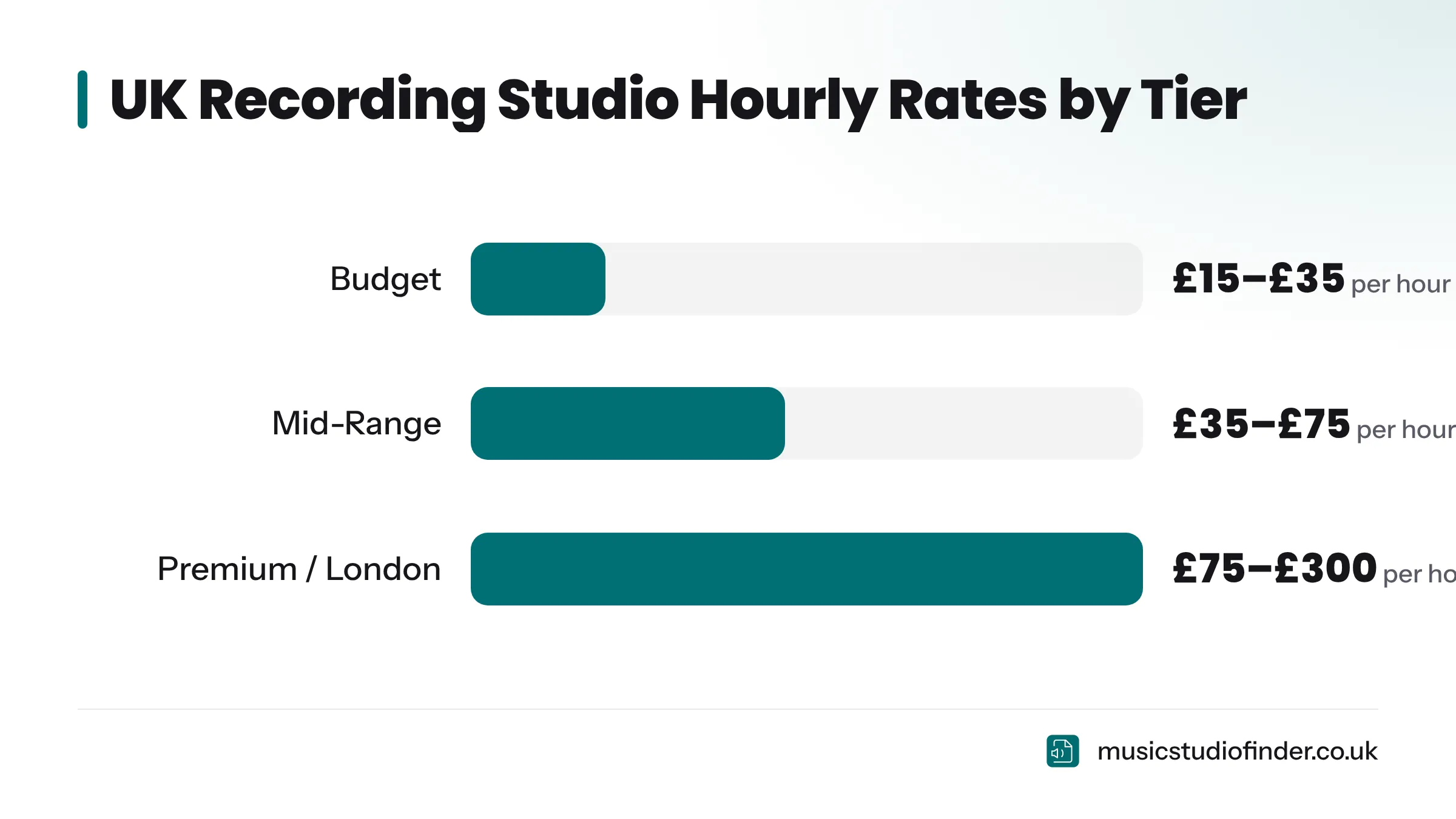
UK recording studio hourly rates range from £15 to £300 depending on tier, location, and what the price actually covers. Budget studios in regional cities start from around £15-£35 per hour. Mid-range professional studios charge £35-£75. Premium and major studios in London and other large cities charge £75-£300 or more.
That figure answers the surface question. The more important question is what sits behind those numbers - and that is where most musicians get caught out.
Budget Recording Studios (£15-£35 per hour)
Budget studios are often owner-operated project spaces - frequently converted garage or loft builds - equipped with capable but modest gear: a Digital Audio Workstation such as Logic Pro or Ableton Live, an entry-level audio interface, and a small selection of condenser microphones from brands like Rode or AKG. Acoustic treatment varies widely at this tier.
Day rates at budget studios typically run from £80 to £150. An engineer is sometimes included but not always - always confirm before booking. These spaces suit demo recordings, podcasters, bedroom producers needing acoustic space, and solo vocalists with tight budgets.
Mid-Range Recording Studios (£35-£75 per hour)
This tier covers the majority of independent UK studios that serve working musicians professionally. Expect a dedicated control room running Pro Tools or Logic Pro, a proper live room with acoustic treatment, a vocal booth or isolation booth, and at least one experienced staff engineer. Many studios at this level run outboard gear from Universal Audio (UAD) and a mid-tier mixing console.
Day rates typically fall between £200 and £450. Engineer fees are usually included in the room rate. This is the most common tier for recording singles, EPs, and demo albums across the UK outside London.
Professional Recording Studios (£75-£150 per hour)
Professional studios operate to commercial release standards. You will typically find a Neve or SSL mixing console in the control room, a large live room capable of tracking a full band simultaneously, a selection of premium microphones including Neumann models, and an experienced in-house producer or engineer. Solid State Logic and Neve consoles are genuine price drivers at this tier - the capital investment in a single console can exceed £100,000, and that cost flows through to the hourly rate.
Day rates run from £450 to £900+. These studios are appropriate for artists releasing on labels or independently financed artists targeting streaming and physical release quality.
Premium and Major Recording Studios (£150-£300+ per hour)
At the top tier, you are booking world-class facilities: multiple live rooms, vintage outboard gear, full-time maintenance engineers, in-house catering, and access to some of the most experienced producers and engineers in the industry. Studios at this level in London can charge £250-£400 per hour. Day rates regularly exceed £1,200-£2,000.
This tier is relevant for major label sessions, film scoring, and established artists recording full productions with large ensembles.
Pricing Tier Summary
| Tier | Typical Hourly Rate | Typical Day Rate | Best For | Usually Includes |
|---|---|---|---|---|
| Budget | £15-£35 | £80-£150 | Demos, vocals, podcasts | Room, basic gear, sometimes engineer |
| Mid-Range | £35-£75 | £200-£450 | Singles, EPs, indie albums | Room, engineer, outboard, monitoring |
| Professional | £75-£150 | £450-£900 | Label releases, full productions | Engineer, premium console, large live room |
| Premium | £150-£300+ | £1,200-£2,000+ | Major label, film, TV | Full facility, vintage gear, senior engineer |
Recording Studio Prices by Region in the UK
Location is one of the strongest price variables in the UK studio market. A mid-range London studio might charge more per hour than a professional-tier studio in Sheffield. Here is how rates compare across the major cities based on listings in the Music Studio Finder network.
London Recording Studio Rates
London carries the highest studio rates in the country, driven by property costs, demand, and the concentration of industry professionals. Budget studios in outer zones (Zones 4-6) start from around £25-£40 per hour. Mid-range studios in areas like Hackney, Peckham, and Walthamstow typically charge £50-£90 per hour. Professional studios in central or well-established locations - Soho, Bermondsey, Islington - regularly charge £100-£200 per hour.
The Recording Studio London is one example of a professionally equipped London facility listed on the platform.
Day rates in London scale accordingly: expect £250-£600 for mid-range and £700-£2,000+ for professional and premium tiers.
Manchester Recording Studio Rates
Manchester has a thriving studio scene built on decades of music industry heritage. Mid-range studios across the city - including Salford, Ancoats, and the Northern Quarter - typically charge £30-£60 per hour. Professional studios run from £60-£120 per hour. Day rates for mid-range bookings fall in the £180-£400 range, making Manchester one of the best-value major cities in the UK for professional-quality sessions.
Birmingham Recording Studio Rates
Birmingham's studio market is competitive. Budget studios charge from £15-£30 per hour; mid-range facilities from £30-£60 per hour. The city offers strong quality-to-price ratios, particularly for hip-hop, grime, and R&B production. Day rates at mid-range studios run from £150-£350.
Edinburgh and Glasgow Recording Studio Rates
Scotland's two major cities offer genuinely strong value. In Edinburgh, studios like Offbeat Recording Studio - a specialist in music, audiobook, and voiceover sessions - and Anvil Recording Studio represent the mid-range tier well. Typical Edinburgh and Glasgow hourly rates sit at £25-£55 per hour for mid-range studios. Professional facilities rarely exceed £100 per hour. Day rates typically run from £150-£350.
Glasgow in particular has a strong independent music scene with competitive studio pricing and a culture of supporting emerging artists.
Leeds and Sheffield Recording Studio Rates
Yorkshire's twin music cities offer some of the most competitive pricing in England. Budget studios in Leeds and Sheffield start from £15-£25 per hour. Mid-range studios charge £25-£50 per hour. Hohm Recording Studio in Bradford represents the kind of well-equipped independent facility common across the region. Day rates typically range from £120-£300.
Bristol and Cardiff Recording Studio Rates
Bristol has a strong independent music and electronic production scene. Mid-range studios typically charge £30-£60 per hour; day rates run from £180-£380. Cardiff, with its growing creative industry sector, offers comparable pricing to Bristol, with mid-range studios at £25-£55 per hour.
Sub Station Recording Studio in Dunfermline and similar regional independents show that professional-standard recording is accessible well outside the major English cities.
Other UK Regions
Studios across the East Midlands, Northern Ireland, East Anglia, and rural England typically charge £15-£45 per hour for mid-range work. HQ Recording Studio Leicester is a good example of a regional independent offering professional results at accessible rates.
Regional Price Comparison
| City / Region | Average Hourly Rate (Mid-Range) | Average Day Rate (Mid-Range) | Notes |
|---|---|---|---|
| London | £50-£90 | £250-£600 | Highest rates; outer zones more affordable |
| Manchester | £30-£60 | £180-£400 | Strong scene, competitive pricing |
| Birmingham | £30-£60 | £150-£350 | Excellent value; strong urban music scene |
| Edinburgh | £25-£55 | £150-£350 | Good quality-to-price; emerging scene |
| Glasgow | £25-£55 | £150-£350 | Competitive; strong indie culture |
| Leeds / Sheffield | £25-£50 | £120-£300 | Best value in England for mid-range |
| Bristol | £30-£60 | £180-£380 | Strong electronic / indie scene |
| Cardiff | £25-£55 | £150-£320 | Growing market, competitive rates |
| East Midlands / Other | £15-£45 | £100-£250 | Budget-friendly; quality varies |
Studios outside London are consistently cheaper - sometimes by 30-50% for equivalent quality. For artists who can travel, a multi-day album session in Manchester or Leeds can save hundreds of pounds over London rates.
What Does a Recording Studio Day Rate Actually Include?
A day rate is not a standardised product. Two studios charging identical day rates may offer very different packages. Here is what you should confirm is covered before signing anything.
Room and Live Space
At minimum, your day rate covers access to a live room or tracking room and the control room. The size of the live room matters enormously for drums, ensembles, and acoustic instruments. A vocal booth - a treated space that isolates vocals from ambient noise - is standard at mid-range and above.
Engineer Fees - Included or Extra?
This is the most common source of budget confusion. Many studios include a staff engineer in the day rate. Others charge the room separately and the engineer on top - typically £20-£50 per hour extra at mid-range, £50-£150 per hour at professional tier. Always ask: "Is an engineer included, and is that engineer the one who will be at the desk for my entire session?"
If you want to bring your own producer or work without a house engineer, many studios allow this at a reduced rate. Our guide on booking a recording studio without a producer covers how to approach that conversation.
Equipment and Outboard Gear
Room hire generally includes the DAW installation (Pro Tools, Logic Pro, Ableton), the mixing desk, monitors (Adam Audio, Genelec, or Yamaha NS-10s are common at professional level), and a standard microphone selection. Specialist gear - specific vintage outboard units, particular Neumann microphones, hardware synthesisers - may carry a hire surcharge.
File Formats and Session Exports
Receiving your session files after recording is not always automatic. Some studios include WAV exports in the day rate; others charge separately for stem exports, alternative file formats, or session archiving. Confirm exactly what you receive at the end of the day: raw multitracks, a rough mix, or both.
Mixing and Mastering - Separate Costs?
Day rates typically cover tracking only. Mixing and mastering are almost always separate engagements. This is worth understanding upfront - see the full breakdown in the hidden costs section below.
What to Confirm Before You Book: Checklist
- Is an engineer included in the day rate?
- What console and DAW will be used?
- Is the vocal booth or isolation booth included?
- What microphones are available at no extra charge?
- Are WAV exports and session files included?
- Is there a half-day rate available?
- What happens if we run over time?
- Is mixing included or a separate cost?
- Is VAT included in the quoted price?
- Is parking available on site?
Our full guide to what's included when you hire a recording studio walks through every line item in more detail.
How Much Does It Cost to Record a Song, EP, or Album?
Hourly rates are a starting point. What musicians actually need to know is the end-to-end cost of a finished, release-ready piece of music. Here is a realistic, tiered cost breakdown by project format.
Recording a Single - Estimated Total Cost
A single typically involves tracking vocals and any live instrumentation, with production either pre-built or tracked in session. A solo vocalist recording over a finished backing track might need 2-4 hours of studio time. A live band recording a single from scratch - drums, bass, guitar, keys, vocals, and overdubs - might need 8-16 hours.
| Studio Tier | Estimated Hours | Studio Cost | Mixing | Mastering | Estimated Total |
|---|---|---|---|---|---|
| Budget | 3-6 hrs | £60-£180 | £50-£150 | £30-£80 | £140-£410 |
| Mid-Range | 4-8 hrs | £160-£560 | £150-£400 | £80-£150 | £390-£1,110 |
| Professional | 6-12 hrs | £500-£1,700 | £300-£800 | £150-£300 | £950-£2,800 |
Recording an EP - Estimated Total Cost
An EP of four to five tracks multiplies the single figures, but economies of scale apply: block-booking discounts often kick in for EP sessions, and a single mixing engineer working across the whole project is more efficient than booking piecemeal.
| Studio Tier | Estimated Hours | Studio Cost | Mixing (per track) | Mastering (EP) | Estimated Total |
|---|---|---|---|---|---|
| Budget | 12-20 hrs | £240-£600 | £50-£150 × 5 | £150-£300 | £640-£1,650 |
| Mid-Range | 16-30 hrs | £640-£2,100 | £150-£400 × 5 | £250-£500 | £1,640-£5,100 |
| Professional | 20-40 hrs | £1,650-£5,600 | £300-£800 × 5 | £400-£900 | £3,550-£10,500 |
Recording an Album - Estimated Total Cost
A full album of ten to twelve tracks is a significant undertaking. Professional studio albums in the UK have historically cost anywhere from £5,000 to £100,000+. For independent artists, a well-planned album at mid-range quality is achievable for £4,000-£15,000 end to end when you factor in tracking, mixing, and mastering. UK Music industry data consistently shows that independent artists are spending more on production quality as streaming platform competition intensifies.
| Studio Tier | Estimated Hours | Studio Cost | Mixing (×12 tracks) | Mastering (album) | Estimated Total |
|---|---|---|---|---|---|
| Budget | 30-60 hrs | £600-£1,800 | £50-£150 × 12 | £200-£400 | £1,400-£4,000 |
| Mid-Range | 40-80 hrs | £1,600-£5,600 | £150-£400 × 12 | £400-£800 | £3,800-£11,200 |
| Professional | 60-120 hrs | £5,000-£17,000 | £300-£800 × 12 | £700-£1,500 | £9,300-£31,100 |
How Many Studio Hours Will You Actually Need?
The answer depends on three factors: how many musicians are recording live simultaneously, how well-rehearsed the material is, and how much overdubbing and comping the project requires.
As a rough guide:
- Solo vocal over a pre-made track: 2-4 hours per song
- Band recording live (drums, bass, guitar): 4-8 hours per song for tracking only
- Full production with overdubs and comping: Add 50-100% to your tracking estimate
Our detailed guide to how many hours to book in a recording studio gives a more granular breakdown with genre-specific examples.
How to Estimate Your Studio Budget: Step-by-Step
- Count how many songs you are recording.
- Estimate tracking hours per song using the ranges above as a starting point.
- Multiply by your target studio's hourly or day rate.
- Add mixing cost (per track × number of tracks).
- Add mastering cost (single, EP, or album rate).
- Add 15-20% contingency for overruns and revisions.
- Check whether VAT (20%) applies on top - see below.
Hidden and Additional Recording Studio Costs
This is the section that could save you from a very unpleasant invoice. A headline studio rate is rarely the final figure. Here are the costs that catch musicians off guard - with realistic estimates for each.
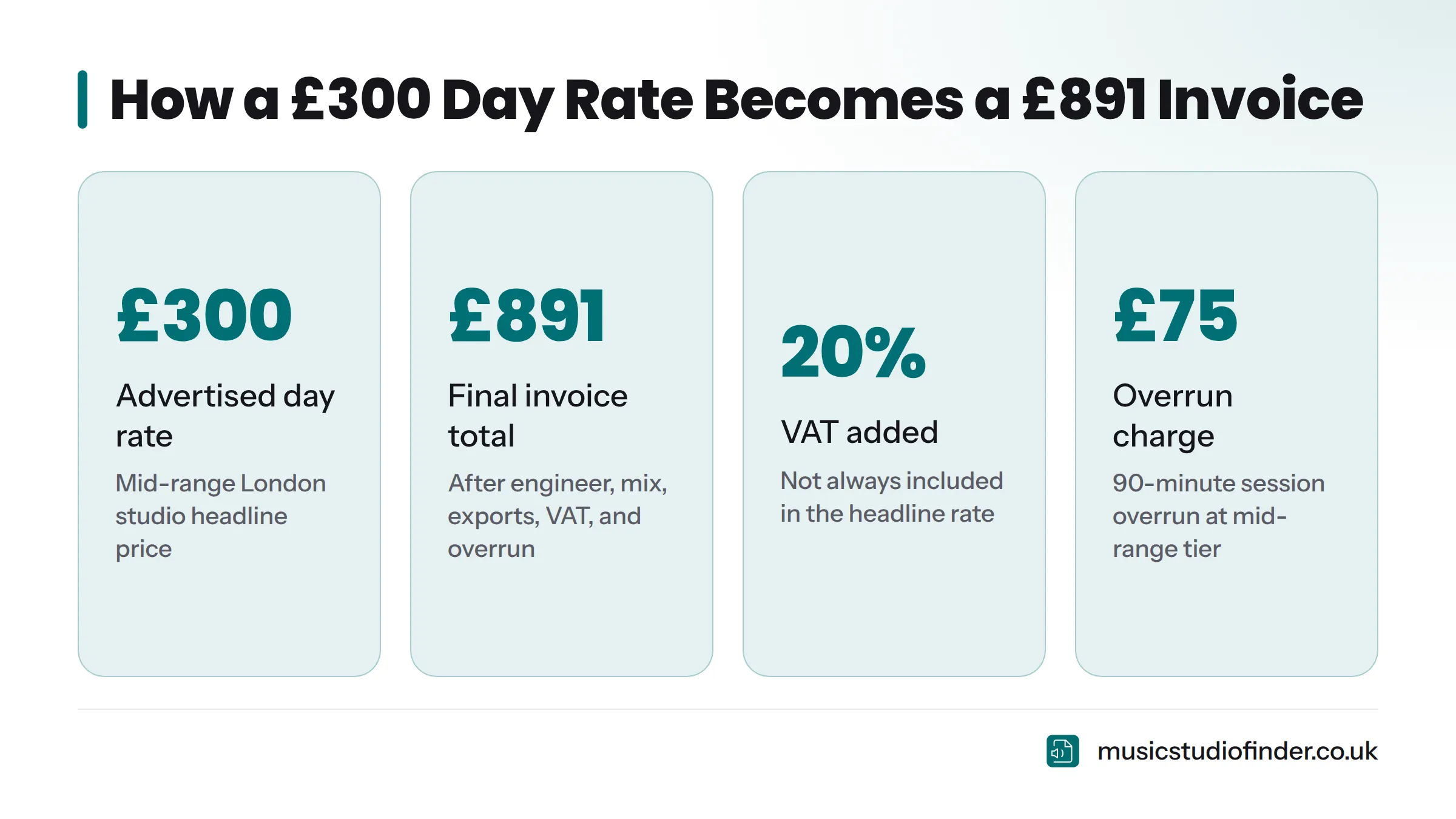
Budget Trap: Why Your £300 Studio Day Can Become a £600 Invoice A mid-range London studio advertises a £300 day rate. Engineer not included: +£250. Rough mix at the end of the session: +£100. Stem exports in WAV: +£30. VAT at 20%: +£136. Session overrun by 90 minutes: +£75. Total: £891. None of these are dishonest charges - they are simply not in the headline.
Mixing Costs
Mixing is the process of balancing, processing, and creatively blending your recorded tracks into a cohesive stereo (or spatial) output. A professional mix engineer in the UK charges £100-£500 per track at mid-range, rising to £500-£2,000+ per track for senior engineers with major-label credits. Budget online mixing services exist from £30-£80 per track. The gap in quality is real - but for a debut single, an experienced independent mixer at £150-£250 is often the sweet spot.
Mastering Costs
Mastering is the final stage of audio post-production, preparing your mix for distribution. In the UK, professional mastering runs from £50-£150 per track for independent mastering engineers, £200-£500 per track at specialist mastering suites, and £500-£1,500+ for album mastering at premium facilities. Online services such as eMastered and LANDR offer automated mastering from £5-£20 per track - useful for demos, but not a substitute for human mastering on a commercial release.
Session Musician Fees
If you need a drummer, bassist, string arranger, or any live instrumentalist you are not bringing yourself, session musician fees apply. The Musicians' Union publishes recommended minimum session fees as guidance for fair pay in the industry. Standard buy-out session fees for commercial recordings start at around £180-£220 for a three-hour session for MU members, though rates vary widely by experience and project type. Always clarify whether session fees include re-recording revisions or are a one-off buy-out.
Instrument and Backline Hire
Most studios supply a drum kit. Specific snare drums, cymbals, guitar amplifiers, bass amplifiers, and keyboards may attract a hire charge. Backline hire within studios typically runs £10-£40 per item per day. Some premium studios include a full backline; always ask.
Studio Time Overruns
Running over your booked time is charged at the standard hourly rate - sometimes at a premium rate if it pushes into another booking. A 90-minute overrun at a £50/hr studio costs an additional £75. Budget a 10-15% time buffer, especially for first sessions or complex arrangements.
VAT (20%) on Studio Invoices
Professional recording studios registered for VAT in the UK - which most commercial studios are - add 20% VAT to their invoices. A £400 day rate becomes £480 with VAT. A £1,500 week of sessions becomes £1,800. This is not optional and is not the studio's margin - it is a legal requirement. HMRC guidance on VAT for creative services sets out exactly how this applies to studio hire. Always ask whether quoted prices are inclusive or exclusive of VAT.
File and Stem Export Fees
A stem export means receiving individual audio files for each instrument or group - drums stem, bass stem, vocal stem, and so on - rather than a single mixed file. This is useful for remixing, licensing, and sync submissions. Studios may charge £20-£75 for stem export packages. Confirm this before your session if stems are part of your release plan.
ISRC Code Registration
An ISRC (International Standard Recording Code) is required for commercial digital distribution. PRS for Music provides ISRC codes to registered members. Some studios offer ISRC registration as a service; others leave it to the artist. PRS membership is required, and ISRC codes themselves are free to registered members - but it is a step that catches first-time releasers off guard.
Hidden Costs Summary
| Cost Item | Typical Range | Notes |
|---|---|---|
| Engineer (if not included) | £20-£150/hr | Ask upfront |
| Mixing (per track) | £30-£2,000 | Huge range; quality varies accordingly |
| Mastering (per track) | £30-£500 | Online vs. human engineer |
| Session musicians | £180-£500+ per session | MU rates as a benchmark |
| Instrument / backline hire | £10-£40 per item | Drums usually included |
| Overrun time | Standard hourly rate | Budget a buffer |
| VAT (20%) | On all invoices from VAT-registered studios | Confirm whether price is ex-VAT |
| Stem exports | £20-£75 per project | Negotiate upfront |
| ISRC registration | Free (PRS membership required) | DIY via PRS |
| Parking | £5-£20/day | Often overlooked in city studios |
What Factors Affect Recording Studio Prices?
Several variables move a studio rate up or down. Understanding them gives you leverage when comparing quotes.
Studio Location and City
As the regional table above shows, London commands a significant premium. Within cities, studios in central locations pay higher rents and pass those costs on. A studio in East London will almost always cost more than an equivalent-quality studio in Bradford or Cardiff.
Studio Tier and Equipment Quality
A control room built around an SSL 4000 or Neve 8078 console represents a capital investment of hundreds of thousands of pounds. That equipment availability is factored into the rate. Similarly, a large, professionally designed live room with genuine acoustic isolation costs vastly more to build and maintain than a treated home studio. Equipment quality is a genuine price driver - not marketing.
Engineer Experience and Reputation
A house engineer with major-label credits commands more per hour than an up-and-coming engineer at a project studio. That experience difference also shows up in session speed: a senior engineer who gets great drum sounds in 20 minutes rather than 90 minutes may deliver better value even at a higher rate.
Time of Day and Day of Week
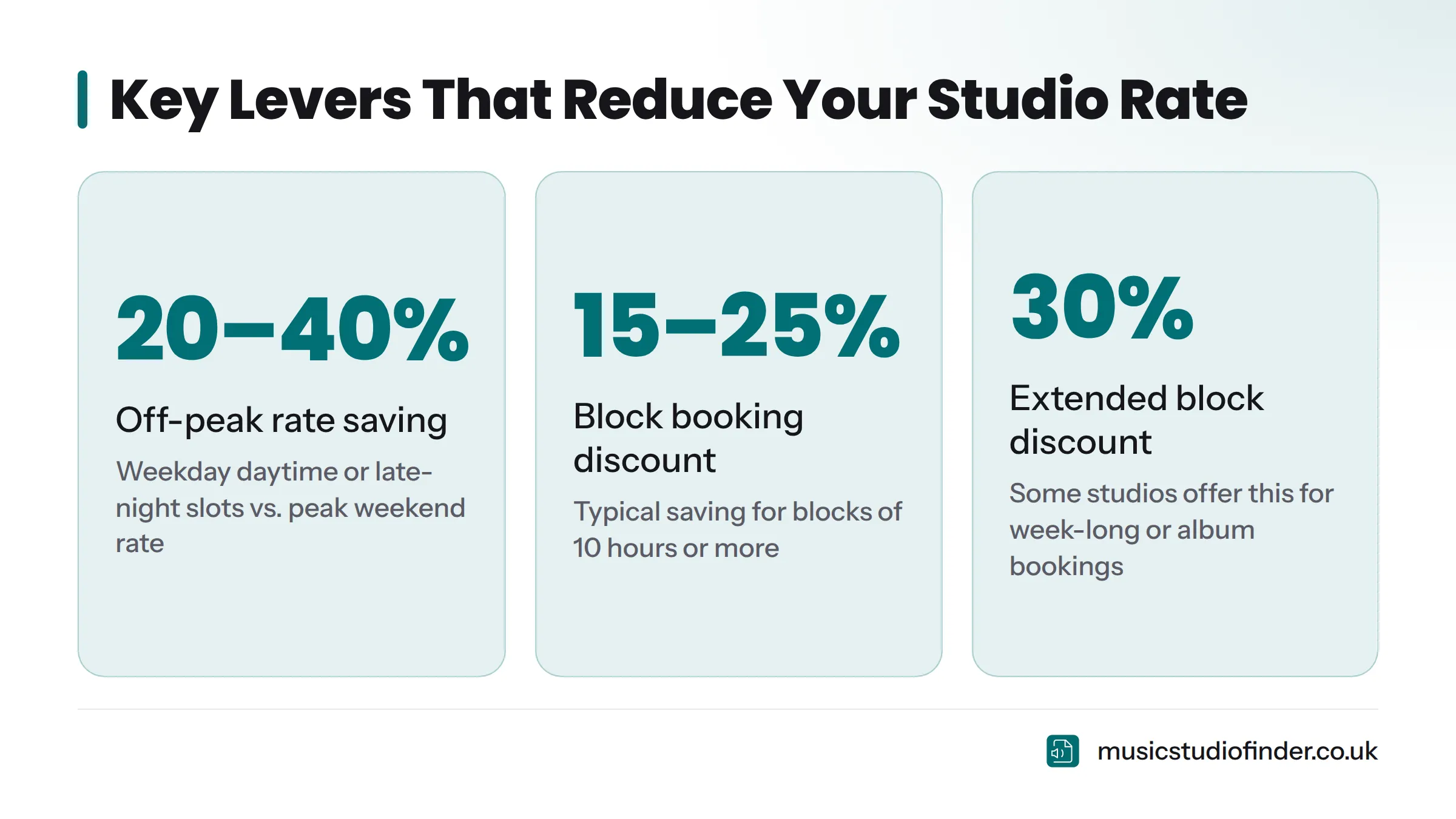
Most studios offer off-peak rates for weekday daytime bookings, late-night sessions, or extended blocks that start outside peak weekend hours. Off-peak rates can be 20-40% below the advertised weekend rate. This is one of the most accessible cost levers available to independent artists with flexible schedules.
Length of Booking - Block Discounts
Block-booking discounts are common and rarely advertised. Studios typically offer 15-25% off for blocks of 10 hours or more, and some extend this to 30% for week-long or album-length bookings. The key is to ask - these discounts exist even when they do not appear on a rate card. Committing to a larger block upfront also locks in your rate against future increases.
Genre and Technical Requirements
Recording a string quartet requires different room setup, microphone placement, and acoustic considerations than recording a hip-hop vocal. Complex productions with multiple overdubbing passes, electronic integration, or large ensemble tracking take more setup time, which flows through to the final cost. Studios that specialise in orchestral or classical recording frequently charge premium rates for the specialised expertise and room acoustics required.
How to Get the Best Value From a Recording Studio
Smart pre-production is worth more than any negotiation tactic. Here is a structured approach to reducing your studio bill without compromising the quality of the result.
Pre-Production: The Most Effective Cost-Saving Step
Pre-production means getting everything as close to finished as possible before you walk into the studio. Arrange your songs fully. Rehearse them until every part is locked. Record rough demos at home using a basic interface and DAW so you can hear structural problems before they cost you studio time to fix. Studios cannot fix an underprepared song - they can only record it slowly.
Our guide to how to prepare for your first studio session covers the specific steps that make the biggest difference to session speed.
Book Off-Peak Hours
Weekday daytime slots - Monday to Thursday, 10am-6pm - are typically the cheapest available hours at most UK studios. Night owl rates (after 10pm) are sometimes cheaper still, though fewer engineers are available at those hours. If your schedule allows flexibility, off-peak booking is the single easiest way to reduce your hourly rate.
Negotiate Block Booking Rates
Do not accept the published rate as final, especially for multi-day projects. Contact the studio directly and ask: "If we commit to X hours over the next month, what can you offer us?" Studios prefer predictable revenue over empty sessions. A polite, professional approach to negotiation almost always produces a better outcome than paying the rack rate.
Bring a Click Track and Song Structure Plan
Walking into a session without a click track means the drummer sets the tempo - and the tempo may drift. Correcting timing issues in post-production costs mix engineer time. A pre-agreed song structure plan (verse, chorus, bridge - with bar counts) means everyone in the room knows exactly what is being recorded. Every minute saved on clarification is a minute saved on the invoice.
Good recording studio etiquette also includes arriving on time, knowing your parts, and minimising social chatter during billable hours - all of which directly reduce cost.
Consider Online Mixing and Mastering Services
Online mixing services - where you upload your stems and receive a mixed file back within 48-72 hours - have matured considerably. At the £100-£300 per track price point, experienced independent online mixing engineers often deliver results comparable to in-studio mix sessions, particularly for pop, folk, electronic, and hip-hop genres where live room acoustic character is less critical. This approach is explored in detail in our recording studio vs home studio guide.
Use Platform Tools to Compare Studios
Music Studio Finder lets you browse and compare UK recording studios by location, price, equipment, and availability. Rather than emailing studios individually and waiting for rate cards, you can shortlist options that match your budget tier and project requirements before making contact. This cuts the research phase down considerably and gives you the comparison data needed to negotiate with confidence.
10 Ways to Reduce Your Studio Bill Without Cutting Corners
- Rehearse your material until every part is locked before booking
- Record home demos to iron out arrangement problems
- Book weekday daytime (off-peak) slots
- Ask for a block-booking discount on any booking over 8 hours
- Bring a click track and printed song structure map
- Confirm your engineer is included before comparing day rates
- Use online mixing for budget projects rather than in-studio mix-downs
- Negotiate stem export inclusion upfront rather than paying post-session
- Check whether the studio's rate is ex-VAT before budgeting
- Use Music Studio Finder to compare multiple studios before committing
Recording Studio vs Home Studio - Which Is More Cost-Effective?
This question comes up constantly, and the honest answer is: it depends on your project, your skill level, and what you mean by "cost-effective."
Upfront Costs of Home Recording
A functional home recording setup - audio interface, condenser microphone, headphones, studio monitors, DAW licence, and basic acoustic treatment - costs roughly £500-£2,500 to assemble to a standard capable of capturing clean vocals and acoustic instruments. A more capable home studio with a quality Focusrite interface, Neumann microphone, proper room treatment, and a hardware synth or two can easily reach £5,000-£15,000.
Ongoing Costs of Home Recording
Software subscriptions (Splice, plugin licences, sample packs), hardware maintenance, and the opportunity cost of self-engineering rather than making music are the ongoing costs most home studio advocates understate. A Pro Tools subscription runs approximately £30-£33 per month. Plugin suites can add hundreds of pounds per year.
When Professional Studio Time Is Worth the Investment
A professional studio delivers things a home setup cannot: acoustic space, premium outboard gear, an experienced engineer listening objectively to your performance, and a track record of delivering release-quality results. For recordings where the live room sound is central - acoustic drums, full band tracking, string sections, live brass - a professional studio is not a luxury. It is the only way to achieve the result.
If you are a solo vocalist or producer working primarily within a DAW, a well-treated home vocal booth and a quality microphone may legitimately serve your recording needs. In that case, professional mixing and mastering are often where the investment matters most.
The Hybrid Approach: Record at Home, Mix Professionally
The most cost-effective approach for many independent UK artists in 2026 is the hybrid model: record scratch tracks, vocals, and electronic elements at home, take only the parts that require a live room - drums, live band, acoustic instruments - to a professional studio, then deliver all stems to an independent mix engineer. This concentrates professional studio spend where it genuinely matters and eliminates room hire costs for everything that does not require acoustic space.
Home vs Professional Studio Comparison
| Factor | Home Studio | Professional Studio | Verdict |
|---|---|---|---|
| Upfront cost | £500-£15,000+ | £0 (hire as needed) | Home wins for frequent users |
| Per-session cost | Near zero after setup | £80-£2,000+ per day | Professional wins for occasional recording |
| Live room acoustic quality | Limited (unless purpose-built) | High | Professional wins |
| Engineer experience | Self-engineered | Professional included | Professional wins |
| Mixing quality (in-studio) | Depends on user skill | High | Professional wins |
| Flexibility and hours | Unlimited | Booked slots only | Home wins |
| Equipment range | Limited | Wide | Professional wins |
| Best for | Demos, electronic, home vocals | Live bands, commercial releases | Depends on project |
Is This Studio Price Fair? How to Evaluate a Quote
Getting a quote back from a studio is only useful if you know how to read it. Here is how to assess whether a price represents genuine value.
Red Flags in a Studio Quote
- No VAT status stated (you may discover a 20% addition later)
- Engineer listed as optional with a vague "from £X" note
- No mention of what file formats or exports are included
- Day rate significantly below the regional average with no explanation
- No mention of overrun policy
Green Flags That Signal Value for Money
- All-in day rate with engineer clearly included
- Written confirmation of equipment list and DAW
- Clear overrun rate stated upfront
- Session files and WAV exports explicitly included
- References or portfolio available from previous clients
How to Compare Quotes Across Studios
When comparing quotes from multiple studios, convert everything to a true all-in cost: add engineer fees if separate, estimate likely mixing and mastering costs on top, add VAT if not included, and divide by the number of finished tracks you expect to produce. This produces a cost-per-finished-track figure that makes genuinely different rate structures directly comparable.
Our guides on how to choose a recording studio and what to look for when booking a recording studio cover the full evaluation process in practical detail.
Is This Studio Worth the Price? Five Questions
- Is the engineer experienced enough for my project type? (Check their credits)
- Does the room match my instrument setup? (Drum kit? Isolation booth?)
- Is the quoted price all-in, or does VAT and engineer cost apply on top?
- Can the studio provide examples of recordings at this price point?
- Does the studio's availability match my project timeline?
If you answer yes to all five: book it. If you hit three or more nos: keep looking.
Frequently Asked Questions About Recording Studio Prices in the UK
How much does a recording studio cost per hour in the UK?
Recording studio hourly rates in the UK range from £15 to £300+ depending on the studio tier and location. Budget studios charge £15-£35 per hour. Mid-range professional studios charge £35-£75 per hour. Professional studios with premium consoles and engineers charge £75-£150 per hour. Premium and major studios in London and other large cities charge £150-£300 or more.
What is a typical day rate for a UK recording studio?
A recording studio day rate in the UK covers a fixed block - usually eight to ten hours - and typically runs from £80-£150 per day at budget tier, £200-£450 at mid-range, £450-£900 at professional tier, and £1,200-£2,000+ at premium level. Day rates are almost always cheaper per hour than individual hourly bookings when you need more than four to five hours.
Do recording studio prices include a sound engineer?
Not always. Many mid-range and professional studios include a staff engineer in the day rate, but budget studios and project studios frequently charge the engineer separately - typically £20-£150 per hour on top of room hire. Always confirm this before comparing prices between studios.
How much does it cost to record a single in the UK?
Recording a single in the UK costs roughly £140-£410 at budget tier, £390-£1,110 at mid-range, and £950-£2,800 at professional level. These figures include studio time, mixing, and mastering but exclude VAT and session musician fees if applicable.
Are recording studios cheaper outside London?
Yes, often by a considerable margin. Mid-range studios in Manchester, Birmingham, Leeds, and Edinburgh typically charge £25-£60 per hour compared to £50-£90 in London for equivalent quality. Regional studios can represent a saving of 30-50% on comparable London rates, making a travel investment worthwhile for longer projects.
Can I negotiate a recording studio price?
Yes. Most studios have flexible pricing, particularly for block bookings, off-peak sessions, and repeat clients. Always ask - the worst outcome is being quoted the standard rate. A polite request for a block rate on a multi-day booking almost always produces a better price than the published figure.
Do I pay VAT on top of studio hire prices?
If the studio is VAT-registered - as most commercial studios are - VAT at 20% applies to the invoice. Always ask whether the quoted price is inclusive or exclusive of VAT. A £400 day rate becomes £480 with VAT applied. HMRC guidance confirms that studio hire is a standard-rated supply for VAT purposes.
How do I find an affordable recording studio near me?
Music Studio Finder is the most direct way to search UK recording studios by location and budget. Our guide on how to find an affordable recording studio UK also covers off-platform strategies including local music venue contacts, university studio hire, and community recording projects.
What is the cheapest way to record a song professionally in the UK?
The cheapest route to a professionally finished song in 2026 is the hybrid approach: record vocals and any electronic elements at home on a basic interface, book a budget studio for any parts that genuinely need a live room, and use an experienced independent online mixing engineer for the mix. Budget £140-£350 end-to-end for a solo vocal single using this method, or up to £600-£800 for a live band single.
How many hours do I need to record one song?
A solo vocalist recording over a pre-built backing track typically needs 2-4 hours. A full live band recording a track from scratch - tracking drums, bass, guitar, then overdubbing keys and vocals - typically needs 8-16 hours. More complex arrangements with multiple takes and comping sessions require more time. Our detailed guide on how many hours to book in a recording studio gives a genre-by-genre breakdown.
Sources
- UK Music - Music By Numbers 2024
- Musicians' Union - Session Fee Guidance
- BPI - UK Recorded Music Industry
- PRS for Music - ISRC Codes
- eMastered - Online Mastering Service
- LANDR - Online Mastering and Distribution
- Solid State Logic - SSL Console Information
- Music Studio Finder - Browse Recording Studios UK
- Music Studio Finder - Recording Studio Cost UK Guide