
Recording studio prices in the UK run from around £15 per hour at a basic home-converted setup to well over £300 per hour at a world-class London facility - and that gap can feel baffling when you are trying to plan a session budget. The variation is not arbitrary. Recording studio pricing factors include location and property costs, the quality of installed equipment, acoustic design, whether a professional engineer is included, the studio's reputation, and what the quoted price actually covers. Each of those factors compounds the others, which is why two studios in the same city can quote prices that are miles apart. Our recording studio cost guide covers the full pricing picture for 2026. This article explains exactly what sits behind the numbers.
Here are the main factors that affect recording studio prices:
- Location and premises costs
- Equipment quality (consoles, microphones, outboard gear, monitors)
- Room design and acoustic treatment
- The recording engineer
- Studio reputation, track record, and demand
- What is included in the rate
- Pricing model (hourly, half-day, full day, block booking)
Let's break each one down, with real UK price context at every step.
No Two Studios Are the Same - and the Price Difference Reflects That
Walk into Abbey Road Studios in St John's Wood and you are stepping into a building that has hosted recordings since 1931, with multiple live rooms large enough for a full orchestra, a collection of vintage and modern console desks, and a team of full-time staff. Walk into a converted terraced house in Sheffield and you might find one room, a DAW running on a mid-range computer, and a condenser microphone hanging from the ceiling. Both call themselves recording studios. The recording studio rate explained in simple terms is this: price is the logical output of wildly different cost structures.
What you are actually paying for when you book studio time
Every hour you pay for in a professional studio covers a share of the premises, the gear, the staff, and the expertise that keep that room running. A £60/hour rate at a mid-range studio might break down roughly like this:
| Cost Component | Estimated Share of £60/hr Rate |
|---|---|
| Premises (rent, rates, utilities) | ~£18 (30%) |
| Equipment amortisation and maintenance | ~£12 (20%) |
| In-house engineer salary and NI contributions | ~£18 (30%) |
| Studio insurance, admin, and sundries | ~£6 (10%) |
| Net studio profit (before tax) | ~£6 (10%) |
These proportions shift at every price point. A £15/hour studio is likely operating from owned or very cheap premises with minimal staff and consumer-grade equipment. A £200/hour London facility is carrying enormous rent, a full payroll, and £500,000 or more in equipment and room build cost spread across its hourly rate.
Why price alone does not tell you enough
A high price does not guarantee a great result, and a low price does not always mean poor quality. What matters is whether the price matches your project's actual needs. A solo artist recording a voiceover demo does not need an SSL 9000 console. A band tracking a live album does. That mismatch - understanding it before you book - is the most valuable thing you can take from this article.
Factor 1 - Location and Premises Costs
Commercial property in the UK varies enormously by city, neighbourhood, and building type. A recording studio is a specialist space: it needs thick walls, high ceilings, controlled airflow, and often custom construction. That space costs money, and in central London it costs a great deal more than in Stockton-on-Tees.
Why London studios charge more than regional studios
Central London commercial property rates consistently rank among the highest in Europe. A studio leasing 2,000 square feet in Soho or Brixton pays rent that can exceed £80,000-£120,000 per year - before rates, service charges, or fit-out costs. To cover those overheads across billable hours in a year, the hourly rate must be significantly higher than an equivalent space in a regional city.
A band recording an EP in Leeds or Sheffield typically finds rates 40-60% lower than equivalent studios in central London, and the quality of the room and equipment is often comparable. The city premium is real. The quality gap often is not.
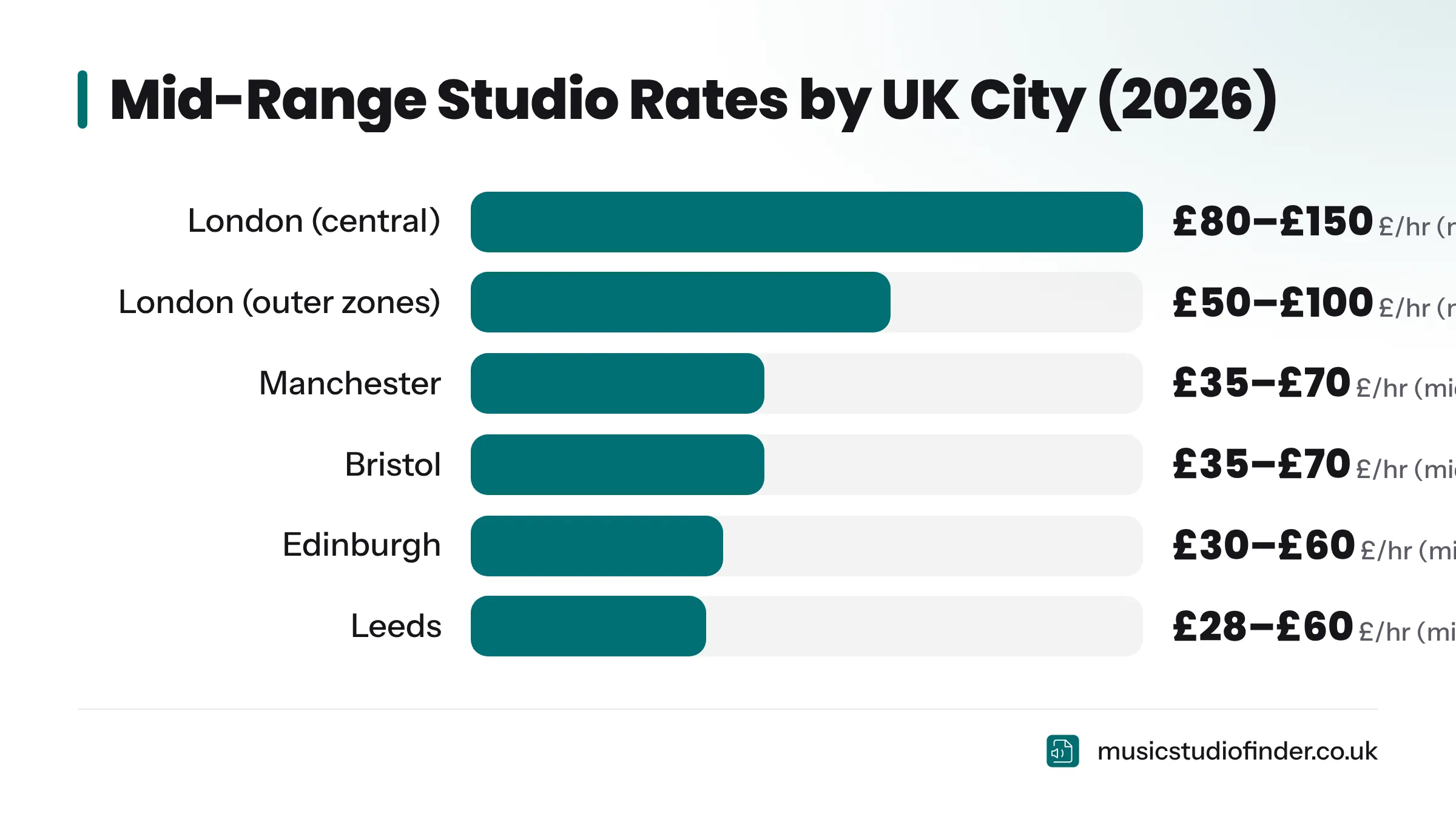
UK city price comparison for 2026
Prices below are indicative hourly ranges based on data from studios listed across the Music Studio Finder platform, reflecting the 2026 market. Individual studios will fall above or below these ranges depending on their specific offer.
| City | Budget Rate (£/hr) | Mid-Range Rate (£/hr) | Professional Rate (£/hr) |
|---|---|---|---|
| London (central) | £35-£60 | £80-£150 | £150-£300+ |
| London (outer zones) | £20-£40 | £50-£100 | £100-£200 |
| Manchester | £15-£30 | £35-£70 | £70-£150 |
| Birmingham | £15-£30 | £30-£65 | £65-£130 |
| Edinburgh | £15-£28 | £30-£60 | £60-£120 |
| Bristol | £15-£30 | £35-£70 | £70-£140 |
| Leeds | £12-£25 | £28-£60 | £60-£120 |
For a fuller breakdown of recording studio prices in the UK, including city-level data updated for 2026, our dedicated pricing guide covers it in detail.
Rural and home studios - cheaper, but what is the trade-off?
Home and rural studios can offer rates as low as £10-£20/hour. The operator typically owns the property, eliminating the single largest overhead. That saving is real and can make genuine sense for certain projects. The trade-off usually shows up in acoustic design - a converted spare room behaves very differently from a purpose-built live room - as well as in equipment investment and the availability of a professional engineer. Our piece on the recording studio vs home studio debate explores when it makes financial sense to stay local and when the upgrade is worth paying for.
Factor 2 - Studio Equipment and Technology
Equipment is the second biggest driver of studio hire price differences after location. The gap between a budget and a professional studio's gear list is not cosmetic - it directly affects the signal chain from microphone to master file, and that chain sets the ceiling on what your recording can sound like.
The cost of professional consoles (SSL, Neve, API)
The mixing desk at the heart of a control room sets the tone - literally and figuratively - for what a studio can charge. A Solid State Logic (SSL) 4000 series console, the desk behind countless major label albums, commands £40,000-£150,000 on the used market and requires ongoing maintenance. A Neve 8078, the console associated with studios like Metropolis Studios and AIR Studios in London, can cost £200,000 or more in restored condition. An API 1608 or 2448 sits in the £30,000-£80,000 range.
A studio running one of these analogue consoles passes a portion of that capital investment into the hourly rate. A studio running a DAW-only setup - a high-spec computer with software - might have spent £5,000-£15,000 on its entire signal chain. That difference explains why a console studio might charge £80-£150/hour while a comparable DAW-only room starts at £20-£40/hour.
Microphones, outboard gear, and monitoring
A single Neumann U87 condenser microphone - the industry standard for vocals and acoustic instruments - retails at approximately £2,600-£3,000 in 2026. A professional studio typically holds multiple U87s alongside dynamic microphones like the Shure SM7B (around £400), ribbon microphones, and specialist options for drums, brass, and strings. A well-stocked microphone cupboard alone can represent £20,000-£50,000.
Outboard gear - hardware compressors, preamps, EQs, and effects units from manufacturers like Universal Audio, Neve, and API - adds tens of thousands more. Monitoring systems matter too: Genelec studio monitors or the Yamaha NS10s (the industry's long-standing reference workhorse) cost thousands per pair and must be properly calibrated to the room.
DAW and plugin licences
Professional studios running Pro Tools Ultimate pay hundreds of pounds per year in software subscriptions. Logic Pro, Ableton Live, and Cubase are common alternatives with their own licence costs. Beyond the DAW itself, a professional studio might own £10,000-£30,000 worth of plugin licences from developers like Universal Audio (UAD), Waves, Slate Digital, and iZotope. Budget studios often run stripped-back plugin bundles, which limits the processing options available during your session.
What gets cut at the budget tier and why it matters
When a studio operates at the £15-£35/hour tier, cuts happen somewhere. Usually it is the console (replaced by an audio interface costing £500-£2,000), the microphone selection (fewer options, lower specification), the monitoring (consumer-grade speakers rather than professional studio monitors), and the outboard gear (minimal or none). None of this is automatically disqualifying. For a straightforward vocal take or a podcast, these tools can be entirely adequate. For a band recording live to tape or an artist chasing a specific analogue warmth, it matters considerably more.
Factor 3 - Room Design and Acoustic Treatment
The room is the most invisible and most underestimated factor in studio pricing. You cannot see acoustic treatment in a photograph the way you can see a Neve console, but its effect on your recording is just as significant.
Why a properly treated room costs thousands to build
A professional recording room is not simply soundproofed - it is acoustically designed to behave in a specific, controlled way. That means calculating and addressing modal resonances (the frequencies that a room's dimensions naturally amplify or cancel), installing bass traps at corners and low-frequency problem zones, mounting broadband acoustic panels at reflection points, and diffusing high frequencies to prevent a harsh, dead-sounding space.
A professional acoustic build for a single tracking room - including construction, materials, and acoustic engineering consultancy - typically costs £20,000-£80,000 or more. Studios at the top end commission architects who specialise in acoustic design. Those build costs become part of the studio's financial baseline and feed directly into the hourly rate.
Live rooms, vocal booths, and control rooms - do you need all three?
Most professional studios have at least a control room (where the engineer sits with the console and monitoring), a live room or tracking room (where the musicians perform), and one or more vocal booths (small, treated rooms for isolated vocal or instrument recording). Each room is acoustically designed for its purpose. Many budget studios offer only a single combined space, which limits your ability to record multiple sources simultaneously or isolate vocals from backing tracks.
Recording a solo acoustic artist? A single well-treated room may be all you need. Tracking a full band live, or needing an isolation booth to prevent bleed between instruments? The number and quality of rooms starts to matter a great deal.
Soundproofing versus acoustic treatment - not the same thing
Soundproofing prevents sound travelling between rooms or escaping to the outside world. Acoustic treatment controls how sound behaves inside the room. A studio can be well soundproofed but acoustically poor - and recording in a room with untreated flutter echoes, bass build-up, or harsh reflections produces recordings that are harder to mix and often carry a distinctively "boxy" or "roomy" quality that no plugin can fully correct.
Factor 4 - The Recording Engineer
The engineer is often the single biggest differentiator between a session that sounds like a record and one that sounds like a rehearsal recording. This one factor has an outsized effect on what affects recording studio cost.
What an in-house engineer adds to the session rate
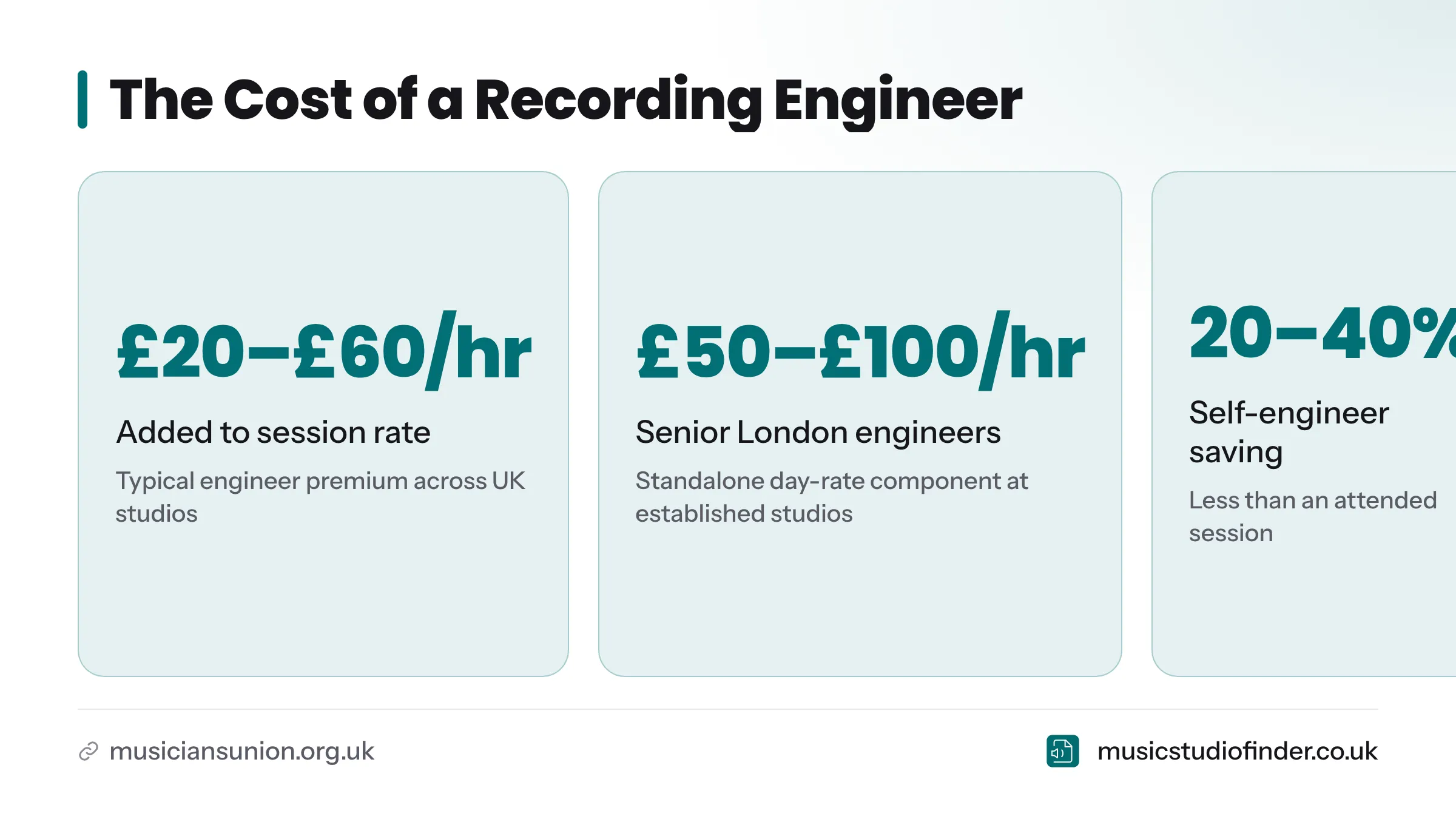
A professional recording engineer brings technical expertise across signal chain routing, microphone placement, gain staging, software management, and in-session problem-solving. Their presence typically adds £20-£60/hour to a studio's rate, depending on their experience and the market. In London, senior engineers at established studios can command £50-£100/hour as a standalone day-rate component.
What you get in return is someone who can hear problems in a take that you cannot, who knows the room's acoustic characteristics intimately, and who can make decisions in real time that protect the quality of your recording. According to the Musicians' Union, professional session engineers in the UK typically earn between £25,000-£55,000 per year - which, when averaged across billable hours, gives a sense of what it costs to keep good talent in the building.
Self-engineer sessions - when they make sense and when they do not
Many studios now offer "self-engineer" or "dry hire" sessions where you book the room and equipment without an in-house engineer. These sessions are cheaper - often 20-40% less than an attended session - and they make sense in specific circumstances: you are an experienced producer who knows your way around Pro Tools or Logic Pro, you are overdubbing a simple part onto an existing session, or you are working on pre-production demos rather than final recordings.
They are a poor choice if you are recording for the first time, tracking complex arrangements, or unfamiliar with the studio's specific signal chain. The money saved on the engineer can easily be spent re-booking time to fix avoidable mistakes. Our guide on booking a studio without a producer covers exactly when self-engineering is a smart move.
Producers vs. engineers - who does what and what it costs
These roles are often confused. A recording engineer operates the technical equipment: setting up microphones, routing the signal chain, managing the recording software, and ensuring the captured audio is clean and usable. A producer makes creative decisions: arrangement, performance, sound selection, and the overall artistic direction of the project. Some people do both. Many do not.
If a studio quotes a session rate that includes a "producer/engineer," confirm exactly what that means. A producer's day rate in the UK mid-range market typically runs £200-£600/day, separate from studio hire. At professional level, producer fees can run into thousands per day and often include a back-end percentage of royalties.
Factor 5 - Studio Reputation, Track Record, and Demand
Reputation is a real economic force in the studio market, and it affects pricing in two distinct ways.
Why famous or award-winning studios charge a premium
Studios with a verifiable track record of producing successful recordings can charge more because they offer something beyond a room and some gear: credibility, a reference point, and often access to a network of engineers, producers, and session musicians. Recording at RAK Studios in St John's Wood or AIR Studios in Lyndhurst Road carries associations that matter to some artists and their labels - and those associations have a price.
This premium is not always justified on purely sonic grounds. Some lesser-known studios have better rooms and better engineers than famous ones. For artists who need the session to carry industry weight, though, the name on the invoice matters.
New studios - the risk-reward trade-off on price
New and emerging studios frequently launch with below-market rates to attract clients and build a track record. This creates a genuine opportunity for artists on a budget: you get a potentially excellent facility at a reduced price, and the studio gets a testimonial and reference recording. The risk is that a brand-new room may not yet have been acoustically tested in practice, the engineer may be less experienced, and the booking processes may be rougher around the edges.
I have spoken with artists who found their best-value sessions in studios that were less than a year old. I have also spoken with musicians who lost three days of re-recording work because a new studio's monitoring was incorrectly calibrated and nobody caught it during the session. Do your homework before you book.
How supply and demand affects UK studio rates
Peak days (weekends, evenings in cities with active live music scenes) and peak times of year - January and September are traditionally high-activity booking months in the UK - drive up effective rates. Many studios apply flexible pricing: off-peak discounts, mid-week promotions, or last-minute availability deals that can reduce the quoted rate by 15-30%. Asking a studio directly about off-peak availability is one of the easiest ways to access genuine value.
Factor 6 - What Is Included in the Rate
Two studios can quote the same recording studio hourly rate UK and be charging for completely different things. Understanding what is bundled into a quote versus what costs extra is the most practical skill a musician can develop before booking.
Engineer, assistant, tea, parking - bundled vs. extra
Standard inclusions at most mid-range studios: use of the room, use of all installed equipment, an in-house engineer, and tea and coffee. Common extras that are sometimes not mentioned upfront: a second engineer or assistant, parking (a significant cost in central London and city centre studios), additional studio time that runs over the booked block, and instrument hire (backline, keyboards, drum kit).
Always ask: "What exactly is included in your quoted rate, and what would I pay extra for?"
Mixing and mastering - in-session vs. additional cost
Many studios separate the recording session from the mix session. Your £50/hour rate may cover tracking - capturing the performances - but mixing (balancing levels, applying processing, and producing a polished stereo mix) is a separate booking. Mastering, the final stage of audio preparation before release, is almost always a separate service, whether handled in-house or referred to a specialist mastering engineer.
Our guide on what's included when you hire a studio breaks down exactly what each stage of the process typically costs, so you can plan your total session budget accurately.
The hidden costs that catch musicians off guard
Here is what to watch for in any recording session costs breakdown:
- Stem exports: Receiving individual instrument and vocal tracks (stems) for mixing in another studio or by an external mixer. Some studios charge £25-£100 per session for this.
- Session file handover: Receiving the full Pro Tools or Logic session file. Not always included in the standard rate.
- Mix revisions: A studio mix quoted at a flat fee may include only one or two rounds of changes. Additional revisions cost extra.
- Overtime: Sessions that run beyond the booked time are almost always billed at the full hourly rate - sometimes with a premium. A session that runs 30 minutes over on an £80/hour rate adds £40 to your bill.
- Instrument tuning and setup: Hiring in a session pianist or guitarist (rates guided by Musicians' Union pay scales, typically £180-£350 per three-hour call) is an additional cost not included in the room rate.
- Parking: Central London studio parking can run £15-£30 for a session day.
- File format conversion: Receiving files in specific formats (24-bit/96kHz WAV, DDP image for CD mastering, etc.) may carry a fee at some facilities.
Always request an itemised quote, not just a headline rate.
Understanding Pricing Models
The structure of how you pay for a studio is almost as important as the rate itself.
Hourly rates - best for short or unpredictable sessions
Hourly booking is the most common model for independent artists. You pay for exactly the time you use, usually with a minimum booking of two hours. It is the right model when your session length is uncertain, when you are doing a quick overdub, or when you want maximum control over spend. The downside: hourly rates are typically the most expensive per-hour option a studio offers.
Half-day and full-day rates - when block booking saves money
Most studios offer a half-day rate (typically four to five hours) and a full-day rate (typically eight to ten hours) at a meaningful discount to the equivalent hourly cost. A studio charging £50/hour might offer a half-day at £180 (saving £20) and a full day at £320 (saving £80 versus eight hourly sessions). Our article on how many hours to book gives specific guidance on matching session length to project type.
Block booking and retainer deals - for prolific artists
Artists recording a full album, bands in active production, or artists with regular creative output can often negotiate block booking deals - purchasing a set number of hours or days in advance at a reduced rate. Retainer arrangements (a monthly commitment to a minimum number of days) are less common but available at some studios for reliable, high-volume clients. These can reduce the effective hourly cost by 20-35%.
| Pricing Model | Best For | Typical UK Range (mid-range studio) | Pros | Cons |
|---|---|---|---|---|
| Hourly | Single songs, overdubs, demos | £30-£80/hr | Flexible, no commitment | Highest per-hour cost |
| Half-day (4-5 hrs) | EPs, multi-track sessions | £130-£320 | Discount on hourly rate | Fixed block, less flexible |
| Full day (8-10 hrs) | Albums, complex sessions | £240-£600 | Best per-hour value | Long commitment, suits experienced artists |
| Block booking (prepaid hours) | Prolific artists, regular releases | 15-25% off standard rates | Significant savings | Upfront spend, may have expiry terms |
| Retainer (monthly) | Producers, active labels | Negotiated individually | Best long-term value | Requires regular use to justify |
Budget vs. Mid-Range vs. Professional Studios
This is the comparison most musicians need, and it is rarely put plainly. Here it is.
What a budget studio (£15-£35/hour) gives you
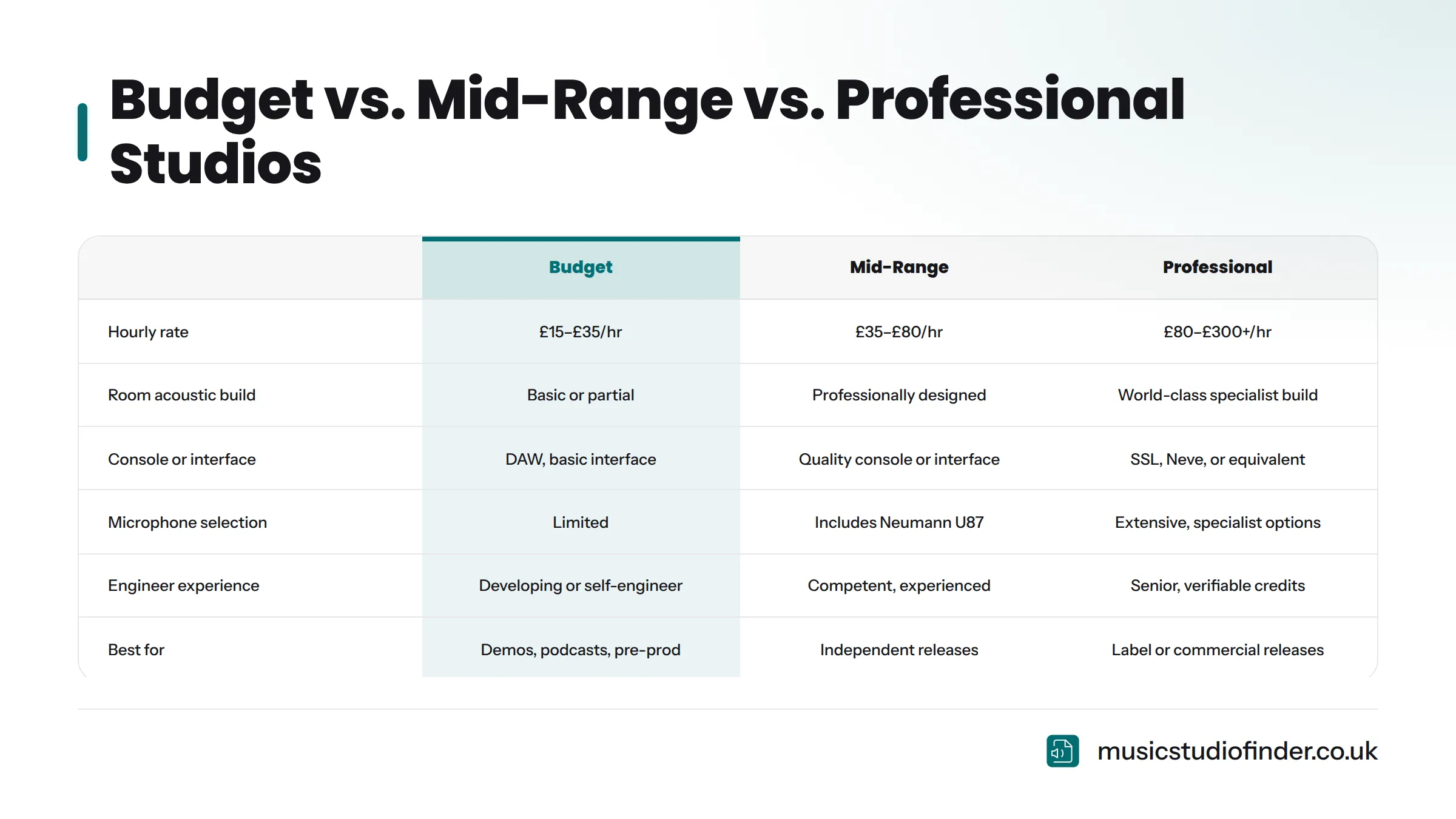
At this price point you get a functional recording environment - a treated or partially treated room, a basic audio interface (Focusrite, Universal Audio Apollo, or similar), a DAW, and a limited microphone selection. The engineer may be the studio owner who is developing their craft, or the session may be self-engineered. For demos, podcasts, voiceovers, and pre-production, this tier is entirely appropriate. For a release-quality track, the ceiling is lower and you may spend more time correcting issues in the mix.
If you want to find an affordable recording studio that still delivers professional results, the key is knowing what questions to ask before you book.
What a mid-range studio (£35-£80/hour) gives you
This is where the majority of independent UK artists record their released material. At this tier you typically get a professionally designed and treated room, a quality console or high-end interface, a solid microphone selection (including a Neumann U87 or equivalent), Genelec or similar studio monitors, a competent in-house engineer, and Pro Tools or Logic Pro as the DAW. The session experience is professional, the engineer has genuine experience, and the output is release-ready with competent mixing.
What a professional studio (£80-£300+/hour) gives you
At this level, you are paying for a fundamentally different infrastructure. The room itself is likely world-class - acoustically modelled and built by specialist contractors. The console may be an SSL 4000, a Neve 8078, or an equivalent professional-grade desk. The microphone list runs to dozens of options. The engineer has significant industry credits. You gain access to extensive outboard gear - hardware compressors, valve preamps, vintage processors - that is unavailable at lower tiers. The session pace, the client experience, and the sonic ceiling are categorically different.
Understanding what makes a recording studio professional at this level goes beyond the gear list - it is about the consistency and intention behind every element of the environment.
| Tier | Price Range (UK) | Equipment Level | Engineer Included | Best Use Case |
|---|---|---|---|---|
| Budget | £15-£35/hr | Audio interface, basic mics, DAW | Sometimes (or self-engineer) | Demos, podcasts, pre-production, beginners |
| Mid-range | £35-£80/hr | Professional desk or interface, quality mics, treated room | Usually included | Singles, EPs, independent releases |
| Professional | £80-£300+/hr | SSL/Neve/API console, extensive mic/outboard list | Yes, experienced engineer | Albums, label releases, broadcast, high-stakes projects |
Red Flags and Green Flags in Studio Pricing
Learning to read a studio's pricing page tells you a great deal about the studio itself.
Warning signs a low price may cost you more in the long run
Red flags to watch for:
- Vague pricing: "Prices available on request" with no indication of rate range suggests the studio is not confident in its offer, or prices fluctuate unpredictably.
- No mention of an engineer: A rate that makes no reference to whether an engineer is included, or that heavily emphasises self-engineering, may leave you alone in a complex technical environment.
- No acoustic information: A studio that publishes no photographs of the room interior, no information about acoustic treatment, and no audio samples has nothing worth showing - or is hiding something.
- Cash-only payment: Not always a red flag in isolation, but cash-only terms combined with other vague signals can indicate an informal setup with limited accountability.
- No booking terms: The absence of a clear cancellation policy, deposit structure, and session terms is a practical and financial risk.
- No reviews or references: A studio that cannot point to any client testimonials, finished recordings, or verifiable credits has no track record for you to evaluate.
Our guide on what to look for when booking a recording studio covers the full pre-booking checklist in detail.
Signs a higher price is genuinely justified
Green flags that signal real value:
- A published gear list with specific manufacturer and model names (not just "professional equipment")
- Audio samples or portfolio recordings that demonstrate the room's sound
- Named engineer credits - albums, singles, or sessions you can look up and verify
- Clear, itemised pricing that specifies what is and is not included
- Transparent booking terms with a fair deposit (typically 25-50%) and a clear cancellation policy
- Photographs or a virtual tour of the actual control room, live room, and vocal booth
- Client testimonials from named artists with verifiable projects
How to Decide How Much to Spend
This is the question behind every other question in this article. Here is a clear framework to answer it.
Five questions to ask yourself before setting a studio budget
Before you set a number, answer these honestly:
- What is this recording for? A demo for yourself and your friends has different requirements to a single you plan to release on streaming platforms.
- Who is my intended audience? A recording aimed at a major label A&R department needs to compete sonically with major label productions. A recording for a local venue's event calendar does not.
- What is my time worth? A cheap studio that wastes three hours of your session through technical problems has cost you money even if the hourly rate was low.
- Can I self-engineer competently? If not, factor an engineer into your budget from the start.
- Am I paying for the room or the reputation? If you need the studio's name attached to the project for industry credibility, that has a value. If you simply need a great-sounding recording, focus on the room's acoustics and the engineer's credits instead.
Matching your project to the right price tier
Work through this in order:
Step 1: Identify your release intent. Demo only - budget tier. Independent release - mid-range. Label submission or commercial release - professional.
Step 2: Identify your genre and instrumentation. Solo vocal and guitar means a single well-treated room with a quality microphone is sufficient. Full band tracking live means you need multiple rooms, multiple high-quality microphones, and an experienced engineer.
Step 3: Calculate your total session budget, not just the hourly rate. Multiply your expected session length by the hourly rate, add mixing, mastering, and any likely hidden costs, and check the total against your actual budget.
Step 4: Compare at least three studios at your target tier before committing. Use Music Studio Finder to filter studios by location, price range, and facilities - it is the fastest way to see what is actually available in your city and what other artists have said about each studio.
Step 5: Ask each studio the same questions before booking. What is included in the rate? Is an engineer included? What is the cancellation policy? Can I hear samples from the room? Can I speak with a recent client?
How to negotiate or get better value without compromising quality
Negotiation is more accepted in studio booking than many musicians realise. Here are approaches that work:
- Book off-peak: Mid-week daytime slots are consistently cheaper at studios that apply flexible pricing. Ask directly.
- Book a full day rather than hourly: The per-hour saving on a day rate is often significant, and studios prefer the certainty of a full-day booking.
- Ask about new studio introductory rates: Studios that have recently launched or refitted often offer promotional rates to build their client base.
- Offer a testimonial or reference recording in exchange for a discount: This is a genuine trade of value, particularly for newer studios.
- Commit to a return booking: Offering to book a second session contingent on the first session going well can unlock a small discount at studios that value repeat business.
For everything you need to know before walking in on session day, our guide on how to prepare for your first studio session covers preparation, etiquette, and getting the most from every hour you pay for.
This video gives a candid look at the economics of owning and running a recording studio - which puts the UK studio pricing you see from the other side of the console into sharp perspective:
Frequently Asked Questions
Why is there such a big difference in recording studio prices?
Studio prices vary because every studio carries a different cost structure. Location, rent, equipment investment, acoustic build quality, staff wages, and the scope of services included all compound to produce a final hourly rate. A budget home studio has near-zero rent and minimal equipment costs. A central London professional studio with an SSL console, a full engineer team, and multiple acoustically designed rooms carries overheads that can exceed £200,000 per year - and every hour you book pays for a share of that.
What is included in a typical studio day rate in the UK?
A mid-range UK studio day rate (typically covering eight to ten hours) usually includes use of all installed equipment, the in-house recording engineer, tea and coffee, and a rough mix of the day's recordings at the end of the session. It does not usually include mixing revisions, stem exports, a second engineer, parking, or mastering.
Is a cheap recording studio worth it?
It depends entirely on what you are recording and why. A £15-£25/hour studio is perfectly adequate for demos, podcasts, voiceovers, and pre-production work. For a release-quality track intended for streaming platforms, the limitations in room acoustics, equipment, and engineering experience at the budget tier can create a ceiling on your final sound that is difficult to overcome in the mix.
Do I need an engineer, or can I self-record?
If you are an experienced producer who knows your way around the DAW and signal chain, self-engineering is a legitimate option that saves money. If you are recording for the first time, tracking a live band, or aiming for a release-ready result, an in-house engineer is almost always worth the additional cost. The technical expertise they bring - microphone placement, gain staging, in-session problem-solving - is difficult to replicate without significant experience.
Why are London recording studios so much more expensive than studios outside the city?
Central London commercial property is among the most expensive in Europe. A studio leasing space in Soho, Brixton, or Hackney pays rent, rates, and operational costs that are two to four times higher than equivalent studios in Manchester, Leeds, or Edinburgh. Those costs feed directly into the hourly rate. The quality difference between a good London studio and a good regional studio is often minimal - what you pay for in London is primarily the address.
How can I get a better deal on studio time?
Book mid-week during off-peak hours, book a full day rather than by the hour, ask about introductory rates at newer studios, and compare multiple studios before committing. Using Music Studio Finder to compare studios across price, location, and facilities is the most efficient way to identify genuine value in your area.
What hidden costs should I watch out for when booking a studio?
Watch for: session overtime charges, stem export fees, session file handover costs, parking, mix revision charges beyond the included number, instrument hire, and mastering (which is almost always a separate cost). Always ask for an itemised quote before confirming your booking.
How many hours do I need to book to record a song?
A simple song with one or two performers and minimal overdubs can be tracked in three to five hours by a well-prepared artist. A more complex arrangement with multiple instruments, takes, comping, and overdubs can take eight to twelve hours or more. Being thoroughly rehearsed before you enter the studio is the single most effective way to control session length - and cost.
What is the difference between a budget and professional studio?
The differences are in the room's acoustic design, the equipment specification (console vs. audio interface, professional microphone selection vs. basic options), the engineer's experience and credits, and the breadth of services available. At professional level, you also gain access to outboard hardware processing - analogue compressors, valve preamps, vintage effects units - that has a measurable impact on the recorded sound.
Should I book by the hour or go for a day rate?
Book by the hour when your session is short, uncertain in length, or you are doing a quick overdub. Choose a half-day or full-day rate when you have a clear, structured plan for a longer session - the per-hour saving is real, and the absence of time pressure helps everyone work better. If you are recording an EP or album, a full-day rate or block booking deal is almost always the smarter financial decision.
Find the Right Studio for Your Budget on Music Studio Finder
Knowing why studio prices vary is useful. Being able to act on that knowledge - to actually find and compare studios that match your budget, genre, and location - is where the real value lies.
Compare studios by price, location, and facilities
Music Studio Finder is the UK's dedicated studio discovery platform, giving musicians a transparent way to search, compare, and enquire across studios ranging from budget-friendly independents to professional full-service facilities. Filter by city, price range, room type, and facilities - whether you need a vocal booth in Edinburgh, a full live room in Manchester, or a professional SSL studio in London, the comparison is available in a single search.
Every listing includes the studio's gear list, pricing information, photographs, and client reviews - the exact information you need to apply the decision framework above before committing to a booking.
Browse recording studios across the UK
From the Recording Studio service page you can start exploring studios across every region of the UK. Use the filters to match your budget to the right tier, read what previous artists have said, and reach out directly to studios before committing. The platform's listings cover studios at every price point - because the right studio is not always the most expensive one. It is the one that fits your project precisely.
For first-time bookers, our guide on how to find a recording studio near you walks through the process from initial search to confirmed booking, step by step.
Sources
- Musicians' Union - musiciansunion.org.uk
- Abbey Road Studios - abbeyroad.com
- Metropolis Studios - metropolis.co.uk
- AIR Studios - airstudios.com
- RAK Studios - rakstudios.co.uk
- Avid Pro Tools - avid.com/pro-tools
- Solid State Logic - Wikipedia
- UK Music - ukmusic.org
- BPI - bpi.co.uk
- PRS for Music - prsformusic.com
- Music Studio Finder - musicstudiofinder.co.uk