
A professional recording studio is more than a room with expensive microphones in it. It is a precisely engineered environment where acoustic design, calibrated equipment, experienced human expertise, and structured workflow combine to produce recordings that hold their own on any speaker, in any listening environment, at any volume. Strip away any one of those dimensions and you no longer have a professional facility - you have something that looks like one.
That distinction matters because musicians spend real money on studio time, often without a reliable way to tell a genuinely professional studio from an impressive-looking room with a modest interface and a laptop. This guide builds a practical framework - the 7 Pillars of a Professional Recording Studio - to give you exactly that tool. Whether you are booking your first session, comparing studios across price tiers, or assessing your own setup against industry standards, every section here gives you something concrete to test, question, and act on.
At Music Studio Finder, we connect musicians with studios across the UK every day. The patterns we see consistently confirm one thing: the gap between a professional studio and an amateur one is almost never about one piece of gear. It runs deeper than that, and this guide explains precisely where to look.
"Professional" Is a Multi-Dimensional Standard, Not a Gear List
A professional recording studio is a facility purpose-built to capture, process, and deliver audio at a standard suitable for commercial release - where acoustic design, professional-grade equipment, experienced engineering staff, and structured session management work together to consistently produce release-ready recordings.
That definition covers four distinct dimensions, and every one of them matters.
The word "professional" gets used loosely in the studio world. Studios describe themselves as professional when they own a single high-end microphone. Producers call their bedroom setups professional because they use Pro Tools. None of that is wrong exactly, but it misses the point.
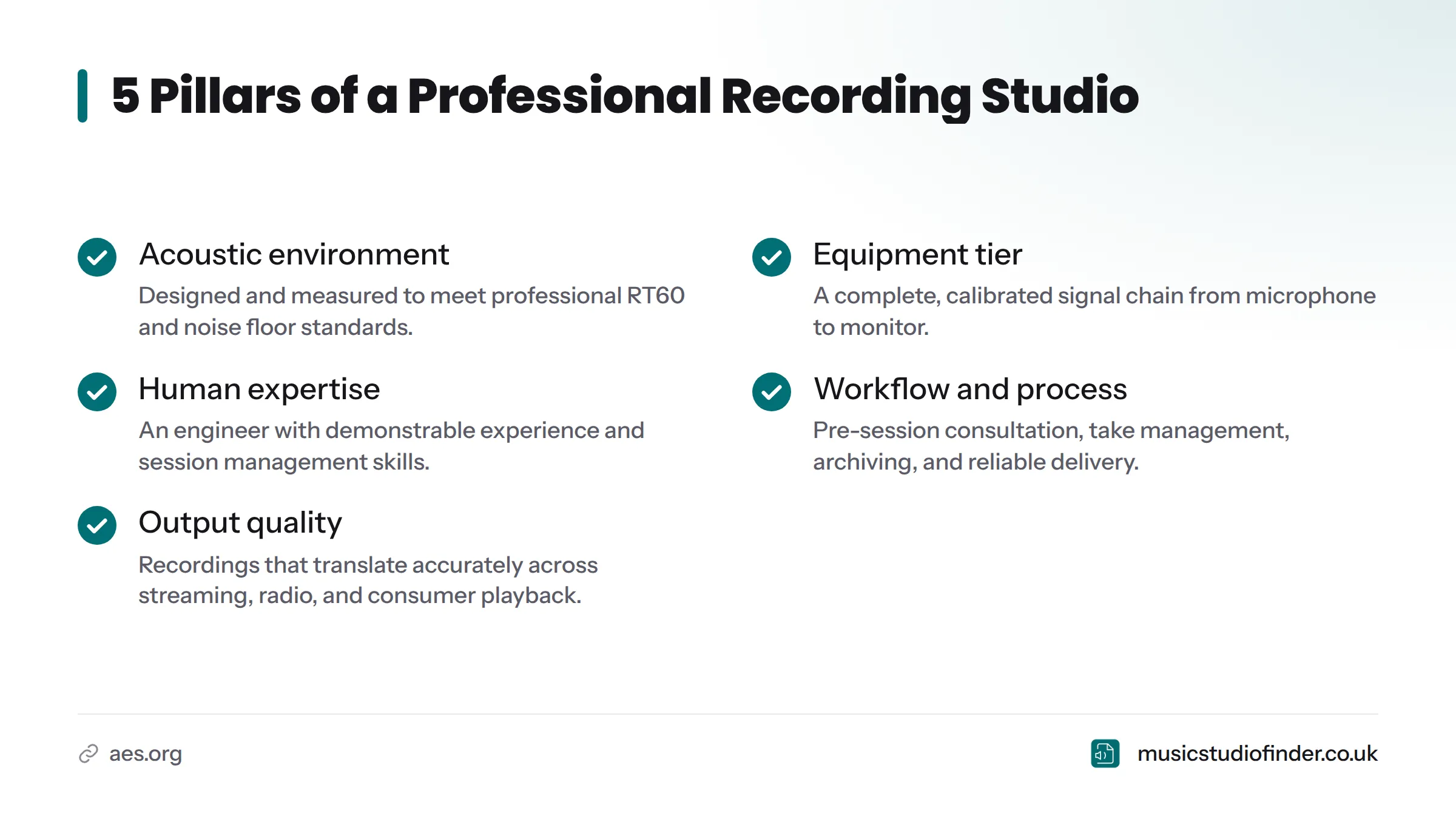
True professional recording studio standards require all five of the following to be present simultaneously:
- Acoustic environment - designed and measured to meet professional RT60 and noise floor standards
- Equipment tier - a complete, calibrated signal chain from microphone to monitor
- Human expertise - an engineer with demonstrable experience, technical knowledge, and session management skills
- Workflow and process - structured pre-session consultation, disciplined take management, proper file archiving, and reliable delivery
- Output quality - recordings that translate accurately to streaming platforms, radio, and consumer playback systems without needing significant remediation
Professionals in the Audio Engineering Society (AES) treat these as inseparable. A studio excelling in three out of five still falls short of the standard.
Professional Studio vs Mid-Range vs Home Studio: Core Differences
The table below lays out the core differences across every dimension a musician should care about before booking.
| Dimension | Professional Studio | Mid-Range / Budget Studio | Home / Project Studio |
|---|---|---|---|
| Acoustic design | Purpose-built with measured RT60, bass traps, diffusion, and a controlled noise floor (typically below NC-25) | Some treatment, often partial - may have audible room issues | Minimal or improvised treatment; significant room colouration |
| Equipment tier | Large-format console (Neve, SSL, API) or high-end interface; outboard compressors, preamps, EQs | Mid-range interface; some outboard; budget-to-mid microphone selection | Consumer-grade or entry-level interface; limited microphone selection |
| Studio monitors | Calibrated professional monitors (ATC, Genelec, Yamaha NS-10) in a treated control room | Decent near-field monitors; room may affect accuracy | Consumer speakers, headphones, or uncalibrated near-fields |
| Engineer expertise | Experienced staff engineer or house engineer with a track record and technical qualifications | Competent but less experienced; may be owner-operator | Typically the artist themselves or a hobbyist |
| Session workflow | Pre-session consultation; structured takes; comping; rough mix delivery; professional file archiving | Basic session management; variable delivery standards | Informal; no fixed workflow |
| Output standard | Release-ready or near-release-ready recordings with accurate gain structure and headroom | Good quality with some limitations; may need remediation in mixing | Variable; often requires substantial post-production work |
| Typical UK hourly rate (2026) | £80 - £250+ per hour | £25 - £79 per hour | Free to £20 per hour (hire arrangements) |
For a deeper look at the full cost picture, the recording studio cost UK guide breaks down current 2026 pricing across every studio tier.
Pillar 1 - Professional Acoustic Design
If I had to name the single most misunderstood aspect of professional studios, it would be acoustics. Musicians routinely overlook the room and obsess over gear - but every engineer worth their session fee will tell you the room shapes the recording more than any microphone.
Why Acoustics Are the Foundation
Sound behaves predictably in a professionally treated room. In an untreated or poorly treated space, sound bounces between parallel walls, creating standing waves and flutter echo that colour every recording. A vocalist recorded in a room with uncontrolled low-frequency build-up at 200 Hz will sound boxy on every speaker - no amount of EQ in the mix fully corrects a bad acoustic capture.
Professional studios eliminate these problems before a single track is recorded.
Soundproofing vs Acoustic Treatment
These terms get used interchangeably by non-engineers, but they describe completely different problems.
Soundproofing (acoustic isolation) prevents sound from entering or leaving the building. A professional studio uses mass-loaded walls, decoupled room-within-a-room construction, floating floors, and isolated HVAC systems to achieve this. Without it, street noise, air conditioning rumble, or sound leaking between the live room and control room contaminates every recording.
Acoustic treatment controls how sound behaves inside the room once it is there. Bass traps absorb low-frequency build-up in corners, broadband absorbers reduce mid- and high-frequency reflections, and diffusers scatter sound to create a natural, spacious character without deadening the room. Together, these elements give the room a controlled, predictable response that the engineer can trust.
A studio with egg cartons on the walls has neither. Egg cartons affect only a narrow band of high frequencies and do nothing meaningful for the low-end problems that cause the most damage to recordings.
Red Flag: Any studio that describes its acoustic treatment as DIY foam tiles, egg cartons, or hanging blankets is not operating to professional acoustic standards. Genuine acoustic design is measured, calculated, and usually installed by a specialist.
The Three Rooms of a Professional Recording Studio
A fully professional studio facility separates its acoustic environments by function. The live room vs control room guide covers the spatial and acoustic differences in detail.
The live room is where performances are captured. It is typically a larger, acoustically lively space with a controlled amount of natural reverb - enough to add life to recordings, not so much that the room overpowers the performance. Professionals use room microphones deliberately in the live room, treating its acoustic character as an instrument in itself.
The control room is where the engineer sits, listens, and makes decisions. This room is tuned to an extremely flat frequency response - meaning the monitors reproduce sound as accurately as possible, with no room peaks or dips colouring the engineer's judgement. A good control room tells the truth. A bad one lies constantly.
The vocal booth is a small, heavily damped room designed for close-up, dry capture of vocals, acoustic guitar, voice-over, or any source that needs isolation and minimal room ambience. A professional vocal booth is quiet enough that the engineer's talkback microphone picking up room noise is the biggest acoustic challenge. For a full breakdown of what this space involves, what is a vocal booth covers the specifics.
RT60, Noise Floor, and Flutter Echo: The Measurable Standards
RT60 measures how long it takes for sound in a room to decay by 60 dB after the source stops. Professional control rooms typically target RT60 values between 0.2 and 0.4 seconds across the audible frequency range, with consistency across frequencies being as important as the absolute number. Rooms with uneven RT60 - fast decay at high frequencies, slow decay at low frequencies - mislead the engineer into making compensatory EQ decisions that sound wrong on other systems.
The noise floor of a professional studio, measured against the NC (Noise Criteria) ratings used in architectural acoustics, should typically be NC-25 or lower for a control room and NC-20 or lower for a recording space. An NC-25 rating corresponds roughly to 35 dB SPL - quiet enough that HVAC, traffic, and electrical noise are inaudible during a session.
Flutter echo - the metallic, repeating decay heard when you clap in a parallel-walled room - is completely absent in a professional studio. Hear it when you visit, and the acoustic design is incomplete.
Pillar 2 - Professional Recording Studio Equipment
Professional equipment matters enormously, but the trap is thinking any single item defines professionalism. What defines professional studio quality is the complete calibrated chain - every component working together at a consistent standard.
The Signal Chain: Every Link Matters
The signal chain is the path your sound travels from source to storage. In a professional studio, every link is chosen, calibrated, and maintained to preserve the integrity of the signal.
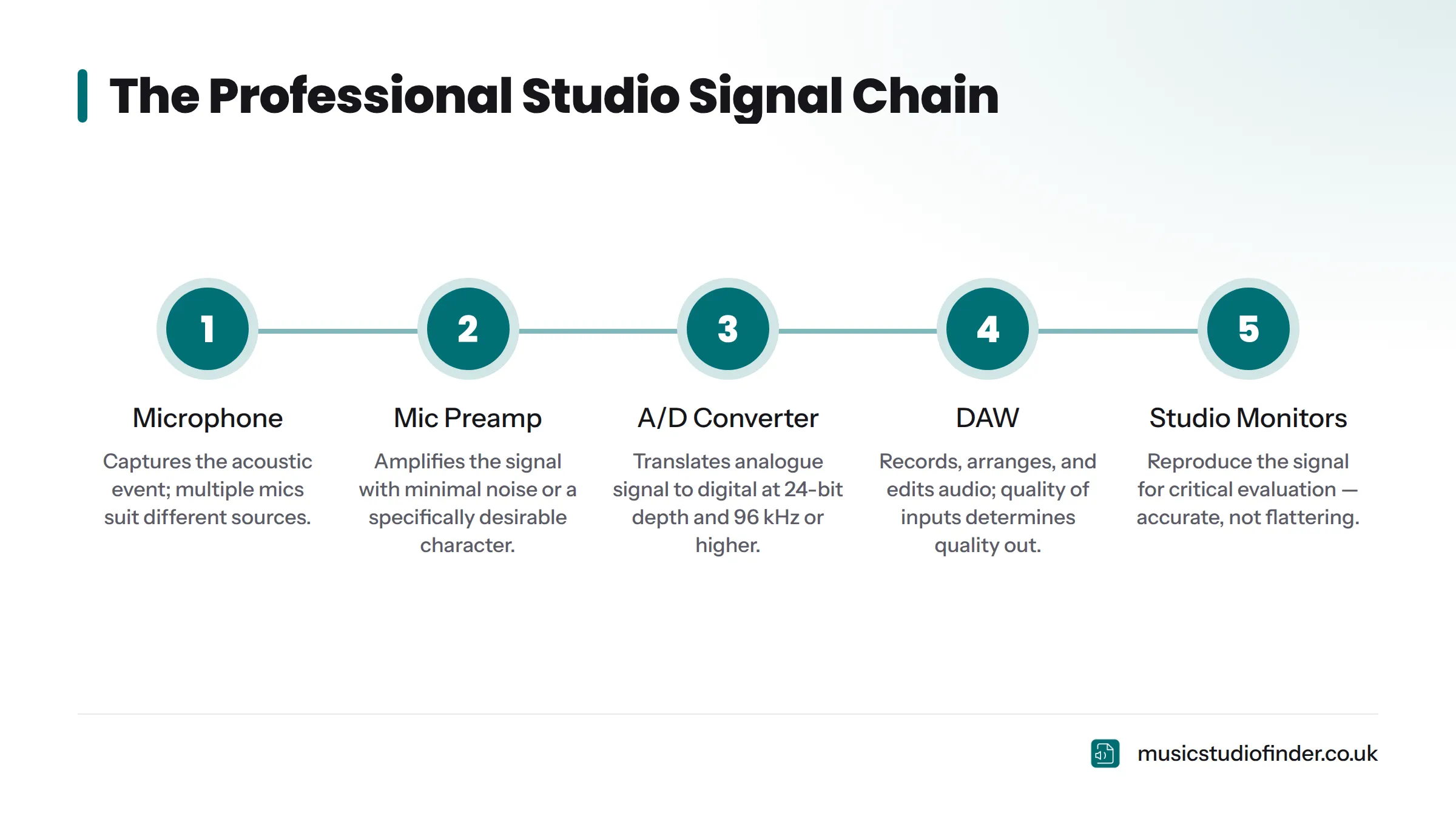
Here is how that chain looks:
Instrument / Voice → Microphone → Mic Preamp → Analogue-to-Digital Converter → DAW → Studio Monitors
- Microphone: Captures the acoustic event. Professional studios stock multiple microphones because different sources suit different capsules, polar patterns, and transient responses.
- Mic preamp: Amplifies the microphone signal with as much gain as needed and as little added noise as possible - or, in the case of transformer-coupled preamps like the Neve 1073, with a specifically desirable character.
- Analogue-to-digital (A/D) converter: Translates the analogue signal into digital data. Professional converters capture 24-bit depth at 96 kHz or higher, preserving dynamic range and frequency information far beyond what consumer gear delivers.
- DAW: Records, arranges, and edits the captured audio. The DAW itself does not determine quality; the quality of everything feeding into it does.
- Studio monitors: Reproduce the recorded signal for critical evaluation. Professional monitors must be accurate, not flattering.
A home studio might have a Focusrite Scarlett interface doing three of those jobs simultaneously at a consumer level. A professional studio treats each as a discrete, purpose-selected component.
Microphone Selection in a Professional Studio
Professional studios invest heavily in microphone libraries because the right microphone for a source makes a recording - the wrong one fights the mix for the entire project. A Neumann U87 - one of the most widely used large-diaphragm condensers in professional facilities worldwide - captures a smooth, detailed high-frequency response that flatters most vocalists. A Shure SM7B gives a darker, warmer character suited to close-miked broadcast-style vocals. A matched pair of small-diaphragm condensers captures acoustic instruments with precision and a natural transient response.
Professional studios typically stock at minimum: one or more large-diaphragm condenser microphones, at least one quality dynamic microphone, one or more ribbon microphones, and a selection of instrument microphones covering kick drum, snare, and overheads. Matching the right microphone to the right source, in the right acoustic environment, is a professional skill.
Why Dedicated Preamps Change the Recording
Mic preamps are where analogue character is imprinted on a recording. Professional studios use dedicated outboard preamps - standalone units from manufacturers like Universal Audio, API, Neve, or Chandler Limited - rather than the built-in preamps of a consumer audio interface. The difference is audible: professional preamps add headroom, depth, and in some cases deliberate harmonic saturation that makes recordings feel three-dimensional rather than flat.
Large-Format Console vs High-End Interface
A large-format mixing console - an SSL 4000 series, a Neve 8078, or an API 1608 - remains the centrepiece of many elite professional studios. These desks provide multiple channels of high-quality preamps, analogue summing that many engineers prefer to digital, tactile control over every signal parameter, and integration with outboard gear through built-in routing.
Not every professional studio runs a large-format console. Many world-class studios operate around high-end audio interfaces and summing amplifiers. What matters is that every component in the chain meets a professional standard - not that it follows a specific configuration. The presence or absence of a large console alone does not confirm or deny professional status.
Professional Studio Monitors: Designed to Expose Problems
Studio monitors are not designed to sound good - they are designed to sound accurate. The Yamaha NS-10, discontinued in 1993 but still found in professional studios worldwide, became legendary not because it sounded beautiful but because it exposed problems. If a mix sounded good on NS-10s, it would translate to almost any system.
Modern professional monitoring choices include Genelec (Finnish precision monitors widely used in European broadcast and mastering), ATC (British manufacturers whose SCM monitors are standard in many UK professional rooms), and Augspurger soffit-mounted systems in larger studio builds. Professional rooms are also typically calibrated with a reference SPL level and a measurement microphone to confirm the room's frequency response is flat.
Consumer speakers are designed to make music sound enjoyable. Professional monitors are designed to make problems audible. That difference determines whether a mix translates or fails on other systems.
Outboard Gear: The Hardware That Software Approximates
Outboard gear - hardware compressors, equalisers, reverbs, and effects units that exist as physical units outside the computer - adds processing capabilities and, in many cases, analogue character that software plug-ins approximate but do not fully replicate. Professional studios typically stock VCA compressors (such as the SSL G-Bus), optical compressors (Universal Audio LA-2A), FET compressors (Universal Audio 1176), and Pultec-style equalisers as standard outboard.
Professional Studio Equipment Checklist:
- Large-diaphragm condenser microphone(s) (e.g., Neumann U87, AKG C414)
- Dynamic microphone(s) (e.g., Shure SM7B, Electro-Voice RE20)
- Ribbon microphone(s) for acoustic sources
- Dedicated outboard mic preamps (minimum 2 channels)
- Analogue-to-digital converter at 24-bit / 96 kHz or higher
- Professional DAW (Pro Tools, Logic Pro, Ableton Live, or equivalent)
- Professional studio monitors (calibrated, reference-grade)
- Subwoofer (for low-frequency verification)
- Outboard compressor (hardware unit)
- Headphone amplifier and artist cue mix system
- Talkback microphone and intercom system
- Patchbay for signal routing
- Metering (PPM, VU, LUFS)
Pillar 3 - The DAW and Recording Infrastructure
The DAW sits at the centre of modern studio work, but treating it as the defining marker of professional quality is a mistake I see consistently - especially among musicians setting up their own spaces.
The DAW Is a Tool, Not the Standard
Pro Tools, produced by Avid and long considered the industry standard for professional session work, is not inherently better-sounding than Logic Pro or Ableton Live. It is preferred in many professional facilities because its session format is universally readable across studios and post-production houses - making file exchange between facilities straightforward. Logic Pro, developed by Apple, is widely used in professional music production and songwriting contexts. Ableton Live dominates in electronic music production and live performance work.
What unites all three at a professional level is how they are configured: correct gain staging from input to output, proper session templates, bit depth set to 24-bit or 32-bit float, sample rates matched to delivery requirements, and project file organisation that enables clean archiving and transfer.
Pre-Built Session Templates Are Non-Negotiable
At a professional facility, the DAW is configured to a session template before the artist arrives. Track names, routing assignments, monitoring sends, and headphone mixes are pre-built for the session type. This is not a luxury - it is how professional studios protect session time and prevent costly mistakes during recording.
A studio that opens a blank Pro Tools session when you arrive and starts creating tracks from scratch while you discuss the plan is not operating to a professional workflow standard, regardless of what software it uses.
Clocking, Converters, and Why Digital Precision Matters
Digital audio quality is determined at the point of conversion. Professional studios use dedicated master clock devices - often from Antelope Audio or Apogee - to ensure every digital device in the studio runs from the same precise timing reference. When multiple digital devices run with mismatched clocks, jitter degrades the audio at a level that is subtle but cumulative across a full recording session. Professional clocking eliminates this entirely.
The quality of the A/D converters themselves matters too. Professional converters capture audio with lower noise floors, greater dynamic range, and more accurate frequency response than the converters built into consumer audio interfaces - differences that accumulate across every track recorded in a session.
Pillar 4 - The Audio Engineer: The Most Consequential Variable
The audio engineer is the single most consequential variable in a professional recording session. A great engineer in a modest studio will outperform an inexperienced engineer in a world-class facility every time. This is the consensus across the engineering community, and in my experience, it holds true.
What the Engineer Actually Controls
The engineer controls the signal chain, sets the gain structure, selects and positions microphones, manages the artist's performance environment, and makes hundreds of small technical decisions every hour that collectively determine the quality of the recording. An experienced engineer hears problems before they are captured. They know when a room is colouring the recording and how to reduce it. They know when a vocal performance has the take within it, even if it is buried under a hesitation in bar three.
For a full breakdown of what this role involves technically and creatively, what does a recording engineer do covers the scope in detail.
What to Look for in a Studio Engineer's Experience
There is no single required qualification for a recording engineer in the UK - no licence, no mandatory certification. The Music Producers Guild UK (MPG) represents professional producers and engineers and advocates for professional standards, but membership is not a legal requirement to practice.
What you should look for instead:
- A demonstrable portfolio of completed, released recordings across the genre relevant to your project
- Familiarity with the specific DAW and signal chain used at the studio
- Experience with the room - knowing where a vocalist sounds best, which microphone works on guitar cabs in that space, how the monitors compare to other playback systems
- References from artists who have recorded with them
- Clear communication and a structured approach to session management
Years of experience matter, but so does the type of experience. An engineer with ten years of podcast recording may not be equipped for a full-band tracking session.
Room Knowledge Is Not Transferable
A professional engineer knows their room intimately. They know its acoustic quirks - where the bass builds up, how the live room responds to drums, what the quiet areas of the vocal booth sound like at different microphone distances. This knowledge is built through hundreds of sessions in the same space, and it is genuinely impossible to replicate from a set of specifications.
When you visit a studio and the engineer cannot tell you where they would position a vocalist, where the sweetest spot in the live room is for acoustic guitar, or what their preference is for recording a drum kit in that specific room - that is a signal that they do not have a professional relationship with the space.
What a Professional Engineer Does Before, During, and After a Session
Before: Reviews the project brief, sets up the session template, checks all equipment, calibrates the monitoring chain, prepares headphone mixes, and communicates with the artist about the plan for the day.
During: Sets gain structure from microphone through to DAW, selects and positions microphones for each source, manages the artist's performance environment through the cue mix and talkback, records takes, comps between takes, and provides a rough mix at the end of the session.
After: Names and organises session files, exports stems or rough mixes to agreed specifications, archives session data, and communicates any follow-up notes or file delivery details to the artist.
At a professional level, none of these steps are optional.
Expert Insight: The Audio Engineering Society's guidelines on professional practice consistently identify the engineer's knowledge of gain structure and signal path integrity as foundational - not the brand of the console they work behind. A well-maintained, calibrated signal chain managed by an experienced engineer will outperform expensive equipment managed poorly.
Pillar 5 - Professional Session Workflow and Studio Management
The difference between a professional studio and an amateur setup is often most visible in how a session is run - before a single note is played.
The Pre-Session Consultation
A professional studio contacts you before your booking to confirm the session plan. They ask about your project: how many musicians, what instruments, what you are hoping to achieve, whether you need a producer in addition to the engineer, and what format you need files delivered in. This pre-session consultation determines how the session template is built, how much time is allocated to setup vs recording, and whether any additional equipment needs to be arranged.
For a detailed walkthrough of what to expect on the day, what happens in a professional recording session covers the full arc from arrival to delivery.
Takes, Comping, and Rough Mixes
A professional engineer records multiple takes of each performance, names and labels them clearly in the session, and works with the artist to identify the strongest moments from each. Comping - selecting the best segments from multiple takes to build a composite performance - is a core professional skill. A vocalist might deliver the best verse on take three and the best chorus on take five; the engineer comps those together into a single seamless performance.
At the end of a session, a professional studio delivers a rough mix - a balanced, unmastered preview of the recorded material that gives the artist a clear sense of what has been captured. Delivering it is standard professional practice, not an optional add-on.
Session Notes and Reproducibility
A professional engineer keeps session notes - a record of microphone choices, preamp settings, room positions, and any relevant observations from the session. These notes mean that if the artist returns for additional recording six months later, the engineer can recreate the same sound precisely. This consistency is a professional service.
File Management, Archiving, and Delivery Standards
Professional studios deliver session files in agreed formats - typically 24-bit WAV files at the original sample rate, organised into named folders by instrument and take. They archive project files on their own servers or backup drives for an agreed period, typically a minimum of six months. If the artist's hard drive fails after delivery, a professional studio can retrieve the session.
Delivery to streaming platforms such as Spotify and Apple Music requires audio that meets specific loudness standards - typically -14 LUFS for integrated loudness, as specified by the AES streaming loudness standards. A professional engineer understands these requirements and can flag if a rough mix is outside acceptable parameters.
Confidentiality and Professional Conduct
Professional studios treat every session with discretion. Artists working on unreleased material have a legitimate expectation that what happens in the studio stays there - no social media posts about the session, no mention of the project to other clients, no audio clips shared without explicit permission. Professional studios put this in writing in their booking terms.
The best guide to navigating studio etiquette from the artist's side is the recording studio etiquette guide, which covers both what studios expect from artists and what artists should expect from a professional facility.
Pillar 6 - The Studio Environment and Client Experience
Great studios know that a great performance comes from a relaxed, focused artist. The physical environment contributes to that more than most musicians realise.
Why Physical Comfort Affects What You Capture
Recording is mentally and physically demanding. Singers fatigue faster when they are anxious, cold, or uncomfortable. Musicians make more mistakes when they are distracted by technical problems or an unfamiliar environment. A professional studio designs the client experience deliberately - the lounge is comfortable, the temperature is controlled, the coffee is good, and the atmosphere communicates that the facility is organised and on your side.
Research in music performance psychology consistently supports the link between environmental comfort and peak performance. A vocalist who feels at home in a space delivers more committed takes than one who is watching the clock and worrying about whether the equipment is working correctly.
Personalised Headphone Monitoring (Cue Mix Systems)
A cue mix is the personalised headphone mix that each performer hears during recording. A vocalist might want more reverb on their voice, more of the bass guitar, and less of the click track. A drummer might want the click loud and everything else quiet. A professional studio provides independent headphone mixes for each performer - typically through a dedicated headphone amplifier and distribution system - so that every artist hears exactly what they need to perform at their best.
A studio where everyone shares the same headphone mix, or where headphone levels are controlled only from the main console, is not delivering a professional client experience.
Facilities, Lounge, and the Longer Session
The waiting area and client lounge in a professional studio serve a real function. When a vocalist is doing vocal warm-ups while the drummer finishes tracking, they need somewhere comfortable to sit away from the control room. When a session runs long, the kitchen needs to have enough supplies for the band. These elements are operational infrastructure for sessions that run professionally.
Booking Process and Professional Administration
A professional studio has a clear, straightforward booking process with written confirmation, a deposit structure, a cancellation policy, and professional invoicing. Studios operating at a professional level do not take cash-only bookings with no paperwork, change the price on the day, or fail to respond to messages promptly.
If a studio cannot tell you clearly what the hourly rate includes - engineer time, use of outboard gear, mixing session, file delivery - that ambiguity is itself a red flag.
Pillar 7 - Output Quality and the Recording Standard That Follows You
Every other pillar serves one purpose: the recording that leaves the studio.
What a Professionally Recorded Track Actually Sounds Like
A professionally recorded track sounds the same on laptop speakers, car stereo, studio monitors, and Bluetooth headphones - with the only variable being the playback system's own frequency limitations, not problems introduced by the recording. It has clean low-end without muddiness, clear high-frequencies without harshness, audible transient detail, and dynamic range that feels natural rather than compressed flat.
More specifically: the noise floor is inaudible. There are no room reflections colouring the vocal. The stereo image is stable and coherent. Each instrument occupies a defined frequency space without fighting another. These qualities are not achieved in post-production - they are built into the recording at the point of capture, in a professional acoustic environment, with a calibrated signal chain.
From Raw Recording to Release-Ready: Understanding the Chain
Recording → Mixing → Mastering describes the production chain, and a professional studio's role is typically in recording and sometimes mixing. Understanding recording vs mixing vs mastering is worth the time because each stage has its own professional standard.
A professional recording session delivers multitrack session files that are correctly gained, clean, well-organised, and ready for a mixing engineer to work with. They do not require the mixing engineer to spend billable hours fixing problems that should have been solved during recording - eliminating room noise, rebalancing gain structure, or editing out technical errors.
How to Assess a Studio's Output Quality Before Booking
The most direct method is to listen to recordings the studio has made. Every professional studio should be able to share a portfolio of released recordings produced there, with the artist's permission. Listen critically:
- Does the low-end translate well on your headphones?
- Do the vocals sit clearly in the mix without sounding boomy or harsh?
- Does the stereo image hold together?
- Can you hear background noise, room reflections, or electrical hum?
If a studio cannot share examples of its work - or if the examples share a consistent flaw such as persistently muddy low-end - take that as a serious signal before committing to a booking.
How to Evaluate Any Recording Studio Before You Book
Knowing the seven pillars is useful. Having a structured process for evaluating a specific studio before you book is practical. Here is how to apply the framework.
Questions to Ask During Your Initial Enquiry
Good questions to ask during the initial enquiry or studio visit, drawn from the framework above:
- What is the acoustic treatment specification of your live room, control room, and vocal booth?
- What microphones are available for the session?
- What preamps and outboard gear does the studio stock?
- What is the monitoring chain in the control room?
- Who is the engineer for my session, and can I hear examples of their recent work?
- What sample rate and bit depth do you record at?
- What is your session file delivery format and archiving policy?
- Do you provide a rough mix at the end of the session?
- What does the hourly rate include, and what is charged additionally?
- Can I visit the studio before booking?
For a comprehensive list of pre-booking questions, questions to ask before booking a music studio covers everything from budget to technical spec.
What to Observe When You Walk In
Walk in and pay attention to the following:
- Control room: Does it feel quiet when the monitors are off? Can you hear any HVAC noise?
- Acoustic treatment: Is it substantial - bass traps in corners, broadband absorbers on walls, diffusion on the rear wall - or cosmetic?
- Equipment: Is the gear well-maintained and organised? Is the patchbay labelled? Are monitor cables properly routed?
- Monitors: Switch them on and listen to a reference track you know well. Trust your ears.
- Headphone rig: Is there a dedicated headphone amplifier system, or a single split cable?
- Organisation: Is the session template already built? Are the cables tidy?
For a practical visual overview, this video covers five things a professional studio has that your home studio does not:
Red Flags That Signal an Unprofessional Setup
Watch out for:
- Egg cartons, hanging blankets, or foam offcuts used as acoustic treatment
- A single consumer audio interface with built-in preamps as the only recording pathway
- No portfolio of released recordings available on request
- An engineer who cannot describe the microphone selection and placement process for your instrument
- No written booking confirmation and no clear pricing structure
- Monitors positioned incorrectly - too close to walls, angled inconsistently, or sitting on a reflective desk surface without isolation
- Background noise audible in the control room when monitors are silent
- No talkback system between control room and live room
The 20-Point Professional Studio Evaluation Checklist
Use this checklist when evaluating any studio. It covers acoustic design, equipment, engineering, workflow, and client experience.
Acoustic Environment:
- 1. Purpose-built acoustic treatment in the control room (bass traps, absorbers, diffusers)
- 2. Isolation booth / vocal booth is present and acoustically separated
- 3. Live room is acoustically distinct from control room
- 4. No audible HVAC noise in the recording or control spaces
- 5. No flutter echo in the live room or control room
Equipment:
- 6. At least one professional large-diaphragm condenser microphone
- 7. Dedicated outboard microphone preamps (not only interface preamps)
- 8. Professional studio monitors, correctly positioned and calibrated
- 9. Dedicated headphone amplifier and cue mix system for artists
- 10. Recording at 24-bit depth / 96 kHz or higher
Engineering and Expertise:
- 11. Engineer can share a portfolio of released recordings
- 12. Engineer describes microphone selection and placement with confidence
- 13. Engineer can explain the studio's signal chain from microphone to DAW
- 14. Pre-session consultation is offered (not just a booking slot)
- 15. Session template is pre-built before you arrive
Workflow and Delivery:
- 16. Rough mix or reference mix is delivered at the end of the session
- 17. Session files delivered as 24-bit WAV, properly named and organised
- 18. Session archiving policy is clear (minimum 6 months)
- 19. Confidentiality terms are included in the booking agreement
- 20. Written booking confirmation, clear pricing, professional invoicing
For further preparation guidance, the studio session prep checklist gives artists a corresponding list of their own responsibilities before the day.
Professional Recording Studios in the UK - What to Expect in 2026
The UK has one of the most active professional studio markets in the world. UK Music's annual reports consistently document the music industry's contribution to the economy, and the recording studio sector reflects that breadth - from boutique London rooms to large residential complexes outside major cities. The range of quality, price, and professionalism is wider than in most markets.
UK Studio Tiers in 2026: Budget, Mid-Range, and Premium
The UK market divides broadly into three identifiable tiers, each with different equipment standards, engineer experience levels, and price ranges.
Budget / entry-level: These studios typically operate from converted commercial or residential spaces. They have some acoustic treatment, a competent audio interface setup, and an owner-engineer who is still building their portfolio. Quality varies considerably.
Mid-range professional: This is where most working musicians recording releases operate. Studios at this level have purpose-built or extensively converted acoustic spaces, a credible outboard gear selection, experienced engineers with a track record across multiple genres, and a structured session process.
Premium / destination studio: These facilities operate large-format consoles, world-class microphone collections, acoustically designed multi-room complexes, and engineers with credits on major label releases. Some operate as residential recording studios, offering overnight accommodation for extended tracking projects.
Typical UK Professional Studio Rates in 2026
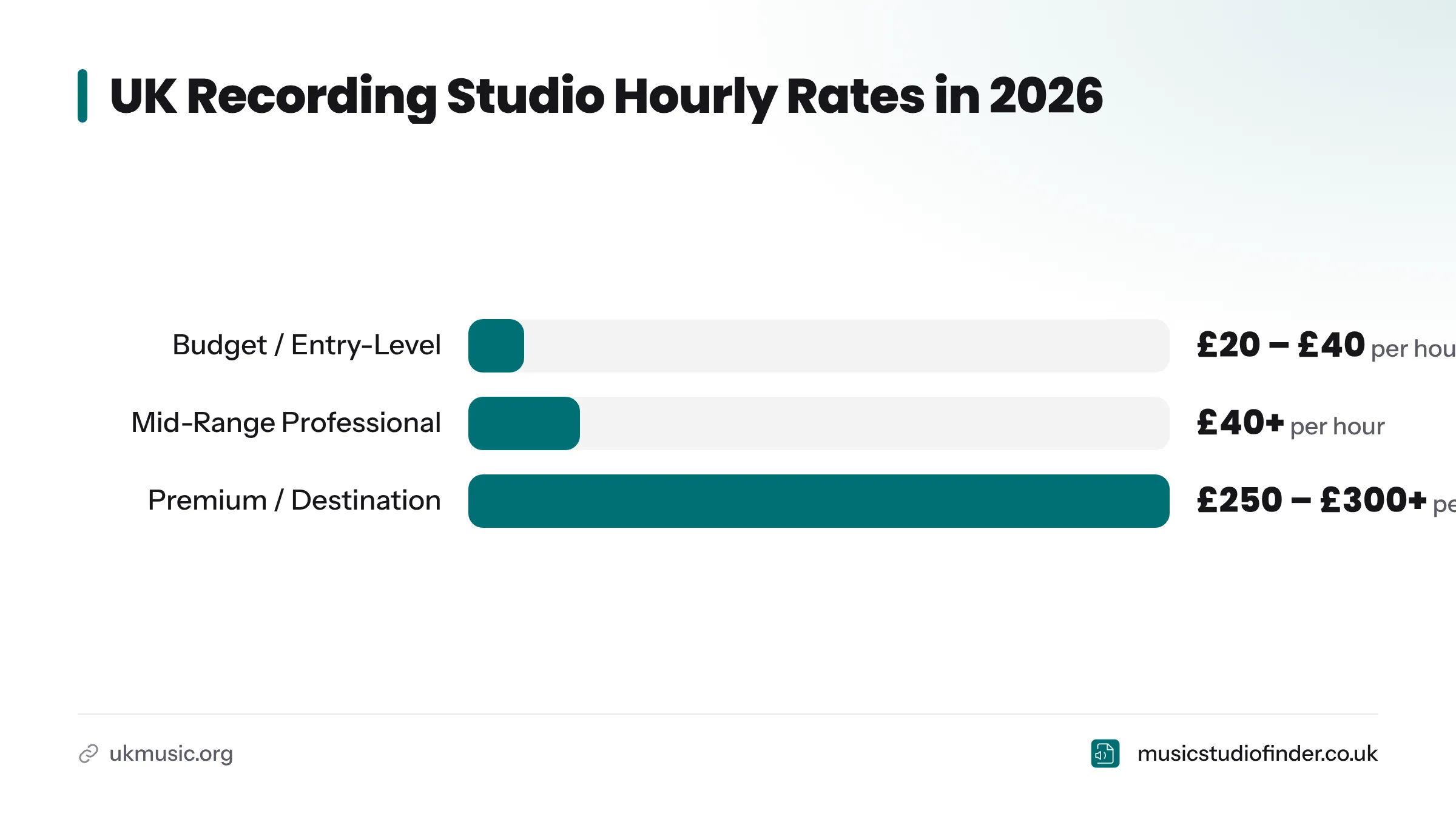
| Studio Tier | Typical Hourly Rate (2026) | What's Typically Included |
|---|---|---|
| Budget / Entry-Level | £20 - £40 per hour | Basic interface, limited mic selection, owner-engineer, no outboard gear |
| Mid-Range Professional | £40 - £80 per hour | Treated rooms, outboard preamps and compression, experienced engineer, rough mix |
| Upper Mid-Range | £80 - £130 per hour | Large-format desk or high-end interface rig, extensive mic locker, senior engineer, tracked stems delivery |
| Premium / Destination | £150 - £300+ per hour | World-class consoles (Neve, SSL), full outboard rack, award-winning engineers, residential option |
Hourly rates alone do not determine value. A mid-range studio with an experienced engineer who knows their room will frequently outperform a premium facility with a less capable engineer. For a full UK pricing breakdown with day rate and project rate comparisons, recording studio cost UK covers the 2026 market in detail.
What the UK Music Industry Considers Professional Standard
The Music Producers Guild UK (MPG) and the Musicians' Union (MU) both advocate for minimum standards of practice in professional recording contexts - including fair terms, accurate billing, and professional conduct. While neither body independently certifies studio facilities, their published guidelines on professional practice serve as useful benchmarks.
The AES publishes technical standards relevant to UK studios, including specifications for studio monitor calibration, noise floor measurement, and digital audio delivery - all of which professional UK facilities are expected to meet or exceed. Studios operating to international release standards (meeting streaming platform LUFS requirements, providing ISRC-compatible session documentation) are operating at a genuine professional level.
Professional Studio vs Home Studio: Which Do You Actually Need?
The honest answer depends entirely on what you are trying to achieve.
When a Professional Studio Is Worth the Investment
Book a professional studio when:
- You are recording a commercial release intended for radio, streaming, sync licensing, or label submission
- You are recording acoustic instruments - particularly drums, piano, strings, or brass - that need a live room and professional microphone placement
- You need a performance environment that separates you from the technical process, so you can focus entirely on playing
- Your project requires an engineer's ears and experience to be competitive with professional releases in your genre
- You need session files that will transfer cleanly to a mixing or mastering engineer elsewhere
For a full comparison across all scenarios, recording studio vs home studio lays out every relevant consideration without bias.
When a Home Setup Is Enough
A home setup is appropriate when:
- You are producing electronic music, hip-hop beats, or heavily processed genre work where the acoustic environment is less critical
- You are doing pre-production work - arranging, programming, demo building - to prepare for a professional tracking session
- You are recording vocals with a good interface and microphone in a treated corner of a room, as a secondary layer over professionally tracked instrumentation
- Budget constraints make a professional session impractical for a specific project phase
The gap between home studio and professional studio has narrowed in some respects - software has improved, and microphones available for under £500 capture excellent results. The acoustic environment and the engineer's expertise, though, remain largely out of reach of the home setup.
The Hybrid Approach: Track Professional, Finish Elsewhere
Many musicians get the best results by using a professional studio for tracking - capturing drums, live instruments, and lead vocals in a proper acoustic environment - and then completing production, editing, and mixing in a home or project studio, or with an independent mixing engineer. This approach gives you the acoustic quality of a professional tracking session at a fraction of the cost of booking the full production process at a premium studio.
Understanding which stages require a professional studio and which can be completed elsewhere is one of the most financially intelligent decisions a working musician can make. The recording vs mixing vs mastering guide explains each stage clearly.
Frequently Asked Questions
What makes a good recording studio?
A good recording studio combines five things: a properly treated acoustic environment with controlled RT60 and a low noise floor; a complete professional signal chain from calibrated microphones through quality preamps to accurate studio monitors; an experienced engineer who knows the room and can manage a session professionally; a structured workflow that includes pre-session consultation, clean take management, and reliable file delivery; and output quality that translates accurately to all playback systems. Remove any one of these and the result is a room that performs like an amateur setup regardless of the budget spent on individual items.
How much does a professional recording studio cost in the UK in 2026?
UK professional recording studio rates in 2026 range from approximately £40 per hour for a credible mid-range studio with an experienced engineer up to £250 to £300 or more per hour for a premium destination studio with world-class equipment and top-tier engineering staff. Budget studios offering basic recording facilities start from around £20 to £40 per hour. Day rates at mid-range professional studios typically run between £300 and £600 for an eight-hour session including engineer time.
How can I tell if a studio is truly professional before I book?
Ask for a portfolio of released recordings produced at the studio. Request a pre-booking visit to assess the acoustic treatment, equipment, and monitoring chain. Ask specific questions about the signal chain, microphone selection, and session workflow. Check whether a pre-session consultation is part of the booking process. Look for written confirmation, clear pricing, and a cancellation policy. Use the 20-Point Professional Studio Evaluation Checklist in this guide as a structured audit before committing.
What equipment should a professional recording studio have?
At a minimum: one or more professional large-diaphragm condenser microphones (such as a Neumann U87 or AKG C414), dedicated outboard microphone preamps, professional studio monitors in a calibrated control room, a dedicated headphone amplifier and cue mix system, a professional DAW operating at 24-bit depth and 96 kHz or higher, and a patchbay for signal routing. Beyond the minimum, a professional studio will stock dynamic and ribbon microphones, hardware compressors and equalisers, and a selection of outboard effects.
Is the engineer or the equipment more important in a professional studio?
The engineer is more important. A skilled, experienced engineer in a mid-range studio will consistently outperform an inexperienced engineer in a facility with a Neve console and a Neumann microphone collection. The engineer controls every decision in the signal chain - microphone selection, placement, gain structure, take management, and rough mix quality. Equipment matters and provides the platform, but the engineer determines what that platform produces. This is the consensus view among professionals in the audio engineering community.
What is the difference between a professional studio and a home studio?
A professional studio is purpose-built or purpose-converted for recording, with measured acoustic design, a complete calibrated signal chain, experienced engineering staff, structured session workflow, and consistent output quality. A home studio is typically a repurposed domestic space with improvised acoustic treatment, a consumer or prosumer audio interface, and the artist serving as their own engineer. The acoustic environment - the most difficult and expensive element to replicate - is the most significant practical difference between the two.
Do I need a professional studio if I record vocals only?
For a commercial vocal recording intended for release, yes. A professional studio offers acoustic isolation in a purpose-built vocal booth, professional microphone and preamp selection matched to your voice, and an experienced engineer to manage gain structure, take management, and delivery. If you are recording demos or reference tracks, a home vocal setup with a quality condenser microphone and basic acoustic treatment may be adequate. For release-quality work, the acoustic environment and engineering expertise of a professional studio make a measurable difference.
What should I look for when visiting a recording studio?
Start with the control room: sit in the listening position and switch the monitors on with a reference track you know well. Trust whether the monitoring feels accurate and revealing. Check the acoustic treatment for substance, not cosmetic foam. Ask the engineer to walk you through the signal chain from microphone to DAW. Visit the vocal booth and listen for background noise when the door is closed. Assess whether the session template is already built for your session type. And observe whether the engineer communicates clearly, confidently, and with specific knowledge of their own room.
Making Your Session Budget Work: Applying the 7 Pillars
The seven pillars - acoustic design, professional equipment, a complete signal chain, experienced engineering, structured workflow, a considered client environment, and release-quality output - are not a binary pass-or-fail checklist. They are a framework for understanding where a studio's strengths lie and where compromises exist.
The best studios understand all seven and have invested in them deliberately. Some are strong in acoustics but modest in outboard gear. Others have excellent engineers working in rooms that are good but not architecturally designed. Knowing the framework helps you evaluate honestly, ask the right questions, and make booking decisions that align with what your project actually needs.
Music Studio Finder lists verified studios across the UK, with enough detail to apply this framework before you pick up the phone. Whether you need a vocal booth session for a single, a full tracking day for an EP, or a week in a residential complex for an album, the right professional studio exists for your budget and your project.
Use the 20-Point Checklist. Ask the questions. Listen to the examples. And invest your session budget in a room that deserves it.
Sources
- Audio Engineering Society (AES) - Professional audio standards and technical documentation
- Music Producers Guild UK (MPG) - UK professional standards for producers and recording engineers
- UK Music - Annual Industry Reports - UK music industry market data and context
- Musicians' Union UK - Professional musician guidance and session standards
- Avid Pro Tools - Industry-standard DAW documentation and specifications
- Genelec Studio Monitors - Professional monitoring specifications and calibration standards
- ATC Loudspeakers - British professional monitor manufacturer specifications
- Universal Audio - Professional preamp, converter, and outboard gear specifications
- Antelope Audio - Digital clocking and conversion standards
- Augspurger Studio Monitors - Custom professional monitor systems
- AES Streaming Loudness Recommendation - LUFS standards for streaming platform delivery