A recording engineer is the person behind the glass who captures, manages, and shapes every sound you make in the studio. Their core duties cover microphone selection and placement, gain staging, signal chain management, DAW operation, multitrack tracking, overdubs, headphone mix management, and session file organisation - all without getting in the way of the music.
If you have ever stood in a live room wondering what that person is actually doing, this guide answers it fully. Whether you are booking your first session or your fiftieth, understanding the recording engineer role will help you get more from every hour you pay for.
The Recording Engineer Role in Plain English
A recording engineer - sometimes called a tracking engineer or studio engineer - is the technical specialist responsible for capturing audio performances to the highest possible quality during a recording session.
That one sentence hides a job that demands deep technical knowledge, fast hands, sharp ears, and the interpersonal patience of a very calm therapist. Let me unpack it.
The Unsung Hero of Your Session
Think about the last time you heard a recording where the vocal sat perfectly in the room, the kick drum had weight without being muddy, and every instrument felt placed with intention. That result did not happen by accident. A recording engineer made hundreds of small decisions before a single note was played.
Before you arrived at the studio, they selected which microphone to use on your instrument and positioned it precisely. They set the gain on the preamp, routed the signal through the console or interface, built your headphone mix so you could perform comfortably, and configured the session in the Digital Audio Workstation (DAW) with every track labelled, routed, and ready. The best engineers make all of this invisible - which is exactly why their work is so easy to overlook.
Recording Engineer Responsibilities: What the Job Actually Covers
Here are the primary studio engineer duties in any professional session:
- Setting up and positioning microphones for each instrument and vocalist
- Managing gain staging and the signal chain from source to DAW
- Operating the recording console and DAW throughout the session
- Capturing raw performances across multiple tracks (tracking)
- Running overdubs and punch-in recordings to fix or enhance specific moments
- Building and adjusting the headphone mix for performers
- Organising session files, naming tracks, and archiving takes
- Communicating clearly with the artist, producer, and session musicians throughout
Let's break each of these down.
Microphone Selection and Placement
Microphone choice is one of the most consequential decisions made before a single note is played. A large-diaphragm condenser like a Neumann U87 responds very differently to a voice than a dynamic microphone like a Shure SM7B or a ribbon microphone from Royer. The music recording engineer selects the right tool for the source, the room, and the sound the artist is chasing.
Placement is equally consequential. Moving a microphone two centimetres changes the tone, the proximity effect (the low-frequency boost that occurs when a directional microphone is placed close to a sound source), and the amount of room sound captured. On a drum kit, a professional engineer might deploy eight or more microphones simultaneously - a kick mic inside the shell, snare top and bottom, hat and overhead condensers, and room mics placed metres away to capture natural ambience. Every position is deliberate.
What this means for you: your engineer's microphone decisions directly shape how your recording sounds before any processing happens. If you have preferences - you have heard that a specific microphone works well on your voice, for example - say so. A good engineer welcomes that conversation.
Gain Staging and Signal Chain Management
Gain staging is the process of setting signal levels at each point in the signal chain - from the microphone capsule through the preamp, into the console or audio interface, and finally into the DAW - so that the audio is strong enough to have a healthy signal-to-noise ratio but never so loud that it clips. In a 24-bit digital recording environment, engineers typically aim to record peaks around -18 dBFS to -12 dBFS, leaving headroom for dynamic transients without risking distortion.
The signal chain is the sequence of hardware and software that audio passes through on its way from microphone to recorded file. A typical chain runs: microphone → preamp (such as a Neve 1073 or Universal Audio 610) → compressor → equaliser → analogue-to-digital converter → DAW track. The recording engineer makes decisions at each of these stages, and each decision affects the final sound.
What this means for you: a weak gain structure cannot be fully repaired in mixing. Getting it right at source is the engineer's job, and a competent one will do exactly that.
Operating the DAW and Recording Console
Most professional UK studios run sessions on industry-standard DAWs. Pro Tools (from Avid) remains the dominant platform in commercial studios, though Logic Pro (Apple), Ableton Live, and Cubase (Steinberg) are all widely used depending on the studio and genre. The DAW engineer operates the session in real time - creating tracks, setting routing, arming record-ready channels, managing takes, and monitoring levels throughout.
Many studios also run a large-format console alongside the DAW. Consoles from SSL (Solid State Logic), Neve, and API handle signal routing, monitoring, and sometimes analogue summing. The engineer uses the console to blend your headphone mix, route signals to outboard gear, and manage control room monitoring levels.
Tracking: Capturing Raw Performances
Tracking is the process of recording individual or simultaneous performances to separate tracks in the DAW. A band might track the rhythm section - drums, bass, and rhythm guitar - all playing together to capture a natural, live feel. Alternatively, an artist might build a song layer by layer, starting with a guide vocal over a backing track.
During this phase, the tracking engineer watches levels in real time, flags technical problems (a cable rattling, a microphone clipping, headphone bleed), calls takes, and keeps the session moving without breaking the creative momentum in the room. This is where interpersonal skill becomes just as important as technical knowledge.
Overdubbing and Punch-In Recording
Once foundational tracks are captured, overdubbing begins. This is the process of recording additional parts - lead vocals, harmonies, guitar solos, string arrangements - on top of the existing session. The performer listens to previously recorded tracks through headphones and plays or sings in time.
Punch-in recording is a specific technique where the engineer drops the DAW into record mode at a precise moment mid-track to replace a specific phrase or note, then drops out of record mode immediately after. This allows a vocalist to fix a single word in an otherwise perfect take without re-recording the entire performance. The timing precision required for a clean punch-in - entering and exiting record within a fraction of a second - takes years to develop reliably.
Managing the Headphone Mix
The headphone mix - also called the foldback mix or monitor mix - is what the performer hears while recording. It is entirely separate from what the engineer and producer hear through the studio monitors.
A good headphone mix is not a luxury. A singer performing to a mix that is too harsh, too reverb-heavy, or out of balance with their own voice will perform worse. The engineer builds and adjusts the headphone mix throughout the session, often managing multiple separate mixes for different performers simultaneously using a headphone amplifier system such as a Focusrite or Hear Technologies unit.
Organising Session Files and Archiving Takes
At the end of a session, the recording engineer organises the session files: naming tracks clearly, colour-coding regions, consolidating audio files, and creating an archive that the mixing engineer - who may be a completely different person - can open and immediately understand. This includes labelling every take, marking the best takes ("comp" takes), and exporting stems if required.
A disorganised session handoff creates serious problems downstream. A professional engineer treats file management as seriously as microphone placement.
Communicating With the Artist
This is the responsibility that separates a good engineer from a great one. Recording sessions are high-pressure environments. Artists can feel self-conscious, frustrated by repeated takes, or uncertain about whether what they are hearing through headphones actually sounds good. The engineer acts as the calm, technically grounded voice in the room - giving confident feedback, flagging genuine problems without alarming the artist, and knowing when to say "that was the one" with conviction.
What a Recording Engineer Does Step by Step
Here is what to expect from your engineer at each stage of your session.
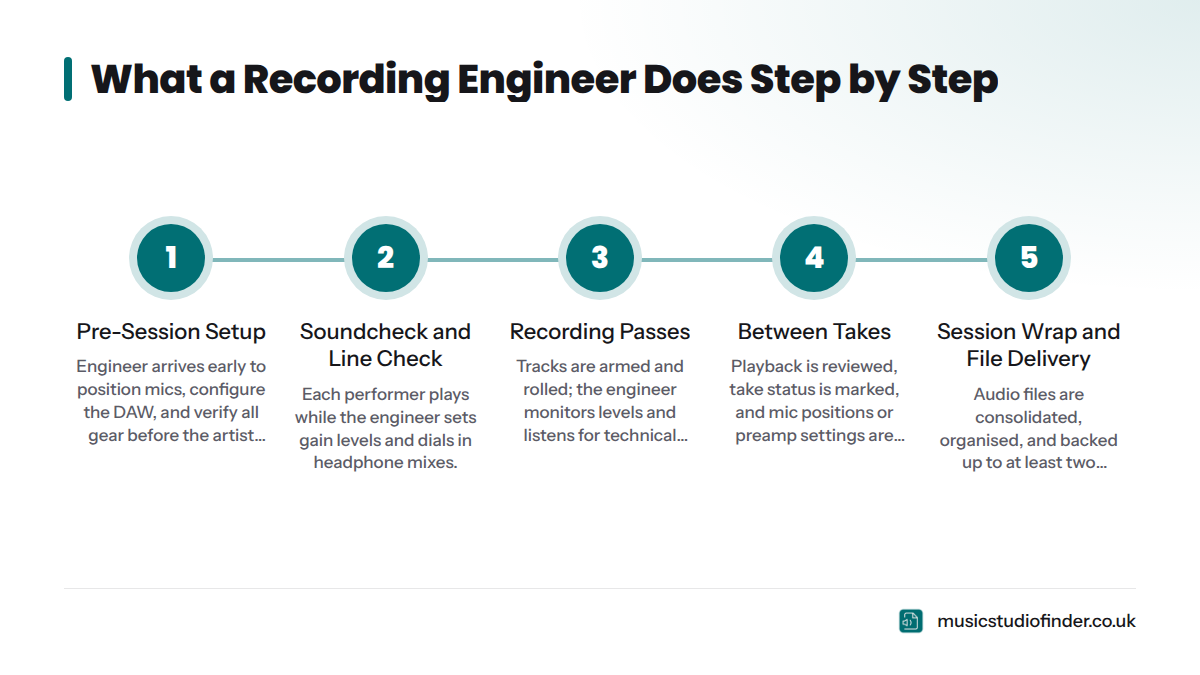
1. Pre-Session Setup (Before You Arrive) The engineer arrives before the session start time. They set up microphone stands, choose mics based on your instrumentation, route the signal chain, check for technical faults, configure the DAW session with tracks pre-named and routed, and verify that outboard gear is working correctly. By the time you walk in, the studio should be ready to record.
2. Soundcheck and Line Check Once you arrive and set up your instruments, the engineer runs a line check - asking each performer to play or sing while they set gain levels, check for signal at every point in the chain, and listen for any buzz, hum, or interference. This is followed by a soundcheck to fine-tune microphone positions and dial in each performer's headphone mix.
3. The Recording Passes With levels set and everyone comfortable, recording begins. The engineer arms the relevant tracks, calls the take number, and rolls record. They monitor levels in real time, watch for technical problems, and listen critically through the studio monitors - not for a creative opinion on the performance, but for anything technically wrong: clipping, noise, phase issues, or microphone bleed.
4. Between Takes Between takes, the engineer plays back the recording so the artist can hear it, marks the take status (keeper, maybe, or scrap), adjusts the headphone mix if requested, and resets for the next pass. They may also adjust microphone positions or dial in different preamp or compressor settings if the sound is not working.
5. Session Wrap and File Delivery At the end of the session, the engineer consolidates all audio files, organises the session, backs up to at least two locations (hard drive and cloud or a second drive), and prepares files for delivery to the mixing engineer or the artist. They may export individual stems or a rough mix for reference. A professional engineer never leaves a session without a confirmed backup.
This practical walkthrough connects directly to what you should know before arriving - the guide on how to prepare for your first studio session covers the musician's side of this preparation in detail.
Recording Engineer vs. Producer vs. Mixing Engineer vs. Mastering Engineer
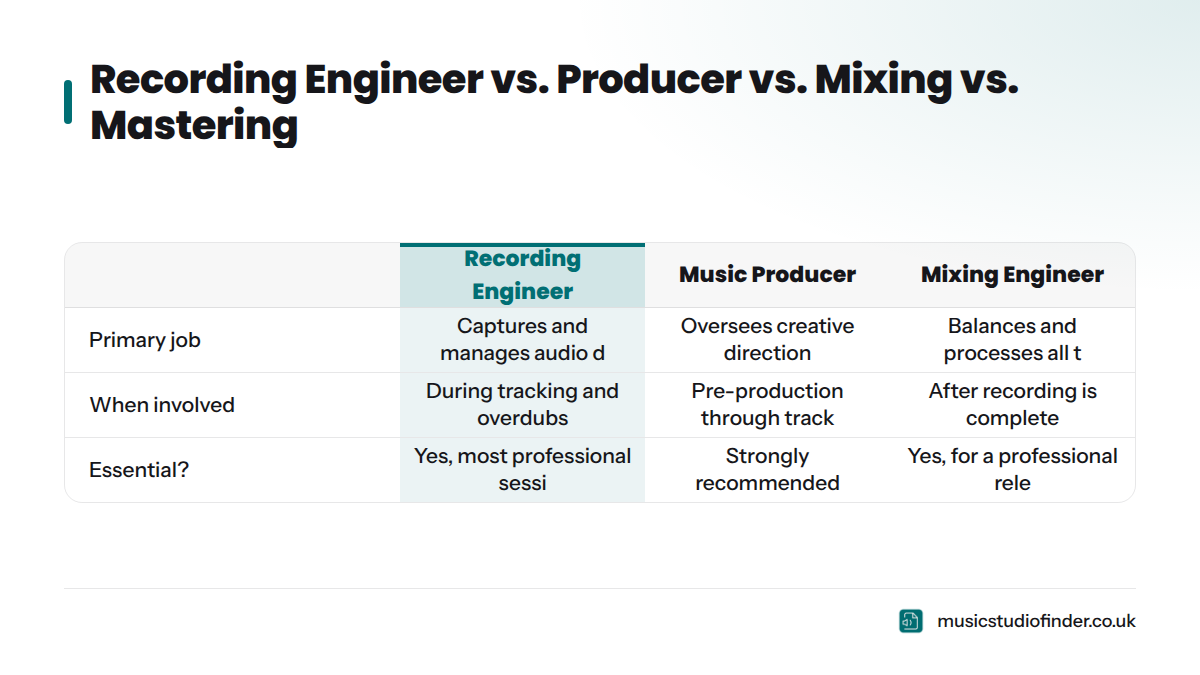
This is the question every musician asks, and the answer matters before you book. Here is a direct comparison:
| Role | Primary Job | When They're Involved | Who Hires Them | Do You Need One? |
|---|---|---|---|---|
| Recording Engineer | Captures and manages audio during the recording session | During tracking and overdubs | Artist or studio | Yes - in most professional sessions |
| Music Producer | Oversees the creative direction - arrangement, performance, sound palette | From pre-production through tracking | Artist or label | Strongly recommended, not always required |
| Mixing Engineer | Balances, processes, and arranges all recorded tracks into a stereo mix | After recording is complete | Artist, producer, or label | Yes - for a professional release |
| Mastering Engineer | Prepares the final stereo mix for distribution - level, EQ, limiting, and format delivery | After mixing is approved | Artist, producer, or label | Yes - essential for streaming and physical release |
These four roles can be held by four different people, or collapsed into one or two. In many UK independent sessions, the recording engineer and the mixing engineer are the same person. A producer-engineer - someone who handles both creative direction and technical capture - is also common, particularly in hip-hop, electronic music, and singer-songwriter contexts.
The key distinction between a recording engineer and a producer: the engineer's primary loyalty is to the audio signal. The producer's primary loyalty is to the song. Both can have opinions about a performance, but their roles are fundamentally different. For a deeper look at sessions without a dedicated producer, read how to book a recording studio without a producer.
A tracking engineer is simply another name for a recording engineer - someone whose specific job is the tracking phase of a session. The terms are interchangeable in most UK studio contexts.
The Tools and Equipment a Recording Engineer Uses
DAWs: The Engineer's Primary Workspace
Pro Tools is the industry standard in commercial UK studios, favoured for its reliability, its integration with hardware controllers, and the fact that virtually every mixing engineer in the world can open a Pro Tools session. Logic Pro is popular in smaller studios and for sessions with significant MIDI production. Ableton Live dominates in electronic music and live performance contexts. Cubase remains strong in post-production and classical music recording.
Mixing Consoles and Preamps
Large-format consoles from SSL, Neve, and API are the prestige hardware of professional recording. An SSL 4000 or 9000 series console provides dedicated mic preamps, EQ, compression, and routing for every channel simultaneously - giving the engineer hands-on, real-time control that no mouse-and-keyboard workflow fully replicates. In smaller UK studios, outboard preamps are used alongside digital interfaces. Classic units from Universal Audio (the UA 610), Neve (the 1073), and API (the 512c) are widely used and highly regarded.
Microphones and Outboard Gear
A professional studio's microphone locker contains a range of types: large-diaphragm condensers (Neumann U87, AKG C414), dynamic microphones (Shure SM57, SM7B), ribbon microphones (Royer R-121), and small-diaphragm condensers for overheads and acoustic instruments (Rode NT5, Neumann KM184). Outboard gear - hardware compressors, equalisers, and effects units that exist outside the DAW - adds sonic character that plugin emulations can approach but rarely fully replicate. Classic outboard units from Universal Audio, Empirical Labs, and Neve remain in daily use in UK studios.
Studio Monitors and Headphone Amplifiers
The studio monitors mounted in the control room are how the engineer evaluates the sound they are capturing. Professional monitoring systems from Genelec, Focal, and Yamaha provide a flat, accurate frequency response so that what the engineer hears reflects reality. Subwoofers extend the low-frequency monitoring range for bass-heavy genres. Headphone amplifier units from Focusrite, Presonus, or Hear Technologies distribute individual mixes to performers in the live room.
Recording Engineer Skills: What Makes Someone Great at This Job
Technical Proficiency
The core technical skills a music recording engineer must have:
- Deep knowledge of signal flow and routing - understanding exactly where audio goes at each point in the chain
- Gain staging discipline - setting levels correctly from source to DAW every time
- Microphone technique - knowing which microphone to use, where to place it, and why
- DAW expertise - fast, confident operation of Pro Tools, Logic Pro, or the relevant platform
- Knowledge of analogue hardware - preamps, compressors, equalisers, and how to use them musically
- The ability to identify and solve technical problems quickly (ground loops, phase cancellation, clipping, RF interference)
- Understanding of acoustics - knowing how room reflections affect what the microphone captures
- Experience with multitrack editing, comping, and session file management
Active Listening and Communication
A recording engineer listens on two levels simultaneously: technically (is the signal clean, are the levels right, is there any noise?) and musically (is this performance worth keeping?). The best engineers develop an instinct for when a take is technically perfect but emotionally flat - and they know how to say so without crushing the artist's confidence.
Communication is central to the job. The engineer is the conduit between the control room and the live room. They need to relay feedback clearly, manage expectations about what is achievable in the session time available, and keep the atmosphere positive when things are not working.
Problem-Solving Under Pressure
Things go wrong in recording sessions. A cable develops an intermittent fault three hours in. A singer's headphone mix cuts out mid-take. A plugin crashes and the session freezes. The engineer is expected to diagnose and fix these problems quickly - ideally without the artist in the live room even knowing something went wrong. Staying calm under pressure is not a soft skill. It is a professional requirement.
Genre Knowledge and Musical Sensibility
A recording engineer working on a classical string quartet session needs a different skill set from one recording a punk band or a grime MC. Classical recording favours minimal processing, precise stereo placement, and a deep understanding of acoustic space and ensemble dynamics. Rock and metal recording involves close-miking techniques, phase relationships between multiple microphones on the same instrument, and decisions about room sound. Hip-hop and R&B production often centres on vocal capture and integration with producer-generated beats. A great engineer understands these distinctions and adapts accordingly.
The recording engineer's role also shifts depending on context. In a location recording scenario - capturing a live orchestra in a concert hall, for example - the job involves entirely different microphone arrays, different monitoring challenges, and no console in the traditional sense. The core principles remain the same; the application changes significantly.
How to Get the Most From Your Recording Engineer
What to Discuss Before the Session
Book a brief call or exchange a few messages with your engineer before the session date. Tell them:
- What instruments and how many performers will be present
- What genre or sonic reference you are aiming for
- Whether you are tracking live or building the song layer by layer
- Whether you have any specific microphone preferences or have been told you suit a particular preamp character
- What format you need the files delivered in (stems, full session, rough mix)
This pre-session conversation allows the engineer to prepare properly - ordering backline, setting up the right microphone configuration, and flagging any logistical issues before they cost you studio time. The guide on what to bring to a recording studio session covers everything you need to have ready on the day.
How to Communicate What You Want
Be specific about the sound you are after. Bring reference tracks - recordings that capture the tone, feel, or production style you want to achieve. If you want your vocal to sound intimate and close, say that. If you want the drums to sound huge and roomy, name an album where you love the drum sound.
What to avoid: vague adjectives without reference points ("I want it to sound warm"), requests that are actually mixing decisions rather than recording decisions ("I want more reverb on my voice"), and contradictory direction given mid-session that changes the technical setup the engineer has already calibrated.
When to Trust Their Judgement
Here is the honest truth: your recording engineer has almost certainly encountered every mistake you are about to make in the live room, dozens of times, across dozens of sessions. When they suggest a different microphone position, recommend a different take structure, or flag that a particular performance has a technical problem you cannot hear through your headphones - trust them.
That said, you are the artist. Your vision for your music is valid. A professional engineer holds both things at once: their technical authority and your creative autonomy. The best sessions happen when both sides respect that boundary.
For a full picture of what happens across a professional session, the professional recording session guide walks through the full experience from the artist's perspective.
Do UK Recording Studios Include a Recording Engineer?
Not always - and this is one of the most common points of confusion when musicians book studio time for the first time.
Some UK studios include a house engineer as part of the room hire rate. Others charge separately for engineering, either as an hourly add-on or as a day rate. Self-op studios - sometimes called "dry hire" rooms - provide the space and equipment only, with no engineer included. In these spaces, the artist or producer operates the session themselves.
Whether an engineer is included, and what their experience level is, makes a significant difference to the quality of your session and to how long it takes to record a song. Always ask directly before you book. The full breakdown of what is and is not included in UK studio hire is covered in what's included when you hire a recording studio.
Music Studio Finder lists studios across the UK with transparent information about what each room includes - making it easy to filter by whether engineering is provided. If you want to see an example of a professional engineer-producer in a real UK setting, Rob Hobson in York operates as both recording engineer and mix/mastering engineer, which is a common arrangement in regional UK studios.
How Much Do Recording Engineers Earn in the UK?
According to the National Careers Service, sound and recording engineers in the UK typically earn between £18,000 and £45,000 per year depending on experience, location, and specialism. Entry-level assistants and junior engineers generally fall toward the lower end of that range, while senior recording engineers at established commercial studios - particularly in London - can earn £40,000 to £60,000 or more, especially when freelance rates and project-based income are factored in.
Freelance recording engineers in the UK often charge day rates rather than drawing salaries. A day rate for a professional recording engineer in a London commercial studio typically falls between £300 and £600 as of 2026, though regional rates outside London are often lower - £150 to £350 per day is more common in cities like Manchester, Bristol, Glasgow, and Leeds. Rates vary with experience, reputation, and the type of project.
Many recording engineers also supplement their income through related roles: mixing, mastering, music production, podcast production, and broadcast audio work. The skill set transfers broadly across audio professions. See the recording studio cost UK guide for a full breakdown of what studio time costs and how engineer fees fit into the picture.
Is Recording Engineering a Good Career in 2026?
My honest opinion: yes, with caveats.
The demand for audio content has never been higher. Streaming platforms, podcasts, audiobooks, YouTube, TikTok audio, video game soundtracks, advertising - all of it needs recorded and produced audio. The Music Producers Guild UK represents a thriving community of working engineers and producers, and the creative audio sector remains one of the more resilient parts of the UK creative economy.
The honest caveat: the traditional model of a salaried in-house engineer at a major commercial studio is increasingly rare. The consolidation of recording studios, the rise of high-quality home studios, and the emergence of remote session recording - where musicians track at home and send files to an engineer working remotely - have all reshaped the industry. Most successful recording engineers in 2026 are freelancers who maintain relationships with multiple studios and clients, combining recording work with mixing, mastering, or production.
The Audio Engineering Society (AES) - the primary international professional body for audio engineers - publishes resources and research relevant to anyone considering this career path. Membership provides access to technical publications, industry networking, and professional credibility.
For musicians, this means the recording engineer you work with is increasingly likely to be an experienced freelancer brought in specifically for your session, rather than a full-time staff member of the studio. That is not a problem - many freelancers are excellent - but it is worth asking the studio about their engineer's experience and credits before you book.
What Education or Training Do You Need?
There is no single required qualification to become a recording engineer in the UK. The industry values demonstrated skill, practical experience, and professional reputation above academic credentials. That said, training pathways matter - particularly at the start of a career.
Formal Degree Routes
Several UK institutions offer respected degree programmes in audio engineering and music production:
- BIMM Institute operates across London, Bristol, Brighton, and other UK cities, offering undergraduate and postgraduate programmes in music production and audio engineering
- SAE Institute UK has campuses in London, Liverpool, Glasgow, and other cities, specialising in audio engineering and production degrees with strong industry links
- Point Blank Music School in London offers degree and diploma courses in music production and sound engineering, with an emphasis on contemporary electronic music
- University programmes in music technology and sound recording are available at institutions including the University of Westminster, Leeds Beckett University, and the University of the West of England
Apprenticeships and Vocational Training
ScreenSkills - the UK's screen industry skills body - supports training and apprenticeship programmes in broadcast audio and production sound that can provide a route into recording engineering via film, TV, and radio. BTEC qualifications in music technology are available at further education colleges across the UK and provide practical grounding without committing to a full degree programme.
The Self-Taught and Assisting Route
Many of the most respected recording engineers working in the UK today are largely self-taught, having started as studio assistants or tape ops - the entry-level studio role that involves setting up sessions, patching cables, and absorbing everything by proximity to more experienced engineers. This path is slower but deeply practical. Studios often hire assistants informally, and word-of-mouth referrals from music schools, local studios, and professional networks are how many people break in.
Building a home studio to practise microphone technique, DAW operation, and signal chain management is now accessible at a relatively low cost. The comparison between recording studio vs home studio is worth reading if you are considering how to build practical skills independently.
Frequently Asked Questions About Recording Engineers
What is the difference between a recording engineer and an audio engineer? "Audio engineer" is the broader category - it includes recording engineers, mixing engineers, mastering engineers, live sound engineers, and broadcast engineers. "Recording engineer" is a specific subset: someone whose primary work is capturing performances in a studio recording context. All recording engineers are audio engineers; not all audio engineers are recording engineers.
What does a recording engineer do during a session? They set up and position microphones, manage gain staging and the signal chain, operate the DAW and console, capture takes across multiple tracks, build and adjust the headphone mix for performers, run overdubs and punch-ins, organise session files between takes, and communicate with the artist and producer throughout. See the step-by-step session workflow section above for a full chronological breakdown.
Do I need a recording engineer if I'm already working with a producer? Not necessarily - but it depends on the producer. Some producers also engineer their own sessions. Others focus entirely on creative direction and rely on a dedicated recording engineer to handle the technical capture. In a professional session, having a dedicated engineer frees the producer to focus on performance and arrangement without splitting attention with the demands of the console.
What software does a recording engineer use? Pro Tools is the most widely used DAW in professional UK studios. Logic Pro, Ableton Live, and Cubase are also common. Many engineers also work with software plugins - compressors, equalisers, and reverb units from companies like Universal Audio, Waves, and FabFilter - within the DAW session.
How much does a recording engineer charge in the UK? Day rates vary widely. Freelance recording engineers in London typically charge £300 to £600 per day in 2026. Outside London, expect £150 to £350 per day for experienced professionals. Some studios include an engineer in the room hire rate; others charge separately. Always clarify this before booking.
Can a recording engineer help improve my sound? Yes - significantly. The right microphone placement, preamp choice, and gain structure alone can transform a recording before any mixing or processing takes place. A skilled engineer can also make real-time adjustments during tracking - using outboard compression or EQ to shape the sound as it is captured - which can save substantial time in the mix.
What's the difference between a recording engineer and a mixing engineer? A recording engineer captures the audio during the session. A mixing engineer receives the recorded session files and balances, processes, and arranges all the tracks into a finished stereo mix. These can be the same person or two completely different professionals. In major label productions, they are typically different people.
How do I find a good recording engineer in the UK? Ask the studio you are booking whether a house engineer is included, and request to see their credits or hear examples of their work. Alternatively, search Music Studio Finder to find studios and engineer-producers across the UK with transparent listings. Personal recommendation from other musicians in your network is also highly reliable.
What qualifications does a recording engineer need? No formal qualification is legally required to work as a recording engineer in the UK. Degrees from institutions like BIMM, SAE, and Point Blank, or practical experience gained through studio assisting, are the most common routes into the profession. Professional membership of the Audio Engineering Society (AES) or the Music Producers Guild UK signals credibility and access to ongoing professional development.
Is recording engineering the same as sound engineering? The terms are often used interchangeably, but "sound engineering" can also refer to live sound - operating the PA and mixing desk at concerts, theatre productions, and events. Recording engineering specifically refers to the studio context. The skills overlap, but the working environment, the equipment, and the priorities are quite different.
Ready to Book a Studio With an Engineer in the UK?
Finding the right studio means finding one where the room, the equipment, and the engineer all match what your music needs. Before you book, it is worth understanding whether recording studios provide an audio engineer as part of the rate - because that one detail changes the cost, the workflow, and the preparation required significantly.
Music Studio Finder makes this straightforward. The platform lists professional recording studios across the UK - from London to Edinburgh, Manchester to Belfast - with clear information about what each room includes, who the engineer is, and how to book. Use it to choose the best recording studio near you and go into your session knowing exactly who is behind the glass and what they are there to do.
Sources
- Sound Engineer Job Profile - National Careers Service
- Audio Engineering Society - aes.org
- Music Producers Guild UK - mpg.org.uk
- ScreenSkills - Screen Industry Skills Body UK
- BIMM Institute - Music Production and Audio Engineering Courses
- SAE Institute UK - Audio Engineering Degrees
- Point Blank Music School - Music Production and Sound Engineering
- Digital Audio Workstation - Wikipedia
- Pro Tools - Avid Technology