
Spend enough time talking to musicians in the UK and the same question keeps coming up: is booking a live-in recording studio actually worth it, or is it a romantic idea that burns through a budget faster than a week of studio catering?
The honest answer is that it depends entirely on who you are and what you are making. A band tracking their debut album together will get something from a residential session that no amount of home recording can replicate. A solo singer-songwriter laying down a two-track demo almost certainly will not. This guide gives you the full picture - real UK residential recording studio costs, genuine drawbacks, a structured comparison of your alternatives, and a practical checklist so you can make the call with confidence.
Before we get into the numbers, it helps to get the definition right. If you want a broader grounding in how professional studios work, the understanding recording studios guide on Music Studio Finder covers the fundamentals well.
What a Residential Recording Studio Actually Is
A residential recording studio is a professional recording facility that includes on-site accommodation, allowing artists, bands, and producers to live and work in the same location for the duration of a project. Unlike standard commercial studios booked by the hour or day, residential studios are typically hired for multiple days or weeks, offering an immersive, distraction-free creative environment.
Think of it as a recording studio crossed with a private retreat: bedrooms, communal spaces, meals, and a world-class control room all under one roof - or at least on the same grounds. The goal is to remove every logistical barrier between inspiration and tape.
How Residential Studios Differ from Standard Commercial Studios
A standard commercial studio - the kind you book in London, Manchester, or Bristol by the session - charges a day rate or hourly rate. You arrive, you record, you leave. The engineer wraps up, the next client comes in, and the room gets reset. That model works well for focused, time-efficient projects. It does not work well when a band needs to argue for three hours about a chorus arrangement, sleep on it, and come back the next morning with fresh ears.
Residential studios charge a residential rate that bundles accommodation, meals, and sometimes a house engineer into one fee. The room is yours for the block. For a full breakdown of the different studio formats available in the UK, Music Studio Finder's studio types guide is worth reading alongside this one.
How Residential Studios Differ from Home Studios
A home studio is a recording setup that an artist builds and owns - typically in a spare bedroom, a converted garage, or a purpose-built outbuilding. The Berklee College of Music's home studio guide gives a thorough breakdown of what a proper home setup requires in terms of gear, acoustic treatment, and room design.
The fundamental difference is the acoustic environment and the separation from daily life. A home studio, however well-treated, sits inside a musician's existing domestic routines: deliveries arrive, family members knock on the door, the broadband goes down, and the acoustic properties of a converted bedroom are rarely a match for a purpose-designed live room with proper isolation. A residential recording studio removes all of that, replacing it with a space built specifically for recording - and nothing else.
What Facilities and Amenities to Expect
Residential studios vary considerably in what they offer, but a well-established facility will typically include:
- A professional control room with a high-grade mixing console (often an SSL or Neve desk)
- One or more live rooms with acoustic treatment and variable room characteristics
- At least one isolation booth or vocal booth
- A selection of outboard gear, microphones, and instrument hire
- DAW setups running Pro Tools, Logic Pro, or both
- Bedrooms for the full band or production team, often with en-suite or shared bathrooms
- Communal kitchen, dining room, and lounge spaces
- Outdoor grounds for breaks and informal writing sessions
- Meals provided (full board at higher-end facilities, self-catering at budget options)
Whether the facility includes a resident audio engineer or expects you to bring your own is one of the most important questions to ask before booking. You can read more about what recording studios provide in terms of engineering support to understand what to expect.
The Case For Residential Recording Studios
Uninterrupted Creative Flow
Recording in a day-rate studio puts you in a permanent race against the clock. Every hour costs money, and that financial pressure has a subtle but real effect on creative decision-making. Musicians play it safe, skip experiments, and rush overdubs that deserved more time. At a residential studio, the clock still ticks - but it ticks across days and weeks rather than hours.
The psychological shift that comes from knowing you will wake up in the same building where your instruments are set up is real. Late-night sessions that catch fire can run until 3am without anyone worrying about taxi money home. An idea that surfaces over breakfast can be on tape by mid-morning. That kind of momentum compounds across a multi-day stay in a way that a series of disconnected day sessions simply cannot match.
Natural Collaboration Between Artists and Engineers
The producer-artist relationship deepens considerably when both parties share meals, morning coffee, and evening conversations. John Storyk, the studio architect credited with designing Electric Lady Studios and over 4,500 other facilities worldwide, has spoken extensively about how the physical design of a studio shapes the creative relationships within it. In a residential context, that design philosophy extends beyond the control room into the communal spaces where some of the best creative decisions actually get made.
Engineers who live in the facility for the duration of a project develop a much deeper understanding of a band's sound, working pace, and creative vocabulary. That intimacy produces better recordings.
Privacy, Seclusion, and Freedom to Experiment
In a standard day-rate studio, there is often an awareness of being observed - other clients in the building, a receptionist at the front desk, the general buzz of a commercial operation. Residential studios, particularly those in rural or secluded settings, strip that away entirely. When no one outside your team is listening, musicians take bigger risks. They try the daft idea, play the wrong chord on purpose, record twenty takes of the same vocal until they find the one that raises the hairs on their arms.
That freedom to fail productively is one of the most commercially undervalued aspects of the live-in recording studio experience.
Iconic Albums That Came From Residential Sessions
The history of recorded music includes a long list of landmark albums that would not exist in the same form without the residential studio model.
Oasis and Rockfield Studio, Wales: Rockfield Studio, founded in 1963 and widely regarded as the UK's oldest residential recording facility, has hosted Queen (Bohemian Rhapsody was recorded and mixed there), Oasis, and dozens of other acts whose careers were defined partly by the immersive environment it provided.
Peter Gabriel and Real World Studios: Real World Studios in Box, Wiltshire, built by Peter Gabriel in 1987, has become one of the UK's most celebrated residential recording environments - a working studio sitting within a converted mill complex with accommodation, gardens, and a genuinely extraordinary acoustic space.
Fleetwood Mac - Rumours (1977): Tracked partly at Record Plant in Sausalito, California, and at various residential-style facilities, Rumours became one of the best-selling albums of all time. It is consistently cited as a product of extended, immersive recording sessions that a day-rate environment could not have sustained.
Black Sabbath, Robert Plant, and others at Rockfield: The facility's residential character is credited by many artists with producing recordings that feel lived-in and emotionally complete in a way that rushed studio sessions rarely achieve.
Wellbeing as a Creative Infrastructure Decision
This angle is almost entirely absent from the existing conversation about residential studios, and it deserves more attention. Sustained creative output is physically and mentally demanding. A week of intensive recording sessions - with early mornings, late nights, and the emotional vulnerability that real artistic work requires - takes a toll on every member of a band or production team.
A recording studio retreat that provides good food, comfortable sleeping arrangements, outdoor space, and a clear separation between working time and rest time is not a luxury. Burnout in the middle of a recording project is one of the most common reasons albums stall, sessions turn fractious, and final results feel unfinished. The on-site wellbeing provisions that good residential studios build into their model are a direct investment in the quality of the music.
The Case Against Residential Recording Studios
The Cost Reality
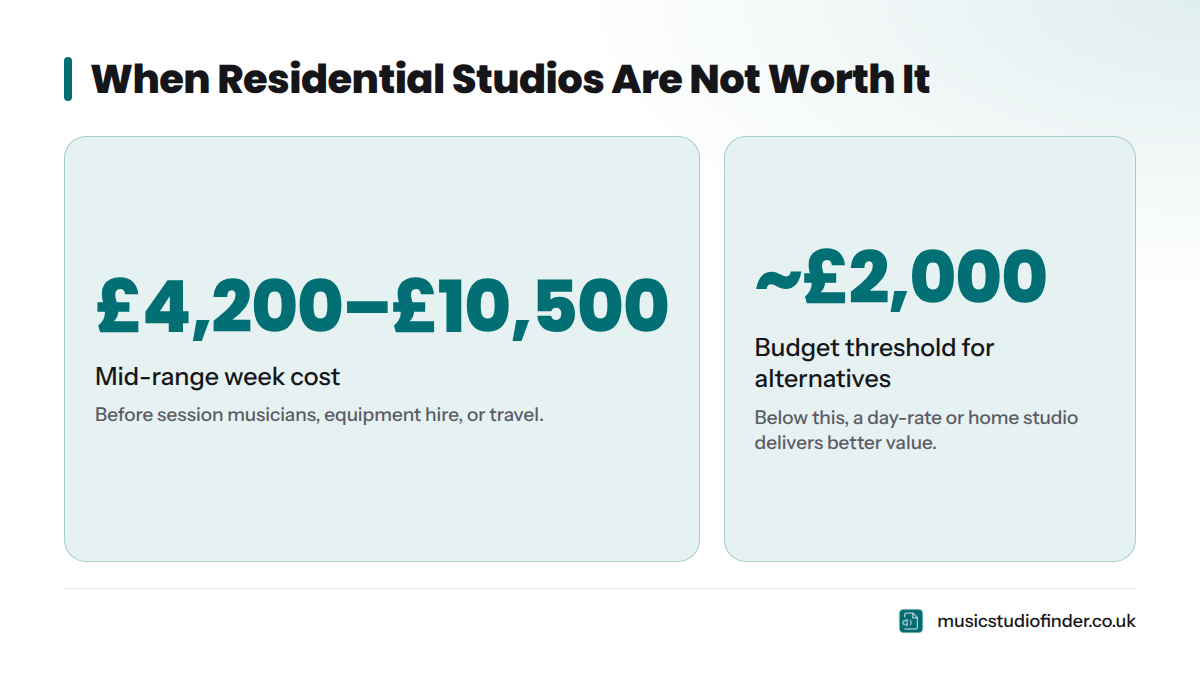
Let's be direct: residential studios are expensive. A week at a mid-range UK residential facility can cost between £4,200 and £10,500 before you factor in session musicians, additional equipment hire, or travel. For an emerging artist or a band that has not yet recouped any investment, that is a significant financial commitment.
The question is not whether residential recording studio costs are high - they are. The question is whether that cost produces a proportionate return in creative output, recording quality, and project completion. For a band recording a full debut album together for the first time, the answer is often yes. For a solo producer laying down backing tracks for a few singles, the answer is almost certainly no.
When Residential Studios Are Overkill
A residential studio booking makes no sense for:
- Solo artists recording one or two tracks
- Producers who work primarily in the box (using a DAW with virtual instruments and minimal live recording)
- Artists on a budget under approximately £2,000 for a full project
- Musicians who already have access to a well-equipped, acoustically treated home setup
- Projects where the creative decisions have already been made and the session is purely about capturing performances
In these cases, a professional day-rate commercial studio - or a well-configured home recording setup - will deliver substantially better value.
Scheduling, Travel, and Group Logistics
Getting a five-piece band to agree on a week when all members are free, can travel to a rural location, and are prepared to live together for five to seven days is genuinely difficult. Add a producer and an engineer and the scheduling challenge compounds. Residential studios, particularly the better-known ones, often have limited availability at peak times of year, and cancellation policies can be strict given the all-inclusive nature of the booking.
Travel costs to secluded rural locations can add meaningfully to the total project budget, particularly for a full band travelling from multiple locations across the UK.
Diminishing Returns on Short Bookings
A two-day residential booking often fails to deliver the creative immersion that makes the model worthwhile. You spend the first half-day settling in, the last half-day packing up, and the middle section still feels like a pressured session rather than a genuine creative retreat. The sweet spot for most projects is a minimum of five days, with a full week being the optimal starting point for anything larger than an EP. Anything shorter than three days and you are paying residential rates for what amounts to a commercial day-rate experience with a bedroom attached.
How Much Do Residential Recording Studios Cost?
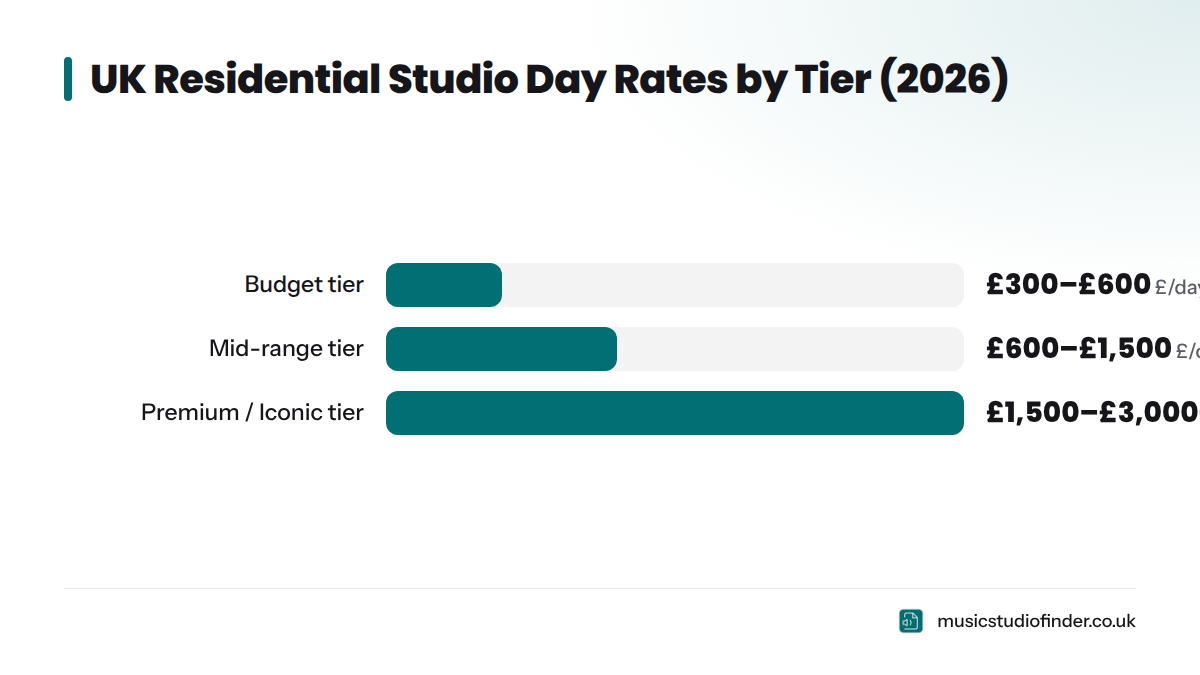
Residential studio pricing in the UK in 2026 covers a wide range depending on the studio's profile, location, and what is included in the fee.
| Duration | Budget Tier (£/day incl. accommodation) | Mid-Range (£/day) | Premium / Iconic (£/day) |
|---|---|---|---|
| Day rate | £300 – £600 | £600 – £1,500 | £1,500 – £3,000+ |
| 3-day block | £850 – £1,700 (total) | £1,700 – £4,200 (total) | £4,200 – £8,500 (total) |
| 1-week block | £1,800 – £3,500 (total) | £3,500 – £9,000 (total) | £9,000 – £18,000+ (total) |
| 2-week block | £3,200 – £6,500 (total) | £6,500 – £16,000 (total) | £16,000 – £35,000+ (total) |
Note: These are estimated UK market ranges based on publicly available studio pricing as of 2026. Prices vary significantly by studio, season, and what is included (engineer, meals, equipment hire).
Block bookings of a week or longer typically attract a discounted rate compared to the daily rate multiplied out. Always ask the studio directly about block booking discounts and what the rate includes.
What Affects the Price
Several factors push the price up or down:
- Location: Rural studios in scenic settings (Wales, the Cotswolds, Scotland) command a premium for the environment itself. Studios closer to urban areas tend to cost less.
- Studio pedigree: Facilities with a recognisable recording history or legendary equipment charge accordingly.
- Included engineer: A resident audio engineer can add £200–£600 per day to the effective cost. Some studios include one in the rate; others treat it as a separate line item.
- Accommodation quality: The difference between a converted barn dormitory and a facility with individual en-suite rooms is reflected in the price.
- Equipment list: Studios with rare or vintage outboard gear, multiple live rooms, or specialist instruments will charge more.
- Meal provision: Full board (three meals plus snacks) costs significantly more than a self-catering arrangement.
- Season: Summer and the run-up to the new year tend to be peak demand periods, with some studios charging seasonal premiums.
What to Budget in 2026
For UK artists planning a residential recording session in 2026, a realistic budget for a week-long mid-range residential booking - including recording studio accommodation, basic catering, and in-house engineering support - sits between £4,500 and £8,500 for a full band, depending on group size and facility. Budget options exist below this range, typically at smaller independent facilities or those that operate on a self-catering basis.
Studios like Rockfield and Real World sit firmly in the premium tier and require direct enquiry for current pricing, which fluctuates based on availability and project scope.
How Residential Studio Costs Compare to Alternatives
To put the numbers in context, here is what comparable spending looks like across different studio models:
- £400–£800: A full day at a professional commercial studio in London or Manchester, without accommodation
- £1,500–£4,000: A quality home studio setup (interface, microphones, monitors, acoustic panels, DAW licence) - a one-time capital investment
- £3,500–£8,500: A week at a mid-range UK residential studio, including accommodation, meals, and engineering
The home studio investment pays back over years of use. The residential studio delivers a single, intensive, immersive project. Neither is inherently better - they serve different purposes.
Residential Studio vs. Commercial Studio vs. Home Studio: A Comparison
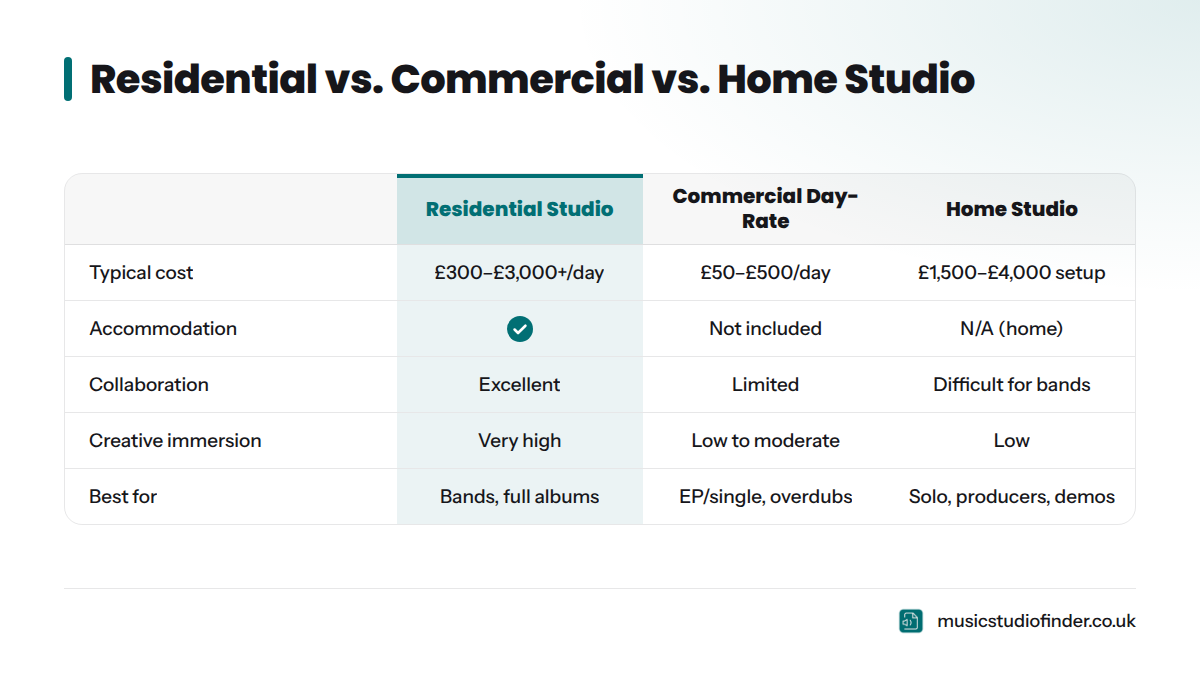
| Feature | Residential Studio | Commercial Day-Rate Studio | Home Studio |
|---|---|---|---|
| Typical Cost | £300–£3,000+/day (all-in) | £50–£500/day (studio only) | £1,500–£4,000 setup cost |
| Sound Quality | Professional-grade, purpose-built acoustics | Professional-grade | Variable - dependent on treatment and room |
| Flexibility | High for duration; fixed location | Moderate - book by session | Maximum - record any time |
| Collaboration | Excellent - artists live and work together | Limited - session-by-session | Difficult for full bands |
| Accommodation | Included | Not included | N/A (home) |
| In-House Engineer | Often available or included | Available at additional cost | Self-engineered or remote |
| Creative Immersion | Very high - dedicated environment | Low to moderate | Low - domestic distractions |
| Best For | Bands, full album projects, breakthrough sessions | EP/single tracking, mixing, overdubs | Solo artists, producers, demo work |
| Booking Flexibility | Block bookings, advance planning needed | Highly flexible, often short notice | No booking required |
| UK Examples | Rockfield Studio, Real World Studios | The Recording Studio London, Born in a Barn | DIY setup at home |
Who Gets the Most from a Residential Recording Studio?
Bands Recording a Full Album
This is the primary use case that residential studios were built for. A band recording an album together needs to capture a collective sound - the way five people play off each other in a room, the chemistry that produces takes worth keeping. That chemistry is extraordinarily difficult to manufacture across a series of disconnected day sessions booked weeks apart.
When a band books a week or two at a residential facility, something shifts in the creative dynamic. The music becomes the only priority. Decisions that would take days of back-and-forth via group chat happen over dinner. Arguments that might fester across multiple disconnected sessions resolve themselves before the next morning's tracking begins.
For a debut album especially, the experience of making the record together in a shared space is part of the artistic foundation the band builds on for years afterward.
Artists Seeking a Creative Breakthrough
Not every residential booking is about tracking an album from scratch. Some artists book a recording studio retreat precisely because they are stuck - blocked creatively, unable to finish a project, or looking for a change of environment that unlocks something new. The combination of seclusion, acoustic quality, and uninterrupted time can break creative log-jams that nothing else touches.
Bracken Hill Hall Recording Studio is one example of a UK facility with an estate-style character that suits exactly this kind of intensive creative retreat booking.
Established Artists and Major Label Projects
Major label album budgets routinely include residential studio time as a line item, and for good reason. When the financial investment in an artist's career is significant, the recording environment becomes a factor in risk management. A well-resourced residential session produces more usable material in less calendar time than the same number of studio hours scattered across months.
Established artists also benefit from the privacy that residential studios provide. Recording away from London or other major cities reduces the chance of unfinished material circulating before a release.
When a Home or Day-Rate Studio Is the Better Choice
Save your residential studio budget if: you are an emerging solo artist recording fewer than six tracks, working primarily with programmed or sampled instrumentation, or operating with a total project budget under £2,500. A well-chosen professional day-rate studio - or a quality home setup - will serve you better at this stage.
The Music Studio Finder directory lists hundreds of professional studios across the UK, including options that deliver excellent results at day-rate prices for artists who do not need the full residential experience.
For these musicians, the smarter move is often to record and track at a professional commercial studio and invest the savings in professional mixing and mastering - where the sonic return per pound spent is frequently higher.
What to Look for in a Residential Recording Studio
Here is a practical checklist for evaluating any residential facility before you commit.
Technical specification:
- What mixing console does the studio use? (SSL, Neve, API, or boutique equivalents all carry different sonic characters - see analogue vs digital recording studios for context)
- How many live rooms are available, and can multiple rooms be used simultaneously?
- What microphone selection does the studio hold?
- What outboard gear is available? (Compressors, preamps, EQs)
- What DAW is the control room configured for? Is Pro Tools or Logic available?
- Is instrument hire available on-site, and at what cost?
- What is the monitoring setup in the control room?
Accommodation and amenities:
- How many beds are available, and is the accommodation included in the stated rate?
- Is catering provided, or is it self-catering? What are the meal options?
- Is there outdoor space or breakout areas for writing and informal sessions?
- What is the noise policy - can sessions run late into the night?
Engineering and staffing:
- Is an in-house audio engineer available, and is their fee included?
- Can you bring your own engineer or producer?
- What is the studio's policy on assistant engineers?
Booking and logistics:
- What is the cancellation policy, and what happens if a session overruns?
- Is the studio accessible by public transport, or is a car essential?
- What is the minimum booking length?
- Are block booking discounts available?
Questions to Ask Before You Book
Before signing any booking agreement, ask the studio directly:
- What exactly is included in the quoted rate - studio time, accommodation, meals, engineering, equipment?
- Are there any additional costs that commonly arise during a residential session?
- What is the maximum number of people the facility can accommodate?
- How is studio time divided if the rate is all-inclusive - is there a set number of recording hours per day?
- What gear is available for instrument hire, and at what additional cost?
- Can we record in the live room late at night, or are there quiet hours?
- Who do we contact if there is a technical issue outside of normal working hours?
- Has the studio worked with projects of our size and genre before?
Red Flags to Watch Out For
- Vague pricing: If a studio cannot give you a clear breakdown of what is and is not included in the rate, expect surprises on the invoice.
- No equipment list: Legitimate residential studios are transparent about their gear. If the website or representative cannot give you specifics, push harder or walk away.
- Poorly maintained accommodation: Studio quality and accommodation quality tend to track together. If the photos of the bedrooms look dated or the kitchen looks inadequate, assume the same approach applies to the maintenance of studio equipment.
- No clear engineering arrangement: Arriving at a residential studio without a clear plan for who is running the desk is a recipe for wasted time and money.
- Very short minimum booking: A residential studio that sells itself as a retreat but only requires a one-day minimum is likely offering a commercial day-rate experience with a bedroom attached. That is not inherently bad, but it is not the immersive residential experience.
Residential Recording Studios in the UK: What Is Available
The UK has a healthy residential studio landscape, from legendary facilities with decades of recorded history to newer independent studios built around converted rural properties and manor houses.
Rockfield Studio in Monmouth, Wales, remains the benchmark. Founded in 1963 by brothers Kingsley and Charles Ward, it holds the distinction of being the UK's oldest residential recording facility. Its discography includes Bohemian Rhapsody by Queen, (What's the Story) Morning Glory? by Oasis, and records by The Stone Roses, Iggy Pop, and Robert Plant. The facility offers two residential studio complexes - the Quadrangle and the Coach House - each with its own live rooms, control rooms, and recording studio accommodation.
Real World Studios in Box, Wiltshire, offers a different character: a beautifully designed mill conversion with an exceptional acoustic environment, accommodation, and the cultural weight of Peter Gabriel's involvement in its founding. Real World has hosted recording sessions across an enormous range of genres and remains one of the most sought-after residential music studio options in Europe.
Beyond these flagship names, the UK's independent residential studio sector includes a growing number of manor house, barn conversion, and countryside facilities - many of which offer a genuinely professional technical specification at a more accessible price point. Born in a Barn Recording Studio is one example of a UK studio with that rural, immersive character.
The Music Studio Finder recording studios directory lists professional studios across the UK, including facilities with residential characteristics and accommodation options, making it the most practical starting point for UK musicians researching their options.
Should You Book a Residential Recording Studio? A Decision Framework
Work through the questions below honestly. Your answers will tell you which studio model suits your project.
Book a residential recording studio if:
- You are recording with a full band (three or more musicians) and need everyone in the same room across multiple days
- Your project is a full-length album or a long-form EP requiring more than three days of tracking
- Creative collaboration and spontaneity between band members, producers, and engineers is essential to the project
- You have a recording budget of at least £3,000–£4,000 for the studio portion of your project
- You have tried recording the project in shorter sessions and found that the disconnected format is hurting the creative output
- The project requires a controlled acoustic environment that your home setup cannot provide
- You want the wellbeing infrastructure - good food, rest, outdoor space - to sustain a demanding creative schedule
Consider a commercial day-rate studio instead if:
- You are a solo artist or duo working on an EP of three or fewer tracks
- Your total recording budget is under £2,500
- The project is primarily produced in a DAW with limited live instrumentation
- You already have a well-treated home setup and only need professional-grade tracking for specific elements (vocals, live drums)
- Your schedule makes a multi-day block booking impractical or impossible
Consider a home studio setup if:
- You work primarily as a producer or beatmaker using electronic instrumentation
- You record iteratively over weeks or months rather than in intensive blocks
- You have already invested in quality monitoring, acoustic treatment, and a solid audio interface
- Your genre and production style does not require large live rooms or specialist acoustic spaces
Here is a video from Jake Lewis that explores the broader question of whether professional studio time is worth it in 2026 - directly relevant if you are weighing up the financial case:
Frequently Asked Questions
Residential recording studios are worth it for bands or artists undertaking large-scale projects - particularly full album recordings - where sustained creative focus and group collaboration are essential. For solo artists recording an EP or single, or musicians on a tight budget, a professional day-rate studio or well-equipped home setup will typically deliver better value. The decision comes down to project scale, budget, and whether the immersive recording studio experience will genuinely change what you create.
Residential studio rates vary widely depending on location, facilities, and duration. Budget residential studios in the UK charge approximately £300–£600 per day including accommodation. Mid-range facilities cost £600–£1,500 per day. Premium and iconic UK residential studios charge £1,500–£3,000 or more per day. Week-long block bookings typically attract a discounted rate, bringing the effective daily cost down by 10–20% compared to the headline day rate.
Recording studios are not becoming obsolete - but the market has stratified. The rise of capable home studio setups has reduced demand for lower-tier commercial studios, while demand for premium residential and specialist facilities has held steady. UK Music, the umbrella body for the UK music industry, has consistently documented the commercial resilience of professional studio services as a sector. What has changed is that artists now have a genuine spectrum of options, and the decision about which to use has become more considered.
Owning a residential recording studio is a challenging business. The capital costs of a purpose-built facility - acoustic construction, equipment, accommodation fit-out, grounds maintenance - are substantial. Running costs are high, occupancy is seasonal, and competition from home studios has compressed rates at the lower end of the market. Premium residential facilities with strong brand recognition and a track record of prestigious bookings can be profitable, but the Music Producers Guild regularly notes that many studio owners operate at thin margins or rely on supplementary income streams (mixing, mastering, music education, events) to remain viable.
A residential recording studio includes on-site accommodation and is typically booked for multi-day or multi-week blocks. The rate covers the studio, the rooms, and often meals. A commercial recording studio is a facility booked by the hour or day, with no accommodation. Artists arrive for their session and leave when it ends. Residential studios are designed for immersive, sustained projects; commercial studios are designed for efficient, time-bounded sessions.
The minimum stay that justifies the residential model is generally three days, though five to seven days is the optimal window for most band-based projects. A full album typically requires one to three weeks depending on how far along pre-production is. Anything shorter than three days tends to produce a commercial day-rate experience rather than genuine creative immersion - you spend too much of the booking on setup, settling in, and wrap-up. If your project genuinely only needs two days, a professional day-rate studio will serve you better.
The Verdict
Residential recording studios earn their price tag for the right project. A band making a serious record together, an artist seeking a concentrated creative breakthrough, or a production team tackling a large-scale multi-week project will find that the immersive environment, acoustic quality, and wellbeing infrastructure produce something that day-rate sessions cannot replicate.
For solo artists, emerging musicians on modest budgets, or producers who work primarily inside a DAW, the maths rarely work out in a residential studio's favour. A well-chosen professional commercial studio - or a quality home setup - delivers more value per pound spent at that stage of a career.
The most practical first step is knowing what is out there. Music Studio Finder covers the UK's professional studio landscape across every format - residential, commercial, and specialist - so you can compare options, read real facility details, and make the call that fits your project and your budget.