Choosing between an analogue recording studio and a digital recording studio is one of the most consequential decisions you make before you walk through the door. It shapes how your music sounds, how your session feels, how long it takes, and what it costs. Most guides on this topic hand you a vague pros-and-cons list and call it done.
This guide takes a different approach. Written specifically for UK musicians, it is grounded in real GBP costs, real studio gear, and real genre considerations. By the time you finish reading, you will know which studio format suits your music, what to expect when you arrive, and how to find the right room to book. If you are new to professional recording, it is also worth reading our guide to understanding how recording studios work before getting into the format debate.
How Analogue Recording Actually Works
Analogue recording captures sound as a continuous electrical signal and stores it as a physical magnetic pattern on tape. The audio waveform exists in an unbroken, flowing form that mirrors the original acoustic energy - no conversion to numbers, no numerical snapshots. The signal stays in the analogue domain from microphone to tape. That is the core distinction, and it matters more than it might first appear.
The Physics of Magnetic Tape
When a musician plays into a microphone, the mic converts air pressure variations into a fluctuating electrical voltage. That voltage travels through the signal chain, through a preamp - often a revered unit such as the Neve 1073 - and into a tape machine's record head. The record head is an electromagnet that magnetises iron-oxide or chromium-dioxide particles on the tape surface in patterns that correspond precisely to the original signal. On playback, the playback head reads those magnetic patterns back as voltage, which is then amplified and sent to speakers.
The tape moves past the heads at a fixed speed, typically 15 or 30 inches per second (IPS) on professional machines. Faster tape speeds reduce noise and improve high-frequency response. A Studer A800 or Ampex ATR-102 running at 30 IPS on 2-inch, 24-track tape is still considered by many engineers to be among the finest recording mediums ever made.
Key Components of an Analogue Studio
A fully equipped analogue studio typically contains:
- Mixing console: Large-format desks such as the SSL 4000 or Neve 8078 provide channel strips with built-in preamps, equalisers, and dynamics processing. These consoles are not just routing tools - their electronics actively colour the sound.
- Multitrack tape machine: Machines from Studer, Ampex, Otari, and Tascam store the recorded tracks on 2-inch tape. Professional studios use 24-track machines; some use 16-track on 1-inch tape for a different tonal character.
- Outboard gear: Rack-mounted hardware compressors (such as the API 2500 or Neve 33609), equalisers, reverb units, and limiters process the signal during recording and mixing.
- Patch bay: A centralised routing matrix that allows engineers to connect any piece of gear to any channel in the signal chain.
Famous Analogue Studios and Their Sound
Abbey Road Studios in London is the most famous analogue recording facility in the world, home to landmark recordings by The Beatles, Pink Floyd, and Radiohead. Metropolis Studios in Chiswick and RAK Studios in St John's Wood also maintain world-class analogue rooms. The sonic character of these spaces is inseparable from their equipment - the heft of an SSL console, the depth of an old Neve preamp, and the subtle compression of tape all contribute to what listeners and engineers describe as the analogue sound.
How Digital Recording Actually Works
Digital recording converts audio into a stream of binary numbers that a computer can store, process, and reproduce with consistent repeatability. Rather than a continuous waveform on tape, the audio exists as a sequence of numerical snapshots taken thousands of times per second.
Sample Rate and Bit Depth Explained
The conversion from analogue to digital happens at the audio interface's analogue-to-digital (A/D) converter. Two numbers define the quality of that conversion:
- Sample rate: How many times per second the converter measures the audio signal. CD-quality audio uses 44,100 samples per second (44.1kHz). Professional studios commonly record at 96kHz or 192kHz, which the Audio Engineering Society recognises as high-resolution audio. A higher sample rate captures more of the high-frequency content of the original signal.
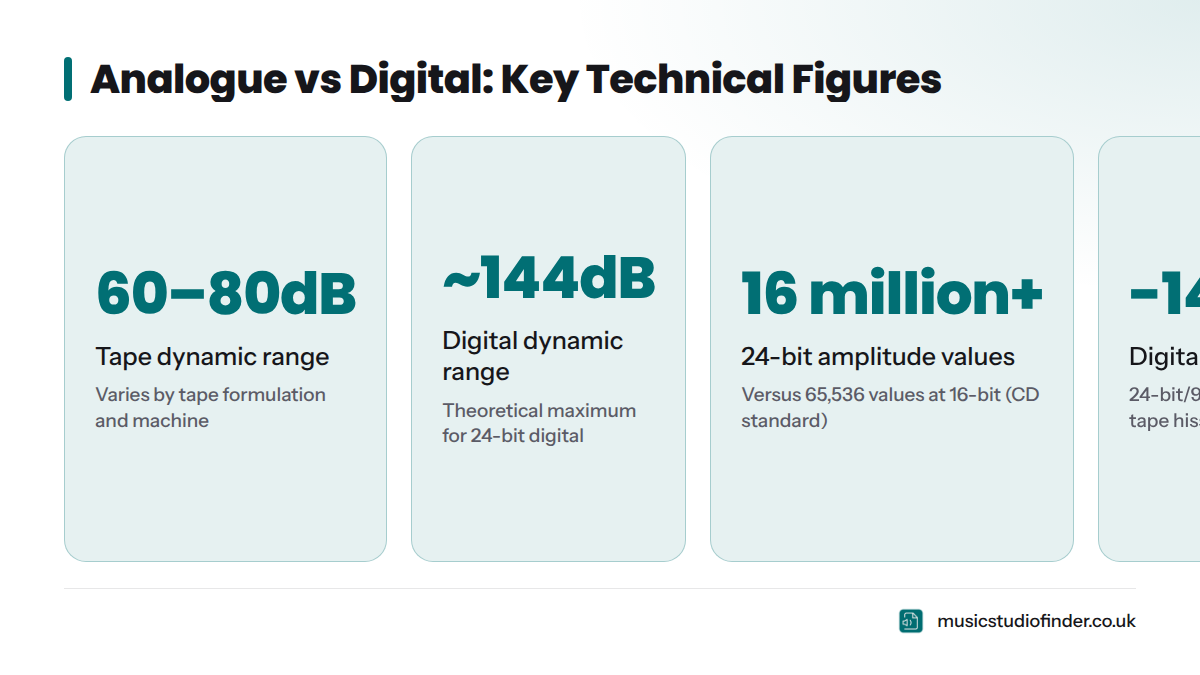
- Bit depth: How many possible values each sample can take. A 16-bit recording (CD standard) offers 65,536 possible amplitude values. A 24-bit recording offers over 16 million. More bit depth means greater dynamic range and a lower noise floor. Professional digital recording almost universally uses 24-bit depth.
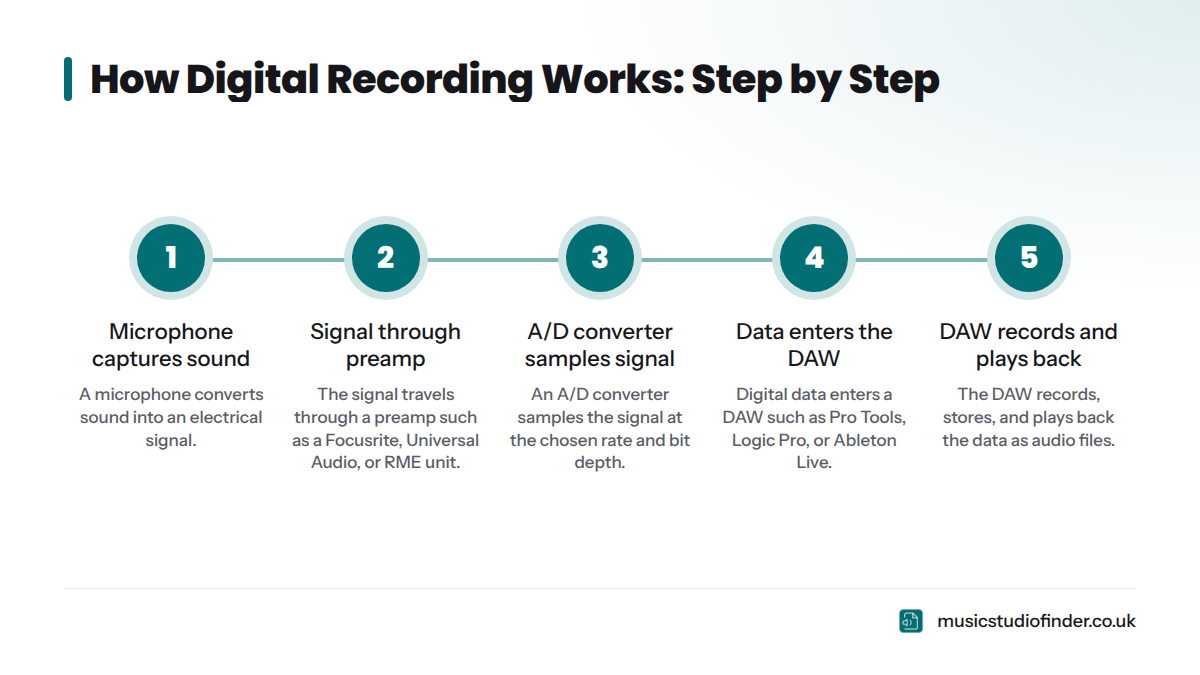
Here is how the process works step by step:
- A microphone converts sound into an electrical signal.
- The signal travels through a preamp - often a Focusrite, Universal Audio, or RME unit.
- An A/D converter samples the signal at the chosen rate and depth.
- The digital data enters a DAW (Digital Audio Workstation) such as Pro Tools, Logic Pro, or Ableton Live.
- The DAW records, stores, and plays back the data as audio files.
Key Components of a Digital Studio
- Digital Audio Workstation (DAW): The central software environment. Pro Tools HD is the industry standard in professional studios; Logic Pro is dominant in music production; Ableton Live is favoured for electronic music and live performance.
- Audio interface: Hardware that handles A/D and D/A conversion and connects microphones, instruments, and monitors to the computer. The Universal Audio Apollo range and Focusrite interfaces are widely used.
- Plugins: Software processors that replicate or replace hardware compressors, equalisers, reverbs, and other effects. Companies such as Waves Audio, iZotope, and Universal Audio (UAD) produce industry-standard plugin libraries.
- Monitor speakers and headphones: Critical for accurate playback in the digital domain, where the mix exists entirely within the DAW until it is converted back to analogue for listening.
Why Digital Became the Industry Standard
The shift from tape to digital happened rapidly through the 1990s and 2000s, driven by falling costs, the arrival of Pro Tools, and the explosion of the home studio market. Digital recording offers non-destructive editing (you can undo any change), unlimited virtual tracks, instant session recall, and no media costs per session. By the mid-2000s, the majority of commercial recordings were made entirely in the digital domain. The Association of Professional Recording Services (APRS) notes that digital facilities now constitute the overwhelming majority of UK studios, with analogue rooms representing a specialist minority.
Analogue vs Digital Sound Quality: What Actually Sounds Different?
This is the question that generates the most heat in recording circles. Let's be precise about what the science and listening evidence actually show.
Tape Saturation, Harmonic Distortion, and "Warmth"
When an analogue signal is recorded onto tape, the magnetic particles on the tape have a finite capacity to hold a magnetic charge. When the signal pushes close to that capacity, the tape begins to saturate. Saturation produces harmonic distortion - the addition of even-order harmonics (particularly second and third harmonics) to the original signal. These harmonics are musically related to the source frequencies and are generally perceived as pleasing. The effect tends to smooth out harsh transients, add apparent sustain, and create a sense of density and warmth in the low-midrange.
Tape saturation is not a flaw being tolerated. For most engineers who work with tape, it is a primary reason to use the format. The late Steve Albini, one of the most respected recording engineers of the past four decades, was publicly and consistently vocal about his preference for analogue recording. He argued that the physical nature of tape produces results that are sonically truer to the original performance than any digital chain.
Gain staging on tape also compresses the signal in a frequency-dependent way, with high frequencies saturating more gently than low frequencies. The result is a natural dynamic behaviour that is genuinely difficult to replicate artificially.
Digital Clarity, Precision, and the "Cold" Criticism
A well-implemented digital system is, in strict technical terms, more accurate than tape. A 24-bit/96kHz recording captures the source signal with a noise floor below -144dBFS and a frequency response flat from DC to 48kHz. There is no tape hiss, no speed fluctuation (wow and flutter), and no physical degradation over time.
The criticism that digital sounds "cold" or "clinical" is real but context-dependent. It most often refers to early digital recordings from the 1980s, when converters were genuinely poor and the format was immature. Modern high-quality conversion, paired with excellent preamps and carefully chosen microphones, can produce recordings of extraordinary warmth and depth. The "coldness" complaint is often more about the workflow and the absence of analogue processing than the digital medium itself.
Blind-Test Evidence: Can Listeners Actually Hear the Difference?
The honest answer: sometimes, but less reliably than partisans on either side would like. Multiple controlled listening tests have found that when experienced listeners compare high-quality digital recordings to analogue recordings at matched levels, their ability to consistently identify the format is limited. The AES has published numerous papers examining high-resolution audio perception, and results are consistently mixed. Preference is subjective, context-dependent, and heavily influenced by the quality of the monitoring chain.
On the myth of analogue superiority: Analogue recording is not inherently better than digital. It is different, in ways that are genuinely valuable for certain music and certain goals. The most honest position is that both formats, used well, can produce exceptional recordings. The question is which set of differences serves your music.
Side-by-Side Comparison: Analogue vs Digital Recording Studios
| Criterion | Analogue | Digital |
|---|---|---|
| Sound Character | Warm, harmonically rich, natural compression | Clean, accurate, transparent |
| Noise Floor | Tape hiss present; typically -65 to -70dBu | Extremely low; 24-bit yields ~-144dBFS |
| Dynamic Range | ~60-80dB (tape-dependent) | ~144dB theoretical; ~120dB practical |
| Editing Flexibility | Very limited; razor blade splicing or bounce to separate machine | Non-destructive; unlimited undo, comping, overdubbing |
| Cost (UK hourly) | £80-£300+ per hour | £20-£100 per hour |
| Media Cost | £200-£350 per reel of 2-inch tape (one-time or reusable) | None (stored on hard drive or cloud) |
| Session Recall | Manual; relabelling faders, patches, outboard settings | Instant, complete, perfect |
| Best For | Rock, jazz, country, folk, blues, live band recording | Pop, hip-hop, electronic, singer-songwriter, podcasts |
| Typical Equipment | Neve/SSL console, Studer/Ampex tape machine, outboard gear | DAW (Pro Tools/Logic/Ableton), audio interface, plugins |
| Learning Curve for Artists | High (decisions are permanent; preparation is essential) | Lower (mistakes are reversible) |
| Maintenance Requirements | High (tape heads must be demagnetised, aligned regularly) | Low |
| UK Studio Availability | Specialist; relatively rare | Widespread; the norm |
The Hybrid Studio: Where Most Professional UK Studios Actually Sit
Here is something most competitor articles skip entirely: the majority of professional UK recording studios in 2026 operate as hybrids. Pure analogue-only or pure digital-only studios are both minority cases in the real market.
What Is a Hybrid Recording Studio?
A hybrid recording studio combines an analogue signal chain with digital recording and editing. Audio is captured through analogue microphones, preamps, and often a large-format analogue console, but the output of that console routes into a DAW rather than onto tape. The result captures the sonic character of analogue hardware during tracking while retaining the flexibility of digital editing, session recall, and non-destructive manipulation.
Hybrid studios may also run analogue outboard gear - compressors, equalisers, reverbs - during the mixing phase, inserting hardware into the signal chain via the interface's analogue outputs and inputs. Engineers call this "out-of-the-box" mixing.
How a Hybrid Session Actually Flows
A typical hybrid session works like this:
- The artist's performance is captured through a high-quality microphone and an analogue preamp (a Neve 1073 or similar).
- The preamp output passes through the analogue summing section of an SSL or API console for level control and initial tonal shaping.
- The signal routes to an A/D converter - often a Universal Audio Apollo or similar interface - and into Pro Tools or Logic Pro.
- Editing, comping, and arrangement happen entirely in the DAW.
- During mixing, the engineer may print stems back out through analogue hardware compressors and equalisers before returning to the DAW for the final mix.
- The mix is exported digitally for mastering.
This approach is now so common that the Music Producers Guild UK treats hybrid working as the default professional studio model, with pure tape studios positioned as a premium specialty.
Are Hybrid Studios Worth It?
For most UK musicians, a hybrid studio offers the best practical outcome: the warmth and character of analogue hardware where it matters most - preamps, console summing, outboard dynamics - combined with the speed and flexibility of digital editing. Sessions cost less than pure analogue (no tape costs) and produce files that are ready for the digital mastering chain.
If you want to explore the full range of studio types available to you, our guide to types of recording studios breaks down the options in practical detail.
Analogue vs Digital Recording Costs in the UK
Cost is where this debate becomes very concrete, very quickly.
What Analogue Studio Sessions Actually Cost
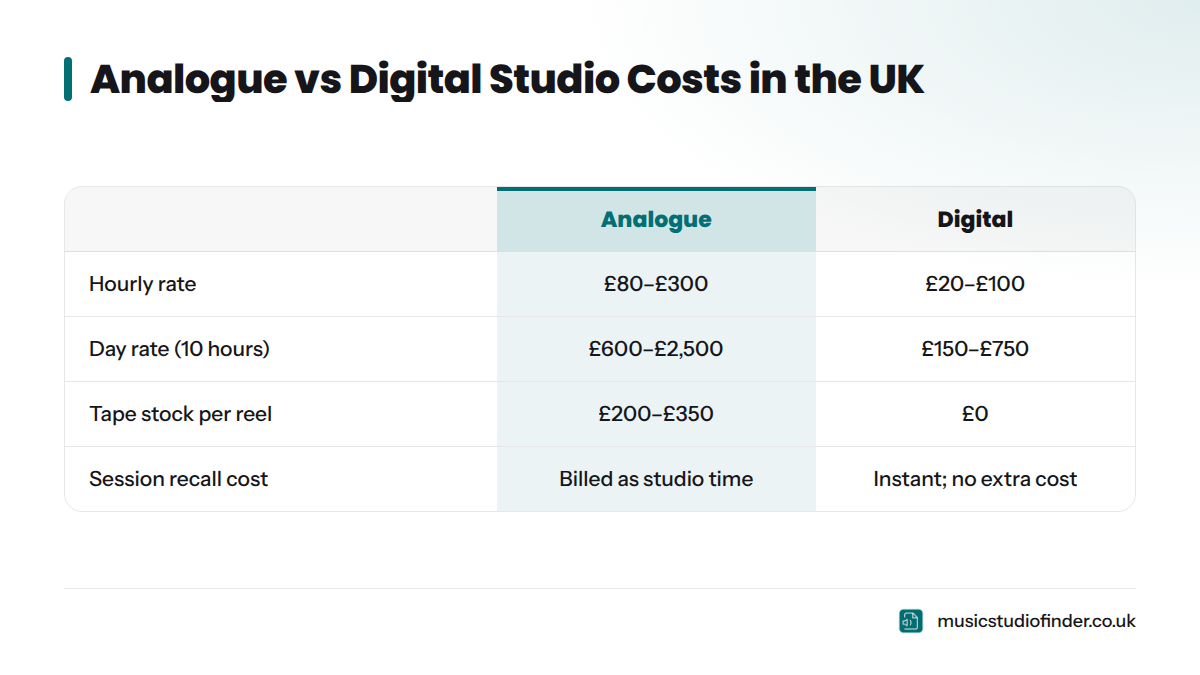
Professional analogue studios in the UK charge a significant premium. The equipment is expensive to maintain, the skill level required of the engineer is high, and sessions typically require more preparation time. Based on current UK market rates:
- Hourly rate: £80-£300 per hour, depending on the facility
- Day rate (10 hours): £600-£2,500
- Engineer fee: Often included at premium studios; at others, an additional £200-£400 per day
- Tape stock: 2-inch, 24-track tape (typically 10.5-inch reels) costs £200-£350 per reel. At 30 IPS, a standard reel gives approximately 15 minutes of recording time. A full album project may use 20-30 reels.
Abbey Road Studios publicly lists studio hire starting from several hundred pounds per hour for their analogue rooms, with full project budgets running into tens of thousands of pounds.
What Digital Studio Sessions Actually Cost
Digital studios are accessible at a far wider range of price points:
- Hourly rate: £20-£100 per hour
- Day rate (10 hours): £150-£750
- Engineer fee: Often included; some budget studios are self-operated
- Media cost: None (sessions stored on hard drive or cloud)
A UK indie band recording a four-song EP in a well-equipped digital studio can realistically budget £500-£1,500 for tracking and mixing, with no additional media costs.
The Hidden Costs: Tape Stock, Maintenance, and Engineer Fees
| Cost Item | Analogue | Digital |
|---|---|---|
| Hourly studio hire | £80-£300 | £20-£100 |
| Day rate | £600-£2,500 | £150-£750 |
| Tape stock (per reel) | £200-£350 | £0 |
| Session recall time | Billed as studio time | Instant; no extra cost |
| Tape head alignment/maintenance | Built into studio overhead | Not applicable |
| Engineer (if separate) | £200-£400/day | £150-£300/day |
| Mixing (separate session) | Often required; at tape or analogue desk | Often included or in-box |
| Tape storage/archiving | Physical storage required | Cloud or drive storage |
The tape stock cost is the most significant hidden expense in analogue recording. For an album-length project, tape alone can add £3,000-£7,000 to the total budget, before a single hour of studio time is booked.
Which Studio Type Suits Your Genre?
Genre is one of the most reliable guides to format choice. Here is a clear breakdown:
| Genre | Analogue | Digital | Hybrid | Notes |
|---|---|---|---|---|
| Rock (indie/alternative) | Excellent | Good | Excellent | Tape adds energy and compression to drums; captures live room feel |
| Jazz | Excellent | Good | Very good | Analogue captures ensemble dynamics and spatial depth beautifully |
| Blues / Country | Excellent | Good | Very good | Tape warmth suits vintage tonality and live performance feel |
| Metal | Good | Excellent | Excellent | Digital handles extreme transients and tight editing better |
| Hip-Hop | Poor fit | Excellent | Very good | Digital workflow matches beat-based production; sampling requires DAW |
| Electronic | Poor fit | Excellent | Very good | In-the-box production is native to electronic music |
| Pop | Adequate | Excellent | Excellent | Pop production demands flexibility, pitch correction, and dense layering |
| Classical / Orchestral | Very good | Excellent | Excellent | Digital's wide dynamic range and minimal noise floor serve classical best |
| Singer-Songwriter (acoustic) | Excellent | Excellent | Excellent | Either works; choice depends on desired aesthetic |
| Punk / Lo-Fi | Excellent | Good | Good | Tape grain and saturation suit the aesthetic perfectly |
When Analogue Is the Right Choice
Choose an analogue studio when:
- Your music relies on live ensemble performance and you want to capture the room energy on tape
- The "vintage" or "warm" aesthetic is central to your artistic identity, not just a production preference
- You are recording rock, blues, jazz, or country and have the budget to commit to a full analogue project
- You are working with an experienced band that can nail performances with minimal editing
When Digital Is the Right Choice
Choose a digital studio when:
- Your music is electronic, hip-hop, or heavily produced pop where the DAW is the instrument
- You need extensive editing, comping, pitch correction, or time manipulation
- Your budget is limited and you need to get the most from every session hour
- You are recording demos, EPs, or projects where flexibility and speed matter more than tonal character
When a Hybrid Studio Makes the Most Sense
A hybrid studio makes sense when:
- You want analogue preamp and console character without the tape cost
- Your genre benefits from both live performance capture and post-session editing
- You want the option to recall sessions and overdub at a later date
- You are an indie or unsigned artist working within a realistic UK budget
What to Expect in an Analogue Studio Session
Walking into a studio like Abatis Recording Studio for your first analogue session is a genuinely different experience from any digital environment. Here is what happens.
Setup, Levels, and Tape Preparation
Before any music is recorded, the engineer prepares the tape machine. This includes demagnetising the record and playback heads, cleaning the tape path, and running a calibration tone from the console onto a section of fresh tape. The playback level is then adjusted to match the reference. This process takes 20-45 minutes on a well-maintained machine. The tape is threaded, leaders are attached, and track sheets are prepared manually.
When musicians set up in the live room, the engineer sets microphone positions and runs levels to the console. Gain staging on an analogue console requires careful attention: the signal must be loud enough to saturate the tape slightly for that characteristic warmth, but not so loud that it clips into distortion.
Tracking Live Performances
On tape, every take has weight. There is no Ctrl+Z. When a band performs a take, it is committed to tape at the chosen position. If a mistake is made, the engineer can punch in (drop into record mode) for the specific bar or phrase, but this requires precision - the punched-over material is gone.
This permanence changes how musicians perform. Most engineers who work in analogue studios describe sessions as more focused and energetic. The band knows the takes matter. That pressure often produces exactly the kind of committed performance that analogue recording captures so well.
Mixing on an Analogue Console
Mixing on an SSL 4000 or Neve 8078 is a physical, tactile experience. Every fader has weight. Every EQ knob is in a fixed position. Recall is manual: engineers write down every setting on a mix sheet. If a client returns two weeks later for revisions, the console must be reset by hand from those notes, which takes hours. This is one of the significant practical limitations of analogue mixing in a commercial context.
Many analogue studios now mix to a two-track tape master, or transfer the final mix to digital for the mastering stage - which is itself almost universally digital.
Checklist: What to Bring and Prepare for an Analogue Studio Session
- Well-rehearsed performances; the band should be able to play songs live from start to finish
- Fresh strings and drum heads fitted before the session, not during it
- A clear track list and arrangement, agreed before arriving
- A conversation with the engineer about tape speed and track count
- Budget confirmation that includes tape stock cost
- A rough live recording (phone or rehearsal room) for the engineer to reference
- Tuned instruments; analogue studios have limited time for instrument setup
What to Expect in a Digital Studio Session
A digital studio session at somewhere like Woodbine Street Recording Studio operates on a fundamentally different set of rules.
DAW Setup and Routing
The session file is typically prepared in advance by the engineer. Template sessions in Pro Tools or Logic Pro include pre-routed input channels, standard plugin chains on key tracks (a compressor and EQ on the vocal bus, for instance), and a folder structure for the project's audio files. Setup time is shorter than in an analogue environment - often just 15-30 minutes for a straightforward tracking session.
If you have a previous session at the same studio, the engineer opens the file and every setting, every plugin, every level is exactly as you left it. Session recall is instant and complete.
Non-Destructive Editing, Comping, and Overdubbing
Non-destructive editing is one of the most significant practical advantages of digital recording. Every take is stored as a separate audio file. Nothing is deleted unless you choose to delete it. The engineer can:
- Record 10 takes of a vocal and compile the best phrases from each into a single "comp" (composite take)
- Move audio regions around the timeline freely without affecting the original recording
- Quantise rhythmic performances to correct timing while preserving the original file
- Use pitch correction tools such as Melodyne or Auto-Tune to adjust specific notes
This flexibility is genuinely liberating, particularly for solo artists and vocalists who do not perform best under the pressure of a live, permanent take.
In-the-Box Mixing and Plugin Chains
"In-the-box" mixing means the entire mix is processed and balanced within the DAW using plugins, with no audio leaving the digital environment until the final stereo bounce. A professional engineer might use 50-150 plugin instances across a full mix, including channel EQs, compressors, parallel bus processing, reverbs, delays, and a mastering limiter on the 2-bus.
Modern plugins from Waves Audio, Universal Audio, and iZotope achieve extraordinary results. UAD's analogue-modelling plugins, which run on dedicated DSP hardware, are particularly respected for their accuracy in capturing the character of specific hardware pieces.
It is worth asking the studio whether the engineer is included in the session fee before you book. Our guide on whether recording studios include an audio engineer answers this question in full.
Checklist: What to Bring and Prepare for a Digital Studio Session
- Reference tracks: 2-3 songs that represent the sound you are aiming for
- Demo recordings of your songs (even rough phone recordings) to share with the engineer
- A rough mix or track arrangement if recording a produced project
- MIDI files, samples, or stems if the project involves pre-produced elements
- A written track list with song titles, tempos, and key signatures
- Any specific plugin preferences or requests for the engineer
- Hard drive or cloud storage details for receiving the session files
Analogue vs Digital: Pros and Cons
Analogue Recording
Pros:
- Natural tape saturation and harmonic richness that is genuinely difficult to replicate
- Frequency-dependent compression that flatters drums, bass, and guitars
- Forces disciplined performances; raises the energy and commitment in the room
- Produces a physical archive medium (though tape degrades over decades)
- Strongly associated with genre-specific aesthetics that artists and audiences recognise
Cons:
- Significantly higher cost - session rates, tape stock, maintenance
- Limited editing; mistakes can be costly
- Tape hiss raises the noise floor, especially on budget machines
- Session recall is manual and time-consuming
- Fewer facilities to choose from across the UK
- Tape degrades physically over time if not stored correctly
Digital Recording
Pros:
- Non-destructive editing means nothing is permanently lost
- Perfect session recall in seconds
- Much lower cost, especially for indie and independent musicians
- Extremely low noise floor and wide dynamic range
- Widely available across the UK at every budget level
- Supports unlimited virtual tracks and parallel processing
- Files can be shared, backed up, and distributed instantly
Cons:
- Can produce results that feel sterile if the signal chain lacks character
- Plugin overload and decision fatigue are genuine workflow risks
- Less pressure on performers; can encourage complacency in the studio
- The tactile, physical experience of working with hardware is absent
Why Artists Are Returning to Tape - and Where Digital Is Heading
Tape sales have grown steadily over the past decade, driven by both the vinyl revival and a broader cultural appetite for physical, tactile music experiences. The Recording Industry Association of America (RIAA) reported sustained growth in physical format revenue in the early 2020s, with vinyl and cassette leading the trend. Artists such as Jack White, Billie Eilish, and Gary Clark Jr. have recorded or released projects on tape in recent years, each citing the sound and the discipline that tape imposes.
In the UK, studios that maintain functional analogue tape rooms are repositioning them as premium offerings, attracting artists willing to pay for an experience that digital cannot replicate.
The most significant development in bridging the analogue and digital worlds is the rise of high-quality analogue-modelling plugins. Companies such as Universal Audio, Waves Audio, and Softube produce software emulations of specific classic hardware units. Universal Audio's UAD platform models the precise circuit behaviour of units such as the Neve 1073, the SSL G-Bus compressor, and the Studer A800 tape machine with a level of accuracy that many engineers find genuinely useful.
These plugins do not fully replicate the experience of working with hardware, and some engineers reject them entirely. Others use them as tools that bring character to an otherwise clean digital chain. My honest assessment: they are very good and getting better, but they are not the same as the real thing.
The trajectory of recording studio technology is towards high-resolution digital recording with analogue-modelled processing, used within hybrid workflow environments. Immersive audio formats such as Dolby Atmos and spatial audio are becoming commercially relevant, and these are purely digital domains. Interest in analogue recording is growing as a luxury and artistic choice rather than a practical necessity. The two formats are not converging - they are diverging into different markets serving different needs.
A Brief History of Recording: From Tape to Digital
Understanding the timeline of recording technology helps contextualise where we are now.
| Era | Technology | Key Development |
|---|---|---|
| 1940s | Magnetic tape (Germany) | AEG Magnetophon tape machines captured by Allied forces; modern tape recording begins |
| 1950s | Multitrack tape | Les Paul pioneers overdubbing; Ampex introduces 8-track machines |
| 1960s-70s | 16 and 24-track tape | The Beatles, Led Zeppelin, and Fleetwood Mac record landmark albums on Studer and MCI machines |
| 1979 | Sony PCM-1 digital recorder | First commercial digital recording system; early digital albums appear |
| 1982 | Compact Disc (CD) | 16-bit/44.1kHz becomes the consumer standard; digital playback reaches mass market |
| 1991 | Pro Tools 2.0 | Nonlinear DAW editing enters professional studios; changes post-production permanently |
| 1990s | ADAT (Alesis Digital Audio Tape) | Affordable 8-track digital recording enters home studios |
| 2002 | GarageBand announced | DAW recording opens up for home musicians |
| 2000s-10s | Hybrid studios emerge | Most professional studios combine analogue hardware with digital recording |
| 2026 | High-resolution digital + tape revival | 24-bit/192kHz digital is the standard; analogue tape is a premium specialty |
The shift from tape to digital was not a sudden break. It was a 30-year transition driven by cost, convenience, and changing listener expectations. Today, both formats coexist, serving different purposes and different artists.
Which Format Should You Choose? A Decision Framework
Here is a practical decision framework based on the most common situations UK musicians face.
Start here: What is your primary goal for this session?
- Capture a live band performance with maximum energy and character - Consider analogue or hybrid
- Produce a beat-based, layered, or heavily edited record - Digital
- Record a debut EP or demo on a limited budget - Digital
- Record a full album with a significant production budget - Hybrid or analogue, depending on genre
- Make a record that sounds like your favourite music from the 1960s-80s - Analogue or hybrid
Now consider your budget:
- Under £500 total - Digital studio only
- £500-£2,000 - Digital or hybrid
- £2,000-£10,000 - Hybrid; analogue possible for limited sessions
- £10,000+ - Analogue viable for a full project
Now consider your genre (see the genre matrix above).
Finally, answer these questions before booking:
Questions to Ask Before Booking a Recording Studio
- Does the studio use analogue tape, digital recording, or a hybrid of both?
- What console and preamp chain will my signal run through?
- Is an engineer included in the session fee?
- What DAW does the studio use, and can I receive the session files after the session?
- If analogue, what is the tape stock policy and who pays for reels?
- What is the session recall policy for additional mixing sessions?
- Can I hear examples of recordings the studio has made in the same genre as my music?
- Is the live room acoustically treated, and what is the room size?
How to Find Analogue and Digital Studios Across the UK
Music Studio Finder lists verified recording studios across the UK, searchable by location, type, and budget. Whether you are looking for a professional analogue room in London, a hybrid studio in Edinburgh, or a digital setup in York, the platform connects you directly with studios that match your needs.
Browse recording studios across the UK to compare facilities, read studio descriptions, and make contact directly. Studios such as Reel Recording Studios in York and Offbeat Recording Studio in Edinburgh represent the range of facilities available across the UK at different price points and with different technical setups.
Glossary of Key Recording Studio Terms
Tape saturation: The point at which magnetic tape particles reach their maximum magnetisation, producing gentle, musically pleasant harmonic distortion as a byproduct.
Harmonic distortion: The addition of overtones (harmonics) to a signal during recording or processing. Even-order harmonics (2nd, 4th) are generally perceived as warm; odd-order (3rd, 5th) can sound harsh.
Bit depth: The number of binary digits used to represent each audio sample. 16-bit = 65,536 values; 24-bit = 16,777,216 values. Greater bit depth equals greater dynamic range.
Sample rate: The number of audio samples captured per second. 44.1kHz (CD quality) and 96kHz (professional standard) are the most common values.
DAW (Digital Audio Workstation): Software used to record, edit, arrange, and mix audio. Common examples include Pro Tools, Logic Pro, and Ableton Live.
Signal chain: The path an audio signal travels from source (microphone or instrument) through all processing stages to the recording medium or output.
Outboard gear: External, hardware-based audio processing equipment (compressors, equalisers, reverbs) used alongside a console or DAW.
Non-destructive editing: An editing approach exclusive to digital, where the original audio files are never altered. All edits are instructions that the DAW applies on playback, and any change can be undone.
Latency: The delay between an input signal (such as a musician playing a note) and its output through the monitoring system. Digital systems introduce a small amount of latency due to A/D conversion and processing; low-latency monitoring is essential for comfortable recording.
A/D conversion (Analogue-to-Digital): The process of converting a continuous analogue signal into a stream of digital samples for computer-based recording.
Dynamic range: The difference between the quietest and loudest signal a system can capture without distortion or noise. Measured in decibels (dB).
Noise floor: The level of background noise inherent to a recording system. Tape has a higher noise floor than digital due to tape hiss. A lower noise floor is generally desirable.
Frequently Asked Questions
Neither format is objectively superior. Analogue recording produces natural tape saturation and harmonic richness that many musicians and engineers value highly, particularly for rock, jazz, and blues. Digital recording offers greater accuracy, flexibility, and a far lower noise floor. The right choice depends on your genre, budget, and artistic goals.
Tape imposes discipline: takes are permanent, decisions have weight, and the band must perform with commitment. The sonic character of tape saturation and frequency-dependent compression is genuinely distinctive. Artists such as Jack White and the Alabama Shakes have cited both the sound and the creative process as reasons to record on tape.
A hybrid recording studio combines analogue hardware - preamps, consoles, outboard gear - with digital recording and editing. Audio is captured through analogue circuitry for its sonic character, then recorded into a DAW for editing, recall, and mixing. This is the dominant professional studio model in the UK in 2026.
Analogue studio sessions in the UK typically cost between £80 and £300 per hour, or £600 to £2,500 for a full day. On top of the studio fee, tape stock costs £200-£350 per reel, and a full album project may require 20-30 reels. Engineer fees may be additional.
High-quality analogue-modelling plugins from companies such as Universal Audio and Waves Audio can convincingly replicate the character of specific classic hardware units. That said, the full experience of analogue recording - tape saturation, wow and flutter, the physical workflow - cannot be perfectly replicated in the digital domain. Plugins are excellent tools; they are not identical to the real thing.
Digital recording is the more practical choice for beginners. Lower cost, non-destructive editing, perfect session recall, and widespread availability make digital studios far more accessible. Beginners benefit from the freedom to make and reverse mistakes without financial consequence - which is simply not possible on tape.
Strongly. Rock, jazz, blues, country, and folk all benefit from the warmth and live-capture qualities of analogue or hybrid recording. Hip-hop, electronic, and most contemporary pop are better served by digital environments where the DAW is central to the creative process. See the genre matrix above for a full breakdown.
Yes. Pure analogue tape studios represent a small and specialist segment of the market. The majority of professional studios now operate as hybrids, with tape machines present in some rooms as a premium option. Purpose-built analogue rooms at facilities like Abbey Road, Metropolis, and RAK Studios continue to operate, but they serve a specialist, higher-budget clientele. For most UK musicians, hybrid and digital studios are the practical reality.
Last reviewed: October 2026
Sources
- Audio Engineering Society - E-Library of Published Research
- Association of Professional Recording Services (APRS)
- Music Producers Guild UK (MPG)
- Abbey Road Studios - Official Website
- Universal Audio - UAD Plug-Ins and Hardware
- Recording Industry Association of America (RIAA) - Revenue Statistics
- Neve Electronics - Wikipedia