
Walk into almost any professional recording studio and you will find two very different spaces sitting side by side, separated by a thick pane of glass. One room is built for making sound. The other is built for hearing it clearly. Understanding the difference between these two spaces - the live room and the control room - changes the way you think about booking studio time, preparing for a session, and getting the most from your recordings.
This guide breaks everything down: what each room is for, how it sounds, what equipment fills it, and how the two spaces talk to each other during a session. Whether you are a vocalist, a drummer, or a producer stepping into a professional studio for the first time, this is the orientation you need.
Quick definitions: A live room is the performance space where musicians play and sing. A control room is the monitoring and mixing space where the sound engineer operates the recording equipment and listens critically to everything captured.
What Is a Live Room in a Recording Studio?
A live room is the performance and capture space in a recording studio - the place where musicians play, vocalists sing, and instruments are recorded. You will also hear it called a tracking room or recording room; the terms are interchangeable in most professional settings.
The Purpose of a Studio Live Room
The live room exists for one reason: to capture sound well. When a band sets up to record, the drummer sits behind the kit, the guitarist faces an amp, and the vocalist stands in front of a condenser microphone. Everything that ends up on a recording starts as a sound wave inside this space.
Because the room's acoustic character becomes part of the recorded sound, its design is not just practical - it is musical. A well-designed live room adds pleasing natural ambience to recordings, giving them air and depth that post-production reverb rarely replicates convincingly. Grammy-winning engineer Bruce Swedien, who recorded Michael Jackson's Thriller, called this quality "acoustic support" - the way a great room seems to wrap around a performance and lift it.
What Does a Live Room Sound Like?
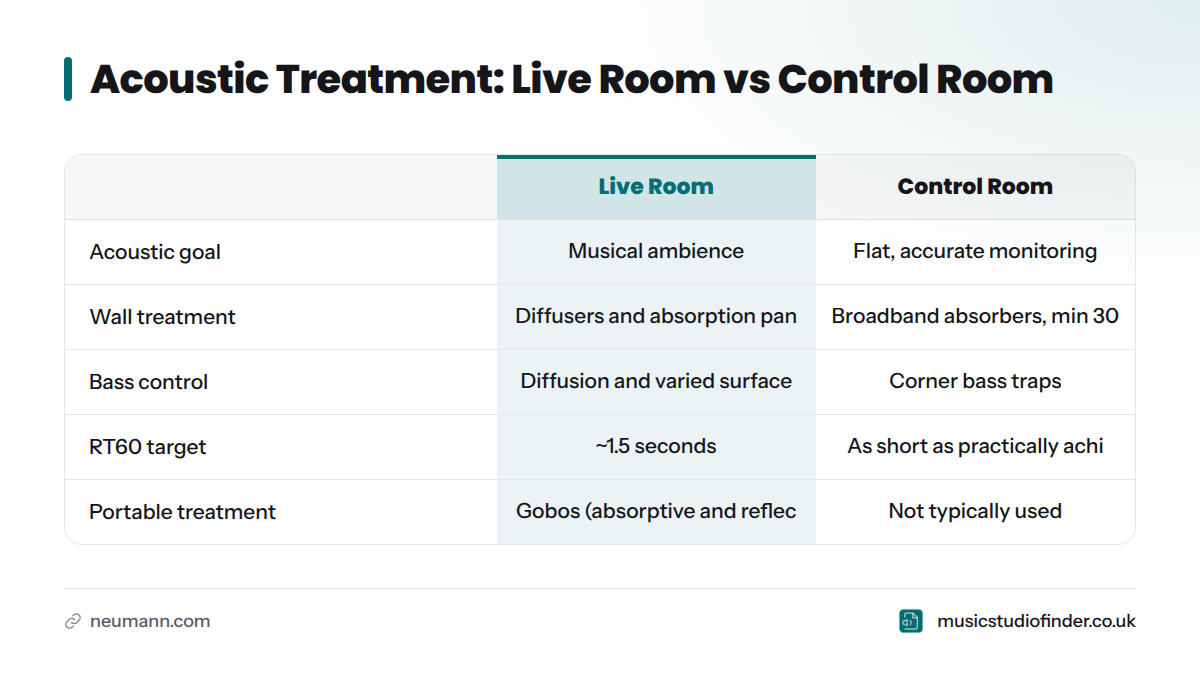
The live room sounds alive. Stand in one, clap your hands, and you will hear the room answer back with a warm, dense reverb tail. Larger live rooms typically have a reverb decay time (RT60) of around 1.5 seconds - long enough to give recordings a sense of space, short enough to keep everything controlled and musical.
That reflectiveness is intentional. Unlike a bathroom, where reflections are chaotic and cause comb filtering - a phase cancellation effect that makes recorded vocals sound hollow and coloured - a well-designed live room manages those reflections through angled walls, varied surface materials, and acoustic diffusers. The result is reverb that sounds musical rather than unpleasant.
What Equipment Is in a Live Room?
Here is what you can expect to find in a professional live room recording studio:
- Large-diaphragm condenser microphones and dynamic microphones on adjustable stands
- Instrument amplifiers (guitar, bass) positioned to minimise bleed between sources
- A drum kit, often raised on a purpose-built riser or carpet platform
- Music stands for charts and lyrics
- A headphone distribution system (also called a foldback or cue mix system) so musicians can hear themselves and the click track while performing
- Gobos and baffles - freestanding, portable acoustic panels used to separate instruments or reduce reflections around a specific source
- Fixed acoustic absorption panels and diffusers on walls and ceiling
- A talkback speaker so the engineer's voice from the control room can be heard
What Does a Live Room Look Like?
Live rooms rarely have perfectly parallel walls. Angled surfaces break up standing waves - the room mode resonances that build up at specific low frequencies when opposing walls face each other straight on. Splayed walls, slanted ceiling sections, and a mixture of hard and soft surface materials are all standard features. Hard surfaces reflect sound; soft surfaces absorb it. The combination creates a balanced, usable acoustic environment.
Larger professional live rooms often have very high ceilings, which pushes room mode resonances into lower, more manageable frequencies and gives the room a grand, open quality that translates beautifully onto recordings of full bands.
What Is a Control Room in a Recording Studio?
The control room is the engineer's workspace - the acoustic command centre of a recording studio. This is where the sound engineer monitors everything being recorded in the live room, makes real-time technical decisions, and later returns to mix the finished tracks.
The Purpose of a Control Room in a Studio
The control room has two jobs. During a tracking session, the engineer sits at the mixing console and listens in real time to what the microphones are capturing in the live room. After the session, the same room is used for mixing - listening back to recorded material, balancing levels, applying processing, and shaping the final sound. You can read more about those distinct stages in this guide to recording vs mixing vs mastering.
The engineer and producer work here. They never need to be physically close to the instruments. What they need is an accurate acoustic environment where they can trust what they hear through the monitors. That is the control room's entire reason for existing.
What Does a Control Room Sound Like?
Where the live room is warm and reverberant, the control room is the opposite. It is acoustically neutral - designed to be as close to sonically "dead" as possible, with minimal reflections and a flat frequency response at the listening position. The goal is not a pleasant-sounding room. The goal is an honest one.
When an engineer adjusts the bass on a mix, they need to hear exactly what they have done without the room adding its own low-frequency character. Bass traps placed in the corners absorb low-frequency energy that would otherwise build up and mislead the engineer's ears. Broadband absorbers - typically panels at least 30 cm thick - line the walls and ceiling to control mid and high-frequency reflections. The result is a room where what you hear through the speakers is as close as possible to what is actually recorded.
The Audio Engineering Society (AES) and the ITU-R BS.1116 standard both address the requirements for a critical listening environment - the benchmark against which professional control rooms are measured.
For a deeper look at what the engineer in that room actually does, see what does a recording engineer do.
What Equipment Is in a Control Room?
The control room houses the technical infrastructure of the studio. Here is the standard equipment:
- A mixing console (from classic analogue desks by SSL or Neve to digital surfaces) or a DAW-centric workstation
- Studio monitor speakers - either soffit-mounted into the wall or free-standing reference monitors from brands like Genelec, Yamaha, or Adam Audio
- An audio interface connecting the microphones in the live room to the DAW
- A patchbay, which routes signals between equipment via a matrix of quarter-inch or XLR connections
- Outboard gear: hardware compressors, equalisers, effects units, and pre-amplifiers
- A talkback microphone and intercom system for communicating with the musician in the live room
- A headphone amplifier for checking mixes on headphones
- A computer running a DAW such as Pro Tools, Logic Pro, or Ableton Live
- Metering and reference monitoring tools
To understand the role of the person operating all of this, read music producer vs recording engineer - the two roles often share the control room but with very different responsibilities.
What Does a Control Room Look Like?
The most recognisable visual feature is the observation window - a thick, angled pane of glass set into the wall between the control room and the live room. The glass is angled to prevent acoustic reflections from bouncing directly back at the engineer, and its mass and isolation rating keep sound bleed between the two rooms to an absolute minimum.
Inside, you will typically see:
- Studio monitors mounted at ear height and aimed at the mix position (the "sweet spot")
- A large acoustic ceiling cloud directly above the engineer's head, absorbing first reflections
- Acoustic absorption panels on the side walls at early reflection points
- Bass traps in all four vertical corners
- A treated rear wall, often combining absorption and diffusion
- Ergonomic furniture designed for eight-to-twelve hour sessions
Live Room vs Control Room - Key Differences at a Glance
| Feature | Live Room | Control Room |
|---|---|---|
| Primary purpose | Recording and performance | Monitoring and mixing |
| Acoustic character | Live, reverberant, reflective | Dead, neutral, controlled |
| Who uses it? | Musicians and vocalists | Sound engineer and producer |
| Key equipment | Microphones, amps, headphones, gobos | Console, monitors, DAW, patchbay |
| Sound treatment goal | Musical ambience and acoustic support | Accurate, flat listening environment |
| Typical size | Larger (band needs space) | Smaller to medium |
| Window | May have one to the control room | Always faces the live room |
| RT60 target | ~1.5 seconds | As short as practically achievable |
| Bass treatment | Diffusion and varied surfaces | Corner bass traps, thick absorbers |
| Communication | Receives talkback from control room | Sends talkback to live room |
How Do the Live Room and Control Room Work Together?
The two rooms are designed to be acoustically separate but operationally inseparable. During a session, a constant two-way exchange of information - audio signal, communication, and visual contact - flows between them.
Signal Flow During a Recording Session
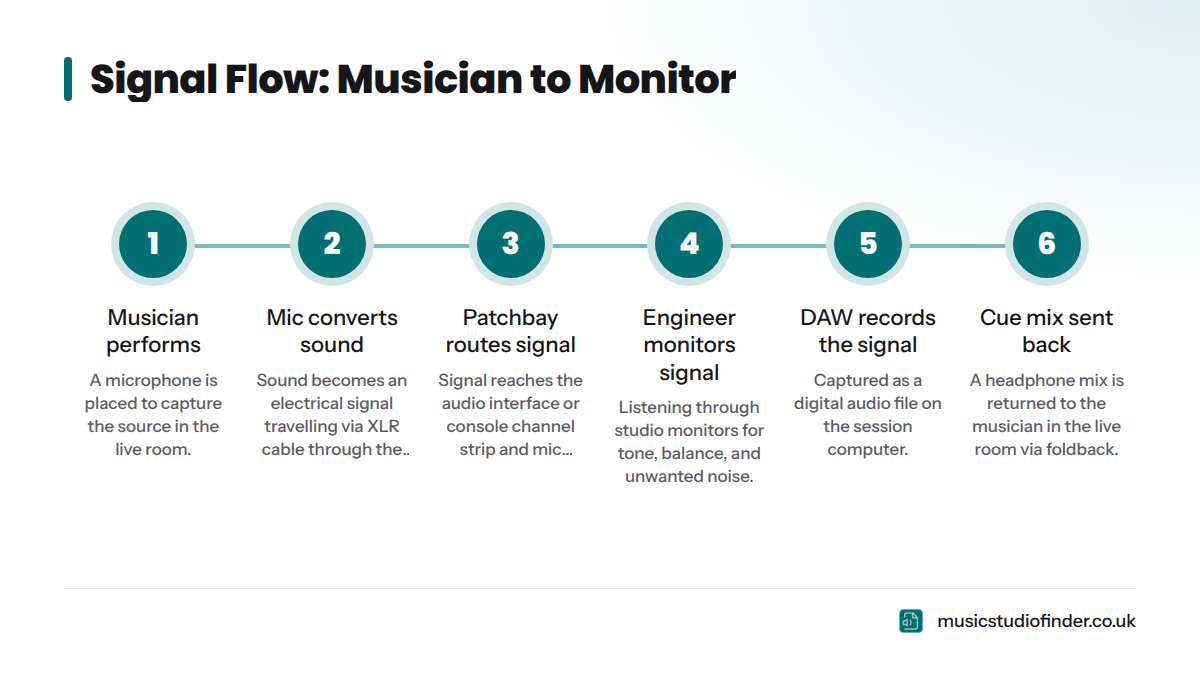
Here is exactly what happens from the moment a musician plays a note to the moment the engineer hears it through the monitors:
- The musician performs in the live room. A microphone is placed to capture the source - a vocal, a guitar, a snare drum.
- The microphone converts sound to an electrical signal. That signal travels via XLR cable through the wall, typically through a wall box or panel, to the patchbay in the control room.
- The patchbay routes the signal to the audio interface or to the console's channel strip, where it passes through a microphone preamplifier.
- The engineer monitors the signal through the studio monitor speakers in the control room, listening for tone, balance, and any unwanted noise.
- The DAW records the signal as a digital audio file on the session computer.
- A cue mix (foldback mix) is created by the engineer - a headphone mix sent back through the wall to the musician's headphone distribution system in the live room, so they can hear themselves and any backing tracks while performing.
This full process is covered in much more depth in what happens in a professional recording session.
The Talkback System - How Engineer and Musician Communicate
With the two rooms acoustically sealed from each other, communication depends on a talkback system. The engineer presses a talkback button on the console, activating a small microphone that feeds directly into the musician's headphones in the live room. The musician can speak back through a talkback speaker near their position, or by pressing their own talkback button if the studio is equipped with one.
The observation window handles everything else: a thumbs-up, a raised finger to signal "one more take," a shake of the head. It sounds low-tech, and it is - but it works. The window is often the most important communication tool in the room.
Physical and acoustic separation exists for a clear reason. Without it, the studio monitors in the control room would bleed into the live room microphones, and the instruments in the live room would be audible in the control room at a level that makes accurate monitoring impossible. Two rooms, two acoustic worlds - working together.
Other Rooms You Will Find in a Recording Studio
Larger professional studios add further specialised spaces beyond the main live room and control room. Here is the full recording studio layout.
Vocal Booth
A vocal booth is a small, acoustically dead room designed for isolated vocal recordings. Its walls are heavily treated with thick broadband absorbers, and its size typically ranges from a large cupboard to a small room holding one or two people.
The vocal booth gives a vocalist complete isolation - no spill from instruments, no room reverb, just the voice captured cleanly. That dryness gives the mix engineer full control over how much reverb and spatial treatment to add in post-production. The trade-off is that some vocalists find the enclosed space uncomfortable; many prefer recording in a larger live room with some natural room sound. Check out the types of recording studios explained for context on how different studio configurations approach this.
Isolation Booth Recording
An isolation booth serves a different purpose from a vocal booth. Rather than housing a vocalist, it typically holds an instrument amplifier - a guitar amp or bass amp - during a live band tracking session. The amp's speaker cabinet sits inside the isolation booth, completely separated from the drum room, while the guitarist stands in the live room playing through a cable that runs through the wall.
This prevents the amp's sound from bleeding into the drum overhead microphones, giving the engineer independent control over the guitar and drum sounds in the mix. Without this separation, adjusting the guitar tone during mixing would be nearly impossible.
Mix Room
Some larger studios maintain a dedicated mix room as a space distinct from the main control room. Used exclusively for mixing already-recorded material - often by a mixing engineer brought in at the end of the recording process - it tends to have an even more carefully calibrated acoustic environment than the main control room. Mixing demands the highest possible monitoring accuracy. See recording vs mixing vs mastering explained for a full breakdown of each stage.
Studio room taxonomy at a glance: Live Room → Vocal Booth / Isolation Booth ↔ Control Room / Mix Room Each space has a distinct acoustic philosophy and a specific function in the recording chain.
What If a Studio Has Only One Room?
Not every studio has this full architecture. Many smaller UK studios and home studios combine the live and control functions in a single space. The engineer and the musician occupy the same room, which means monitoring on headphones during tracking (to avoid mic bleed from the monitor speakers), and switching acoustic modes between "recording" and "mixing" as the session progresses.
This approach works well for solo artists, singer-songwriters, and electronic producers. It becomes problematic for full-band recording, where multiple microphones in one room easily pick up the engineer's monitor speakers, and where the room's acoustic treatment can rarely serve both the "live" and "dead" goals at the same time.
For a full discussion of these trade-offs, recording studio vs home studio covers both the acoustic and practical considerations in detail.
When booking a single-room studio, ask specifically: Can the monitors be turned off during takes? Is the room treated for both recording and monitoring? Is headphone monitoring available? The answers tell you a great deal about whether the room is genuinely set up for both tasks or optimised for just one.
Which Room Do You Need for Your Project?
The answer depends on what you are recording. Here is a practical decision framework:
| Project type | Room you need | Why |
|---|---|---|
| Recording a full band live | Large live room | Space for kit, amps, and bleed control |
| Recording lead vocals | Vocal booth | Isolation and clean, dry capture |
| Recording acoustic instruments | Live room with natural reverb | Ambience enhances the tone |
| Mixing recorded tracks | Control room or mix room | Accurate monitoring is everything |
| Overdubs and electronic production | Control room or small live room | Flexibility over full acoustics |
| Recording guitar or bass amp | Isolation booth | Prevents bleed into other microphones |
| Drum recording | Large live room | Room sound is part of the drum sound |
My honest recommendation: always talk to the studio before booking. A good engineer will ask what you are recording and steer you toward the right room configuration before you spend a penny on studio time. That conversation is free, and it could save you hours.
Before your session, work through the studio session prep checklist - knowing which room you need is just one of the preparation steps that separates a productive session from an expensive one.
Studio Room Acoustics - What to Expect
Acoustic Treatment in the Live Room
When you walk into a professional live room, the surfaces tell the acoustic story immediately. You will see:
- Acoustic diffusers on walls and ceilings - panels with a sculpted or irregular surface that scatter sound energy in multiple directions rather than reflecting it back as a single, coherent echo
- Absorption panels at key reflection points, typically made from dense mineral wool or acoustic foam, reducing excessive high-frequency buildup
- Angled walls and splayed ceiling sections that prevent parallel surfaces from generating standing waves and flutter echo
- Gobos - freestanding portable panels, often with one absorptive face and one reflective face, used to create variable acoustic zones within the room
- High ceilings, in premium rooms, which push problematic room modes further down the frequency spectrum
The Neumann Homestudio Academy's guide on acoustic requirements is one of the clearest publicly available explanations of how these treatments interact to create a usable recording environment.
Control Room Acoustics
The control room's treatment is more precise and more aggressive. Getting low-frequency accuracy right is the single most important acoustic challenge - and here is why: bass frequencies have very long wavelengths, which means they are almost impossible to absorb with thin materials. A panel needs to be at least 30 cm thick to meaningfully attenuate bass frequencies below around 200 Hz. That is why you see thick corner bass traps - the most effective position for absorbing the low-frequency energy that builds up in room corners due to the interaction of room modes.
Above bass, the treatment strategy involves:
- A ceiling cloud of broadband absorption directly above the engineer's head, catching the first ceiling reflection before it reaches the listening position out of phase with the direct sound
- Side-wall panels at the first reflection points - the spots where sound from the monitors bounces off the side walls before reaching the engineer's ears
- Rear wall treatment combining absorption and diffusion to prevent a distinct echo from the back of the room
- Floor-to-ceiling corner treatment for vertical room mode resonances
The practical result: an engineer sitting in a well-treated control room hears a frequency-balanced, time-accurate representation of the mix. What they do to it will translate correctly to speakers outside the studio - which is the only test that matters.
What to Look for When Booking a UK Recording Studio
Booking a studio is easier when you know what questions to ask. Here are the ones that matter most, based on what you now know about these two rooms.
About the live room:
- How large is it? Can it comfortably hold a full drum kit plus two or three musicians?
- What is the acoustic character - more live and reverberant, or drier and controlled?
- Are gobos and baffles available to adjust the sound?
- Is there a separate vocal booth, and is it included in the hire rate?
About the control room:
- What monitor speakers are installed? (The brand tells you a great deal about the studio's monitoring standard)
- Is the room treated to professional acoustic standards?
- Is a mixing console available, or is the studio DAW-only?
About the engineer:
- Is a house engineer included, or do you need to bring your own? See do recording studios include an audio engineer for a full breakdown of how this works across different studio tiers.
About the cost:
- Does the studio charge separately for the live room and control room, or is hire priced per room configuration?
- Are there half-day rates? See the recording studio cost UK guide for 2026 pricing benchmarks.
For a complete walkthrough of how to assess a studio before booking, the how to choose a recording studio guide covers every relevant factor, and what to look for when booking a recording studio goes even deeper on specific red flags and green lights.
Frequently Asked Questions
What does "control room" mean in a studio? The control room is the sound engineer's workspace in a recording studio. It contains the mixing console, monitor speakers, and recording equipment. The engineer uses it to listen to and record what is happening in the live room, and to mix tracks after the session.
What is a live room in a recording studio? A live room is the performance space where musicians play and sing during a recording session. It is acoustically designed to capture a natural, reverberant sound that becomes part of the recorded audio.
What is the difference between a live room and a tracking room? There is no practical difference. "Tracking room" and "live room" refer to the same space. "Tracking" is the industry term for the act of recording individual parts, so a tracking room is simply the room where tracking takes place.
Do all recording studios have a live room and a control room? No. Smaller studios and home studios often combine both functions in one room. A dedicated live room and separate control room are features of mid-to-large professional studios. When booking, always confirm the room configuration in advance.
Can you record vocals in the control room? Technically yes, though it is not standard practice. The control room is acoustically dead and designed for monitoring, not for capturing sound through a microphone. Monitor speaker bleed would also be a problem. A vocal booth or live room produces far better results for most vocalists.
What is the window between the live room and control room called? It is commonly called an observation window or studio window. It is built from thick, angled laminated glass to provide visual contact between the two rooms while maintaining acoustic isolation between them.
What is the purpose of a vocal booth? A vocal booth is a small, acoustically isolated room designed to capture dry, controlled vocal recordings with no room reverb or background noise. It gives the mix engineer full control over how reverb and spatial effects are applied to the vocal in the mix.
What is an isolation booth used for? An isolation booth houses loud instrument sources - typically guitar amplifiers or bass amplifiers - during live recording sessions. Placing the amp in the booth prevents its sound from bleeding into microphones set up to capture drums or other instruments.
What are the different types of rooms in a recording studio? A full-scale professional studio typically includes a live room (performance space), a control room (engineer workspace), a vocal booth (isolated vocal capture), an isolation booth (instrument amp separation), and sometimes a dedicated mix room. Smaller studios may combine several of these functions.
Do home studios have a live room? Most home studios do not have a dedicated live room. Recording and monitoring typically happen in the same space, which is an acoustic compromise. Some home studio owners build small treated rooms specifically for recording, but these rarely match the acoustic performance of a professional live room.
Two Rooms, One Goal
Two rooms. Two completely opposite acoustic philosophies. One shared goal: a great recording.
The live room is designed to flatter sound - to give performances a sense of space, warmth, and natural character that connects with listeners. The control room is designed to tell the truth - to give the engineer an honest, accurate window into the recording so every technical decision lands correctly. Neither room works without the other.
Knowing this before you walk into a studio changes your relationship with the session. You stop being a passenger and start being a participant. You know which room you belong in, why it sounds the way it does, and what the person on the other side of the glass is actually doing.
When you are ready to find a studio with the right setup for your project, Music Studio Finder lists professional UK recording studios with full details on room configurations, equipment, and pricing - so you can book with confidence, not guesswork. And if you want to arrive fully prepared, the how to find a recording studio near you guide is a great next step.