
A music producer oversees the creative direction of a recording project - shaping the sound, arrangement, and artistic vision. A recording engineer handles the technical execution - setting up microphones, operating recording equipment, and capturing the best possible sound. Both work in the studio, but the producer leads creatively and the engineer leads technically.
If you have ever sat down to book studio time and wondered whether you need a producer, a recording engineer, or both, you are not alone. These two roles are routinely confused, partly because the job titles overlap in common usage and partly because one person sometimes does both. This guide untangles every thread: precise definitions, full responsibility breakdowns, sub-role taxonomy, UK earnings data, real-world examples, and a practical decision framework so you can walk into your next session knowing exactly who to call.
What a Music Producer Actually Does
The music producer is the creative architect of a recording project. Think of the role the way you would think of a film director: the producer holds the overall vision, makes the big artistic calls, and steers everyone else toward a shared goal. They are involved from the earliest conversations about a track right through to the moment it is ready for mixing.
In practice, a producer might suggest restructuring a song's chorus, recommend a different drum sound, coach a vocalist through a difficult performance, or decide that a string arrangement needs stripping back. The decisions are artistic, not purely technical - though many producers are deeply technical people.
For a fuller breakdown of what happens during a typical session, our guide on what does a recording engineer do also covers how the producer and engineer divide responsibilities in real time.
Core Responsibilities of a Music Producer
- Pre-production planning: Developing the concept, choosing the studio, selecting session musicians, and mapping out the arrangement before a single microphone is switched on.
- Creative direction: Guiding the artist's performance, suggesting melodic or harmonic changes, and deciding on instrumentation and tempo.
- Arrangement decisions: Determining what goes where in a track - which instruments play in which sections, where space is left, where energy builds.
- Sound design choices: Selecting synthesiser patches, drum samples, or acoustic textures that define the record's character.
- Session management: Keeping the session on budget and schedule, managing the room dynamics, and maintaining momentum.
- Communication with A&R: Acting as the link between the artist and the label's A&R manager when a label is involved.
- Delivering the project: Overseeing the transition from raw recordings to a finished, mix-ready session.
Types of Music Producers
The word "producer" covers a wide range of specialisations. Here is a quick breakdown:
Beat Producer: Creates instrumental tracks - typically loops, drum patterns, and melodic layers - usually working alone in a home studio using a DAW (Digital Audio Workstation) such as FL Studio or Ableton Live. A beat producer sells or leases beats to artists; they may never set foot in a commercial studio.
Co-Producer: Shares production credit with another producer or with the artist themselves. Co-production is common when an artist has a strong vision but needs a more experienced hand to shape and execute it.
Executive Producer: Typically oversees the commercial and logistical side of an album rather than the day-to-day creative work. On major label projects, this is often a senior label figure who funds and co-ordinates the record. On independent projects, it can be the artist themselves.
Arranger-Producer: Focuses specifically on musical arrangement - orchestration, chord voicings, and structural decisions. Particularly common in orchestral pop, jazz, and film score production.
Skills a Music Producer Needs
- Solid music theory: harmony, rhythm, and structure
- Familiarity with at least one major DAW - Logic Pro X, Ableton Live, or Pro Tools are industry standards
- Strong interpersonal and communication skills, because a producer spends as much time managing people as making music
- An ear for what works commercially as well as artistically
- Budget and project management ability
- Knowledge of signal flow and basic recording principles, even if the engineer handles the technical execution
Famous Music Producers - Real-World Examples
Quincy Jones shaped the sound of Michael Jackson's Thriller - still one of the best-selling albums in history - by combining meticulous arrangement with an instinct for pop melody. Rick Rubin co-founded Def Jam Recordings and later stripped Johnny Cash's recordings down to voice and guitar on American Recordings, proving that less is more. Timbaland built an entirely new sonic vocabulary in R&B and hip-hop throughout the 2000s using layered percussion and electronic textures. In the UK, Youth (Martin Glover) has produced for Paul McCartney, The Verve, and Embrace, while Brian Eno's work with U2 and David Bowie defined the ambient and art-rock production styles of the late 20th century.
What a Recording Engineer Actually Does
Where the producer decides what a record should sound like, the recording engineer is responsible for how it gets captured. The recording engineer translates the producer's creative vision into a physical reality - choosing the right microphone, positioning it correctly, setting the preamp gain, managing the signal chain, and committing those sounds to a multitrack recording session in the DAW.
A skilled recording engineer can make the difference between a vocal that sounds like it was captured in a wardrobe and one that fills a room. Their decisions - which condenser microphone to use, how far to place it from the source, how much compression to apply during tracking - shape the raw material that every subsequent stage of production works with.
Core Responsibilities of a Recording Engineer
- Studio setup: Preparing the live room and control room, patching the signal chain, and testing all equipment before the session begins.
- Microphone selection and placement: Choosing between condenser and dynamic microphones, positioning them relative to the sound source, and addressing issues like the proximity effect.
- Gain staging: Setting preamp levels - Neve and SSL consoles are industry benchmarks - so the signal is strong but never clips.
- Monitoring and communication: Running the studio monitors, managing headphone mixes for performers, and communicating clearly with the producer about what is working.
- Recording and punching in: Operating the DAW - most commonly Pro Tools in professional studios - to capture takes, manage playlists, and punch in corrections.
- Tracking overdubs: Recording additional parts - guitar solos, backing vocals, percussion - on top of the basic tracks.
- File management: Organising sessions, labelling tracks, bouncing stems, and preparing files for mixing.
Types of Recording Engineers
The engineering side of music production contains several distinct specialisations:
Tracking Engineer: Focuses on the live recording stage - capturing performances to multitrack in the studio. This is what most people picture when they think of a "recording engineer."
Mixing Engineer: Takes the recorded multitrack session and balances, shapes, and blends every element into a cohesive stereo (or spatial audio) mix. Mixing involves deep use of equalisation (EQ), compression, reverb, and effects processing. This role is often a separate specialist from the tracking engineer.
Mastering Engineer: The final stage before distribution. The mastering engineer processes the finished stereo mix to ensure it sounds consistent across all playback systems, meets streaming platform loudness standards, and is formatted correctly for release. Tools commonly used include iZotope Ozone and hardware limiters.
Live Sound Engineer: Works in live venues rather than recording studios, managing front-of-house and monitor mixes during performances. The skills overlap with studio engineering, but the workflow is entirely different.
Broadcast Engineer: Specialises in audio for television, radio, and film post-production - a distinct career path from music recording.
Skills a Recording Engineer Needs
- Deep knowledge of signal flow from source to DAW
- Microphone technique and acoustic understanding
- Proficiency in Pro Tools, Logic Pro, or another professional DAW
- Understanding of equalisation, compression, and basic audio processing
- Attention to detail and methodical working habits
- Problem-solving under pressure, because sessions rarely go exactly to plan
- Communication skills - the engineer must translate technical issues into plain language for artists and producers
Famous Recording Engineers - Real-World Examples
Steve Albini recorded Nirvana's In Utero, the Pixies' Surfer Rosa, and PJ Harvey's Rid of Me using a philosophy of capturing performances with minimal processing - his approach to microphone placement became influential across indie and alternative recording. Geoff Emerick engineered the Beatles' Revolver and Sgt. Pepper's at Abbey Road Studios, pioneering close-microphone techniques that were considered groundbreaking at the time. Ken Scott engineered David Bowie's Hunky Dory and later produced Supertramp. In the UK, Alan Moulder has engineered and mixed records for Depeche Mode, Nine Inch Nails, and Foo Fighters, demonstrating the long career arc available to a skilled engineer.
Music Producer vs Recording Engineer - Side-by-Side Comparison
Here is a direct comparison across the dimensions that matter most to a working musician:
| Dimension | Music Producer | Recording Engineer |
|---|---|---|
| Primary focus | Creative direction and artistic vision | Technical capture and signal accuracy |
| Typical session role | Leads decisions on sound, arrangement, and performance | Operates equipment, manages signal chain, runs the DAW |
| Key skills | Music theory, communication, arrangement, sound design | Signal flow, microphone technique, DAW operation, acoustics |
| Main tools | DAW (Ableton Live, Logic Pro X, FL Studio), MIDI controllers, synthesisers | Pro Tools, mixing console (SSL, Neve), microphones, preamps, studio monitors |
| Who they work with | Artists, A&R managers, session musicians, co-producers | Producers, artists, assistant engineers |
| When you need them | Pre-production, shaping the sound, developing the record | During tracking, managing the live recording session |
| Average UK day rate (2026) | £250-£1,500+ depending on profile | £150-£600 depending on experience |
| Can they work solo? | Yes - a producer can self-produce and self-record | Yes - a home-studio engineer can track and mix independently |
| Creative authority | High - makes artistic decisions | Lower - executes the vision set by producer and artist |
| Career entry routes | Self-taught beatmaking, music degree, assistant producer | Audio engineering degree, studio assistant, self-taught via DAW |
Day rate estimates are indicative and vary significantly by region, experience, and project scope. See the earnings section below for more detail.
Where the Roles Overlap
In a major label session, the producer and engineer are almost always two different people. In the independent and self-releasing world - which describes most UK artists in 2026 - the line blurs considerably. Budget is the main driver: hiring two specialists costs roughly twice as much as hiring one.
The Producer-Engineer: A Hybrid Role
A producer-engineer (sometimes called a "producineer") handles both the creative direction and the technical recording within a single role. This is increasingly common in modern music production. Many successful records are made by a single person in a home or project studio who writes, produces, records, and mixes the entire project themselves.
The tools that have made this possible are accessible versions of professional software - Logic Pro X for Mac costs a one-time fee of around £199, and Ableton Live Standard starts at around £349. Combined with a quality audio interface and a condenser microphone, a skilled producer-engineer can achieve professional results at a fraction of traditional studio costs.
A real UK example of this hybrid approach: Rob Hobson, a producer, mixing and mastering engineer based in York, offers all three services under one roof - the kind of full-service arrangement that independent artists increasingly seek.
Famous Examples of Producer-Engineers
Butch Vig produced and engineered Nirvana's Nevermind - one of the most commercially successful records of the 1990s - handling both the creative shaping of the record and significant portions of the technical recording work. Prince famously recorded, produced, and played nearly every instrument on his early albums himself, operating as a complete one-man studio operation. Finneas O'Connell produced and recorded his sister Billie Eilish's debut album When We All Fall Asleep, Where Do We Go? almost entirely in their childhood bedroom, winning multiple Grammy Awards for engineering and production in the process.
Can a producer be an engineer? Yes - and it is common. Many working professionals hold both skill sets. In independent and mid-budget sessions, a producer-engineer is often the most cost-effective and creatively coherent choice because one person maintains full context over the project from first idea to finished recording.
Recording Engineer vs Mixing Engineer vs Mastering Engineer - What Is the Difference?
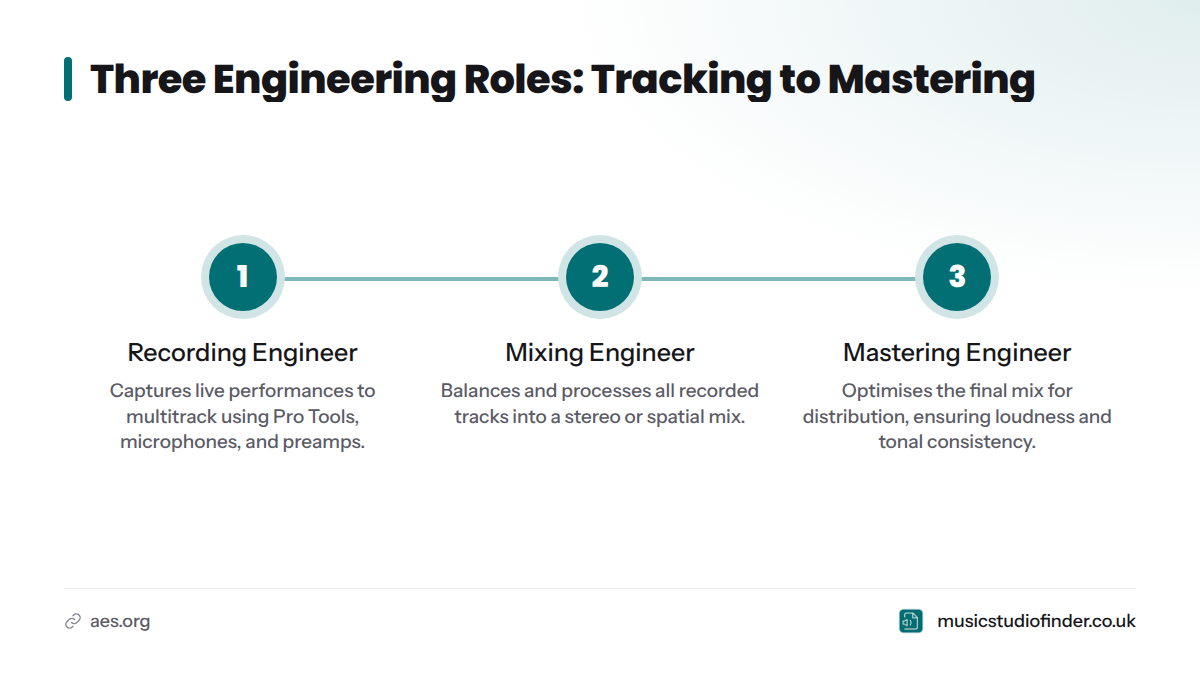
These three engineering specialisations are often confused with one another. They are sequential stages of the same process, but each requires a distinct skill set and a different listening perspective.
| Role | Stage | What They Do | Key Tools |
|---|---|---|---|
| Recording / Tracking Engineer | Tracking | Captures live performances to multitrack | Pro Tools, microphones, preamps, mixing console |
| Mixing Engineer | Post-tracking | Balances, blends, and processes all recorded tracks into a stereo or spatial mix | DAW, EQ, compression, reverb, Waves / iZotope plugins |
| Mastering Engineer | Post-mixing | Optimises the final stereo mix for distribution; ensures loudness and tonal consistency | iZotope Ozone, hardware limiters, reference monitors |
The Audio Engineering Society (AES) - the international standards body for audio engineering - provides technical guidelines and educational resources that underpin professional practice across all three of these stages.
A single project typically passes through all three stages in sequence. Some engineers specialise in just one; others - particularly in smaller studios or home setups - cover two or all three.
Do You Need a Producer or an Engineer for Your Project?
This is the question that brings most readers here, so let's answer it directly. Your answer depends on what stage you are at and what you actually need from a session.
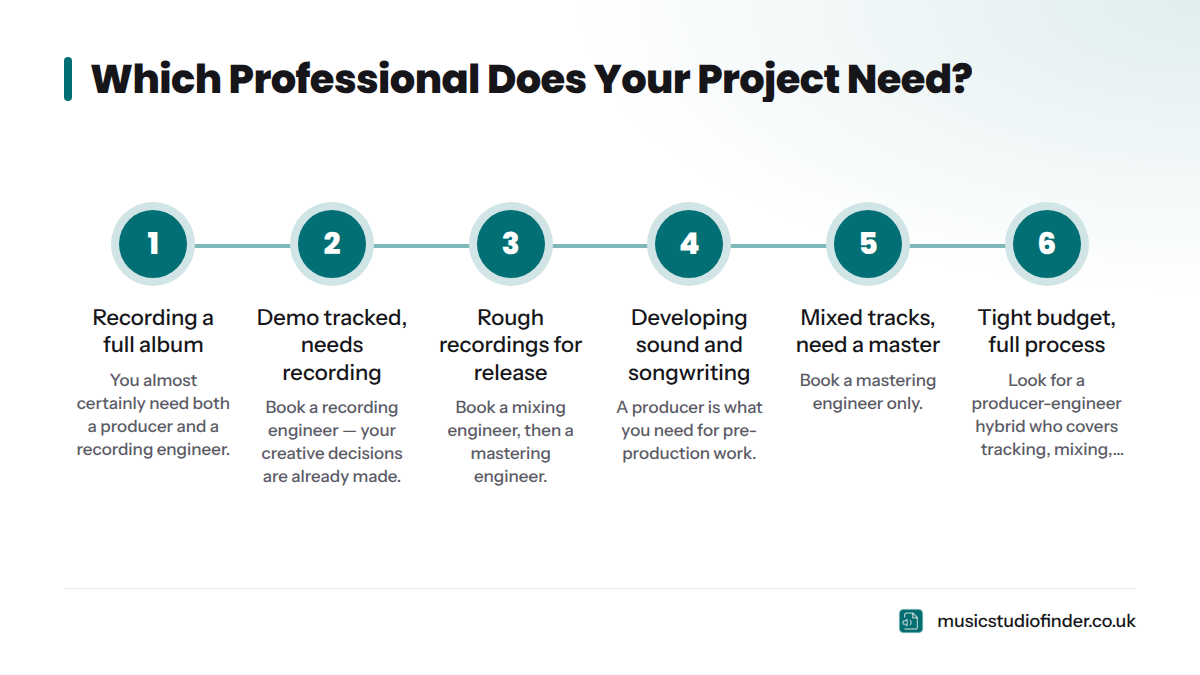
Decision framework - match your situation to the right professional:
- Recording a full album from scratch - You almost certainly need both. A producer shapes the artistic direction; an engineer captures it cleanly. Many studios offer both as a package.
- You have a finished demo and just need it tracked properly - Book a recording engineer. Your creative decisions are already made.
- You have rough recordings and need them balanced for release - Book a mixing engineer (and later a mastering engineer). The tracking phase is already done.
- Your tracks are mixed and you need a release-ready master - Book a mastering engineer only.
- You are still developing your sound and songwriting - A producer is what you need. Pre-production work - before a single note is tracked - is where a producer earns their fee.
- You are on a tight budget and need the whole process done - Look for a producer-engineer hybrid who can handle tracking, mixing, and sometimes mastering under one arrangement.
- You want to record yourself but are unsure whether a studio comes with an engineer - Read our article on do recording studios include an audio engineer before you book.
If you are unsure whether you even need a producer in the room, our guide on booking a recording studio without a producer walks through exactly when that works and when it does not.
Questions to Ask Before You Book
- Does this studio have a house engineer, or do I need to bring my own?
- Does the producer have experience in my genre?
- Will the engineer also handle mixing, or is that a separate booking?
- What DAW does the studio use, and can they export stems in a format I can take elsewhere?
- What is included in the day rate, and what costs extra?
Our full list of questions to ask before booking a music studio covers everything you need to confirm before you commit.
What Each Role Costs in the UK
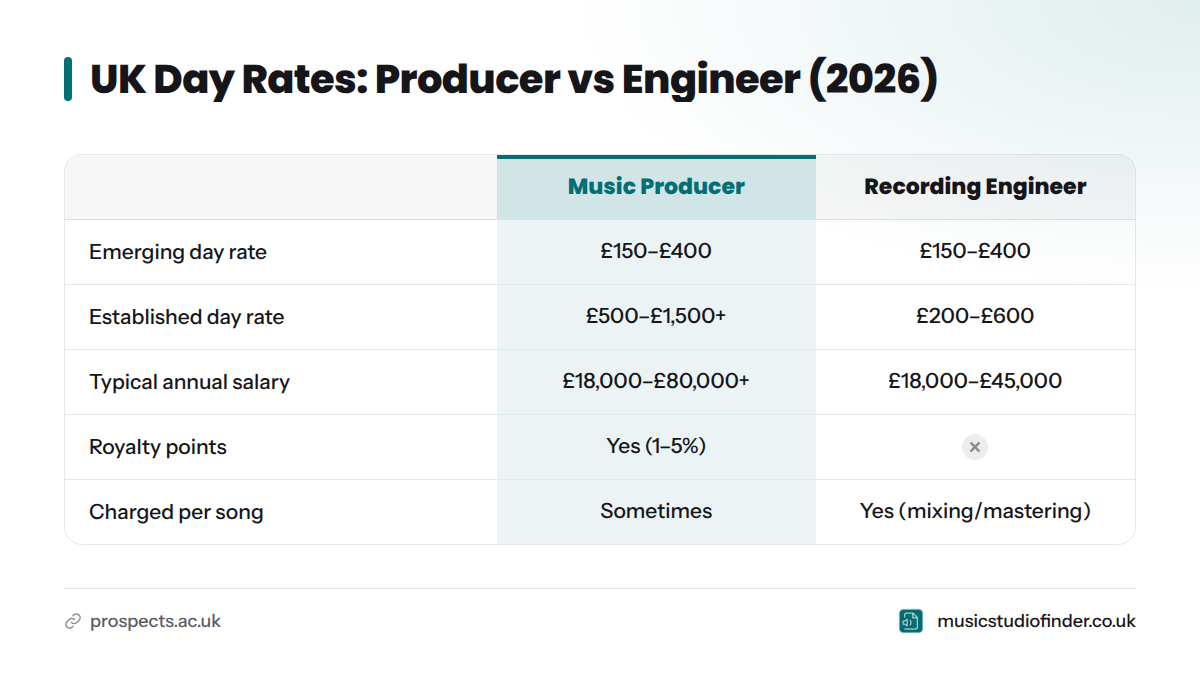
Earnings and rates in music production vary widely depending on experience, location, genre, and whether someone is on a day rate or taking royalties. Here are realistic UK benchmarks for 2026:
| Role | Typical UK Day Rate | Typical UK Annual Salary (Employed) | Notes |
|---|---|---|---|
| Music Producer (emerging) | £150-£400 | £18,000-£28,000 | Plus potential royalty points (1-5% of record sales) |
| Music Producer (established) | £500-£1,500+ | £40,000-£80,000+ | Top-tier producers earn significantly more via royalties |
| Recording / Tracking Engineer | £150-£400 | £18,000-£30,000 | Studio staff roles at lower end; freelance at higher |
| Mixing Engineer | £200-£600 per project | £20,000-£40,000 | Often charged per song rather than per day |
| Mastering Engineer | £50-£200 per song | £20,000-£45,000 | Highly variable; some online services charge from £20 per track |
According to the Sound Engineer job profile on Prospects.ac.uk, starting salaries for audio engineers in the UK typically fall between £18,000 and £22,000, with experienced engineers earning £25,000 to £45,000 and senior or freelance engineers commanding considerably more. The Music Producers Guild UK (MPG) represents producers and engineers in the UK and publishes guidance on fair rates and working conditions.
Producers who work on major label releases typically negotiate "points" - a percentage of royalties - rather than a flat fee, which means their long-term earnings can far exceed their day rate if a record performs well commercially. For a detailed breakdown of what studio time itself costs, our recording studio cost UK guide covers current pricing across different studio tiers.
How to Work Effectively With a Producer or Recording Engineer
Knowing who to hire is half the battle. Knowing how to communicate with them once you are in the room is the other half.
Working With a Music Producer
Come prepared. Arrive at pre-production with reference tracks - songs that capture the feeling or sound you want. A producer cannot read your mind, but they can work from concrete examples.
Be open to feedback. A producer's job is to make the best possible record, which sometimes means suggesting you rethink a chorus or simplify an arrangement. Separating your ego from your song is one of the most productive things you can do in a studio.
Agree on scope upfront. Clarify whether the producer is also handling mixing and mastering, or whether that is a separate engagement. Get it in writing.
Say what you feel. Producers are there to serve the music. If something does not feel right, diplomatic honesty gets better results than silent frustration.
Working With a Recording Engineer
Tune up and be ready. The clock runs from the moment you walk in. Arrive with instruments set up, vocals warmed up, and drum heads tuned. An engineer cannot make a poorly tuned guitar sound in tune.
Trust their microphone placement. A recording engineer who has been doing this for years knows where to position the microphone. Ask questions if you are curious, but do not move their setup without discussion.
Communicate how you want to feel in the headphones. The monitor mix - what you hear through your headphones while recording - is fully adjustable. Tell the engineer if you want more reverb on your voice or less kick drum, and they will dial it in.
Understand that tracking is not mixing. The raw recorded sound will not resemble the finished product. Do not panic when the rough session sounds dry and unprocessed.
Music Production Roles Explained - Career Paths in the UK
Becoming a Music Producer
Most working producers today arrived through one of three routes: self-teaching through a DAW, a music production or music technology degree, or working as an assistant in a professional studio. There is no single correct path.
The self-taught route has become genuinely viable since the mid-2010s. YouTube tutorials, online courses, and affordable software have made it possible to learn production to a professional level without formal education. Many chart-level producers - particularly in electronic, hip-hop, and pop - are self-taught.
Formal education at institutions offering music technology or music production programmes provides structured training in theory, acoustics, and engineering fundamentals. UK institutions offering relevant programmes include BIMM (British and Irish Modern Music Institute), Leeds Conservatoire, and the British Academy of New Music. These programmes typically run two to three years.
The assistant route - starting as a runner or studio assistant in a professional facility and working your way up - remains one of the best ways to absorb real-world knowledge. The Music Producers Guild UK offers networking events and mentorship opportunities that can accelerate this path.
Becoming a Recording Engineer
Audio engineering leans more heavily on technical knowledge than music production does, which means formal training is more commonly cited as a foundation. UK universities and colleges offer BSc and BA programmes in audio engineering, music technology, and sound design.
Practical experience is non-negotiable. Many engineers begin as studio assistants, progressing to second engineer - assisting the lead engineer in sessions - then to lead engineer. Building a portfolio of projects, even self-initiated ones, is essential for establishing credibility.
Key professional development resources include the Audio Engineering Society, which publishes technical papers, runs conventions, and maintains a community of working engineers internationally.
Frequently Asked Questions
Can a music producer also be a recording engineer? Yes. Many working professionals in the UK and globally hold both skill sets and operate as producer-engineers. Butch Vig, Finneas O'Connell, and Prince are well-known examples. In independent and mid-budget projects, one person handling both roles is common and often cost-effective.
How much do recording engineers make in the UK? According to Prospects.ac.uk, starting salaries for UK sound engineers typically range from £18,000 to £22,000 per year. Experienced engineers earn between £25,000 and £45,000, with senior freelance engineers and those working on major label projects earning considerably more. Freelancers typically charge £150 to £600 per day depending on experience and specialisation.
Who makes more money - a music producer or a recording engineer? At the top end of the industry, producers generally earn more because they can negotiate royalty points on commercially successful records. An established producer on a platinum album may earn far more than their original day rate through ongoing royalties. Recording engineers are more commonly paid a flat fee or day rate, though senior engineers on major label projects command substantial rates. At the entry to mid level, earnings are broadly comparable.
Is DJ Khaled a producer or an engineer? DJ Khaled is a record producer and A&R figure - not a recording engineer. His role is primarily executive and creative: he assembles collaborators, secures featured artists, and oversees the artistic direction of projects. The technical recording and engineering on his releases is handled by specialist engineers.
Do I need a producer or an engineer for my recording session? It depends on what you need. If your songs are fully written and arranged and you just need them captured cleanly, book a recording engineer. If you need help shaping the sound, developing the arrangement, or coaching your performance, a producer is the right hire. For a full project from scratch, you likely need both - or a producer-engineer hybrid.
What is the difference between a recording engineer and a mixing engineer? A recording (or tracking) engineer captures live performances to multitrack during the session. A mixing engineer takes those recorded tracks and balances, processes, and blends them into a finished stereo or spatial audio mix. These are often two different people, though some engineers cover both stages.
What does a recording engineer do during a session? A recording engineer sets up and tests all equipment before the session begins, selects and positions microphones, manages the signal chain from source to DAW, monitors levels and sound quality throughout recording, operates the DAW to capture takes and manage playlists, and organises and exports files at the end of the session.
Glossary of Key Music Production Terms
DAW (Digital Audio Workstation): Software used to record, edit, arrange, and produce audio. Pro Tools, Logic Pro X, Ableton Live, and FL Studio are the most widely used in professional and home studio settings.
Tracking: The stage of recording in which performances are captured to multitrack. "We spent two days tracking drums" means two days of recording drum takes.
Overdub: Recording an additional part on top of existing tracks. Backing vocals, guitar solos, and percussion are commonly overdubbed after the basic tracks are recorded.
Mixing: The process of balancing, panning, and processing all recorded tracks into a single cohesive stereo or spatial audio output.
Mastering: The final audio processing stage before distribution. A mastering engineer optimises the mix's tonal balance and loudness for playback across all speaker systems and streaming platforms.
Signal chain: The path that audio travels from the source (e.g., a microphone) through hardware (preamp, converter) and into the DAW. Understanding signal chain is fundamental to engineering.
Preamp: A preamplifier that boosts a microphone-level signal to line level. Neve and API preamps are considered industry benchmarks for their tonal character.
Stem: A bounced audio file that contains a group of related tracks (e.g., "drum stem," "vocal stem"). Stems are used in mixing, remixing, and live performance.
A&R (Artists and Repertoire): The division of a record label responsible for talent scouting and overseeing the artistic development of artists. An A&R manager is a key contact point between an artist and their label.
Session musician: A professional musician hired to perform on a recording rather than as a permanent member of a band. Session musicians are typically paid a flat session fee rather than royalties.
Pre-production: The planning phase before recording begins. Pre-production includes arranging songs, rehearsing, selecting a studio, and making all major creative decisions. Producers typically lead pre-production.
Phantom power: A 48V DC current supplied by a mixing console or audio interface to power condenser microphones. Most condenser microphones - the standard choice for studio vocal recording - require phantom power to operate.
Find the Right Studio, Producer, or Engineer
Knowing the difference between a music producer and a recording engineer changes how you approach a studio booking entirely. You can walk into a session with a clear brief, ask the right questions, and get the most from your time and budget.
Music Studio Finder makes it straightforward to connect with the right professionals across the UK. Whether you need to find a music producer who fits your genre and budget, or want to find a recording studio equipped with an in-house engineer, the platform lists verified options across the country. You can also use our guide to how to find a recording studio near you to narrow down your options by location and studio type.
The right team makes the right record. Now you know exactly who to call.