
You see a studio advertised at £30 per hour and think: "Perfect, that fits my budget." Then the invoice arrives and it's nearly double what you expected. Engineer fee not included. Mixing charged per track. Overtime because the session ran long. File delivery billed separately. This happens to musicians across the UK every week, and it's almost always avoidable.
Recording studio hidden fees span at least twelve distinct categories - from overtime rates and stem export fees to parking charges and VAT. Knowing exactly what to ask before you sign protects your budget and your peace of mind.
This guide covers every common studio booking extra charge at both recording and rehearsal studios in the UK, with real cost ranges, a pre-booking checklist, and a comparison table across studio tiers. Use it every time you enquire about a studio booking - it could save you hundreds of pounds.
If you want a broader look at what studio hire involves before we get into the extras, the recording studio cost UK guide on Music Studio Finder is a solid starting point.
Why Your Studio Quote Often Isn't the Full Price
Room Rate vs. Total Session Cost
Studios advertise their room rate because it is their most competitive number. But the room rate - sometimes called the tracking rate or hire rate - typically covers only the physical space and its built-in equipment for a set block of time. The moment you need a recording engineer, mixing, specific backline, or anything beyond four walls and a desk, you're in add-on territory.
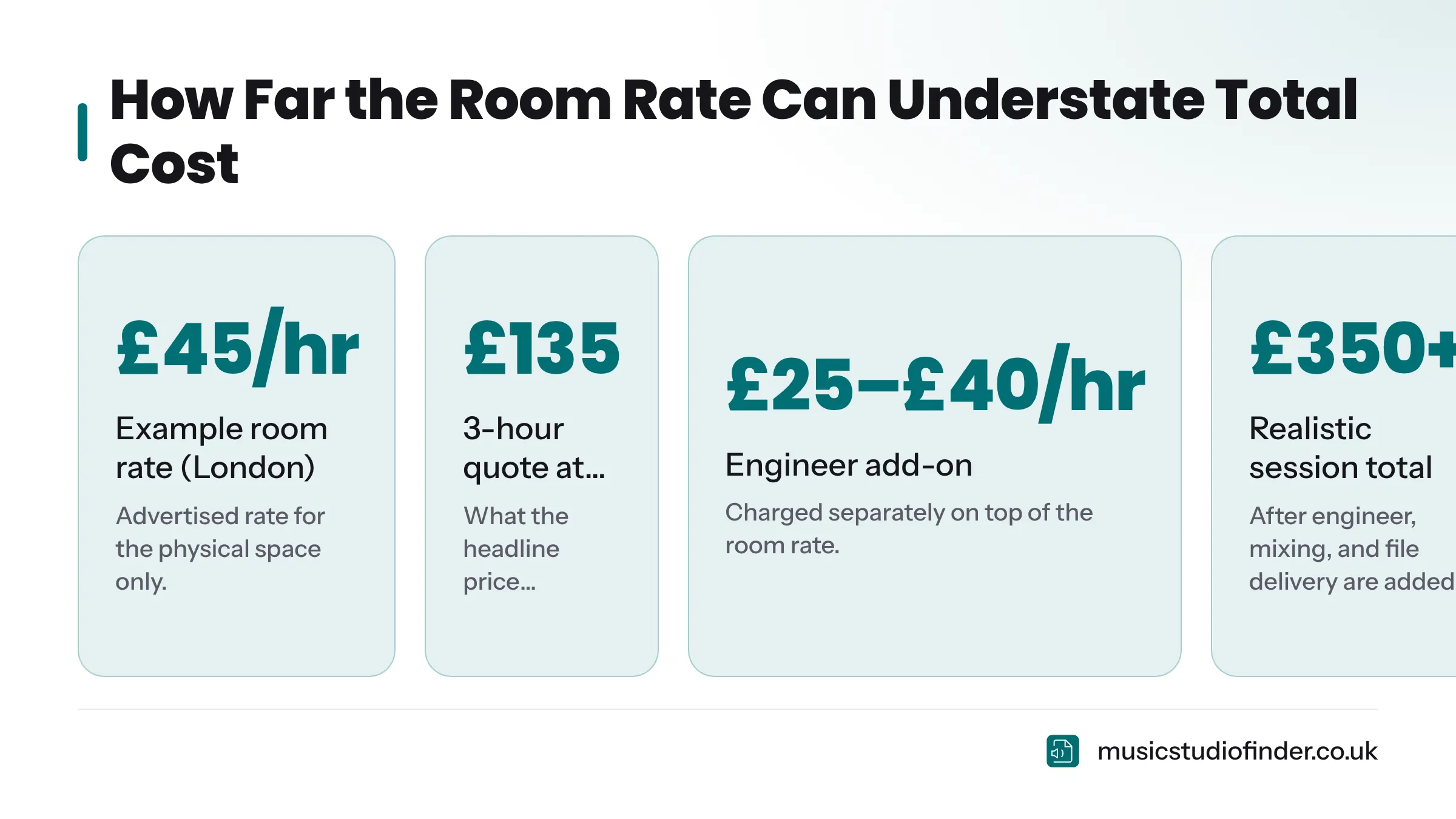
The gap between room rate and total session cost can be surprisingly wide. A London studio might list £45 per hour on its website; by the time you factor in the engineer (£25-£40/hr extra), mixing (£100-£400 per track), and file delivery, a three-hour session quoted at £135 can realistically land above £350.
Always ask: "Is this the room rate only, or does it include the engineer?" If a studio cannot answer that clearly, that tells you something too.
How Studios Structure Their Pricing
Studios generally price in one of three ways: an hourly rate, a day rate vs hourly rate (typically 8-10 hours), or a project-based package. Each model carries different assumptions about what's included.
Hourly rates almost never cover post-production work like mixing or mastering. Day rates sometimes bundle a rough mix or a fixed number of revision rounds. Project packages vary the most - some are genuinely all-in, others are structured so that every deliverable beyond raw tracked audio costs extra. Understanding why recording studio prices vary so much helps you read quotes more accurately from the start.
The Hidden Cost Checklist - What to Confirm Before You Book
Use this checklist every time you enquire about a studio. Each item represents a real cost category that UK studios charge separately, sometimes without volunteering the information unless you ask directly.
1. Engineer and Producer Fees
Many studios - particularly in cities like London, Manchester, and Edinburgh - advertise a room-only rate. The recording engineer, the person who operates the desk, sets up microphones, monitors levels, and manages your session, is quoted separately.
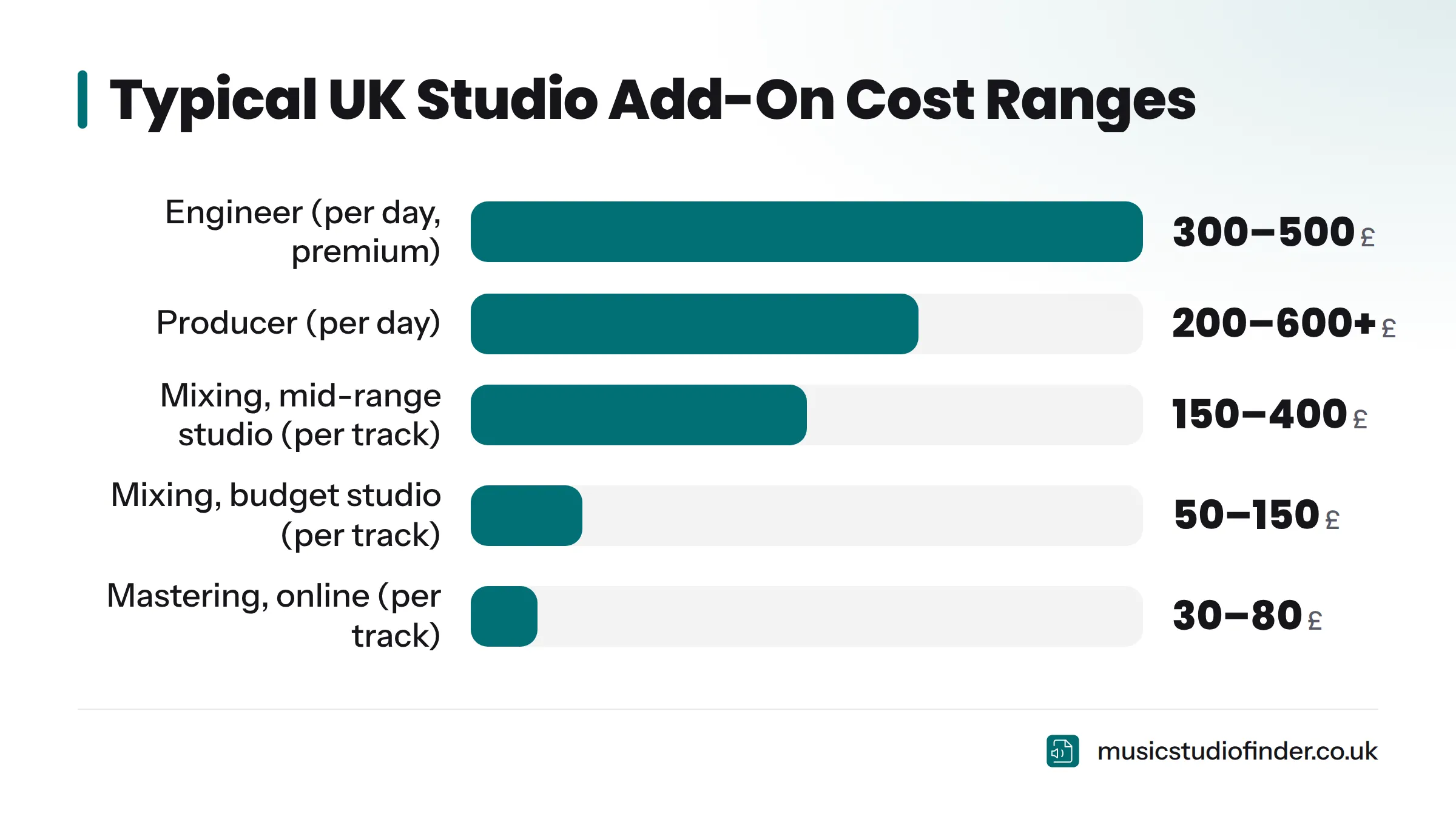
Typical UK cost range: Engineer fees run from £20 to £60 per hour depending on the studio tier and the engineer's experience. A full-day engineer at a premium studio can add £300-£500 on top of the room rate alone.
Some studios offer in-house producers as a further add-on. A producer's role goes beyond technical operation - they shape arrangements, guide performances, and make creative decisions. Producer fees in the UK typically start from £200 per day at independent studios and can exceed £600 per day for experienced credits.
Ask specifically: "Is an engineer included in this rate, or is that a separate charge?"
2. Mixing and Mastering Charges
Tracking your instruments and vocals is one thing. Mixing - balancing every element, applying EQ, compression, and effects so the song sounds finished - is usually a separate service entirely.
Typical UK mixing cost: £50-£150 per track at budget and independent studios; £150-£400 per track at mid-range and premium studios. Some studios charge per stem group rather than per finished track.
Mastering - the final loudness, tonal balance, and format preparation stage before release - is rarely included in a standard session rate. Expect to pay £30-£80 per track for independent online mastering and £80-£200+ per track for in-house mastering at a full-service studio.
If a studio quote says "mixing included," confirm what that actually means: a rough mix at the end of the session, or a full commercial mix with revision rounds?
3. Overtime and Session Overrun Fees
Sessions run over. It happens to every musician, from first-timers to seasoned professionals. Studios protect their schedule with an overtime rate, and it is almost always higher than the standard hourly rate.
Typical UK overtime rate: 1.5x to 2x the standard hourly rate, charged in 30-minute increments. On a £40/hr room with a £30/hr engineer, a one-hour overrun could cost you £105 rather than £70.
The best way to avoid this is to book slightly more time than you think you need. The guide on how many hours to book in a recording studio walks through realistic time estimates by project type.
4. File Delivery and Stem Export Fees
After your session, you expect to leave with your recordings. But "leaving with your recordings" covers a wide range of possibilities, and not all of them fall within the base rate.
Standard delivery typically means a stereo WAV or MP3 mix of the finished track. What often costs extra:
- Stem exports - individual grouped audio exports (drums, bass, guitars, vocals) for future remixing or production. Stems require the engineer to re-bounce multiple files; many studios charge £20-£75 per set.
- Individual track exports (dry files) - every recorded track as a separate audio file, which you might need if you're taking the project to a different studio or mixing engineer.
- Pro Tools, Logic Pro, or Ableton Live project file handover - the actual session file, including all plugins, automation, and settings. Some studios charge £30-£100 for project archive handover.
- Multiple format delivery - WAV, AIFF, and MP3 at different sample rates, all billed separately.
Confirm in writing exactly what file formats you will receive and whether stem export is included before you commit to a booking.
5. Equipment and Backline Hire Charges
Backline refers to the amplifiers, drum kits, keyboards, and other instruments a studio stocks for use during sessions. The term comes from the live music world, where gear sits at the back of the stage. In a studio context, it means any physical equipment beyond the recording desk and monitoring system.
Many studios list "fully equipped" in their descriptions, but that phrasing covers a lot of ground. Whether a drum kit, a specific guitar amplifier, or a grand piano is included in the room rate or billed as a hire charge varies considerably.
Typical UK backline hire costs:
- Drum kit hire: £20-£60 per session
- Guitar or bass amplifier hire: £10-£30 per session
- Upright or grand piano: £50-£150 per session at specialist studios
- In-ear monitoring (IEM) system hire: £20-£50 per session
Ask: "Is the drum kit in the live room included in the rate, or is that a separate hire charge?"
6. Revision and Editing Rounds
Most mixing and mastering services include a set number of revision rounds - usually one or two. A revision round means you listen to the delivered mix, send feedback, and the engineer makes changes. Beyond the included rounds, you pay per revision.
Typical revision costs: £25-£75 per additional round at independent studios; £75-£200 at premium facilities. On a complex project with multiple band members or stakeholders, revision costs can accumulate quickly.
Confirm how many revision rounds are included and what triggers the clock - some studios count listening passes, others only count returned revision notes.
7. Deposit Policies and Cancellation Fees
Almost every UK recording studio requires a deposit to secure a booking. Standard deposits range from 25% to 50% of the total session cost, paid at the time of booking.
What happens to that deposit if you cancel is where things get complicated. Policies vary widely:
- Non-refundable deposits: Common across all studio tiers. If you cancel with less than 48-72 hours' notice, you forfeit the deposit entirely.
- Partial refund on rescheduling: Some studios allow you to move the deposit to a future date rather than losing it.
- Late cancellation charges: Beyond forfeiting the deposit, some studios charge the full session rate for cancellations inside 24 hours, particularly if they cannot rebook the slot.
Before you pay any deposit, read the cancellation terms carefully. The dedicated guide on whether recording studio deposits are refundable covers exactly what to look for and how to protect yourself.
8. Session Musician and Hire Costs
If you need a session drummer, bassist, pianist, or vocalist - either because your band is incomplete or because you want a specialist performance - you will need to arrange and pay for them separately. Studios rarely include session musicians in their rates; they facilitate introductions at best.
The Musicians' Union (UK) publishes recommended minimum session rates to protect working musicians. As of 2026, MU-recommended session rates for a three-hour recording session start at approximately £90-£120 for session musicians working under standard agreements, though experienced players command significantly more.
Platforms like SoundBetter let you hire remote session musicians for overdubs and specific parts, which can be more cost-effective for parts that don't require live room presence.
Budget £100-£300 per session musician per session day when planning a project, and confirm in advance whether the studio can recommend vetted players or whether that sourcing is entirely on you.
9. ISRC Codes and Metadata Registration Fees
An ISRC (International Standard Recording Code) is the unique identifier assigned to each individual sound recording. It's how streaming platforms, PPL UK, and collecting societies track plays and distribute royalties. Every commercially released track should have one.
Some studios offer ISRC registration as part of their delivery service and charge for it - typically £5-£15 per track. Others simply hand you the code to register yourself, which is free through a registered ISRC manager. You can obtain codes via PPL UK if you are a registered label, or through a distributor.
Similarly, embedding metadata - track title, artist name, ISRC, PRS for Music and PPL identifiers - into delivered files is sometimes an additional service. Confirm whether metadata is embedded in your final files and, if so, whether it is included in the session rate.
10. Storage, Archiving, and File Hosting Fees
After your session concludes, your project files live on the studio's server. Most studios keep session files for 30 to 90 days as standard. After that, some delete them; others offer paid extended storage.
Typical storage costs: £10-£30 per month for cloud or server archiving at independent studios. Some charge a one-off project archive fee (£20-£50) to transfer the full session to a hard drive or cloud link for you to keep permanently.
Always collect your files promptly and back them up yourself. Do not rely on the studio to maintain long-term copies unless you have a written storage agreement.
11. VAT and Tax on Studio Hire in the UK
This one catches a lot of musicians off guard. UK studios that are VAT-registered must add 20% VAT to their prices. Whether the rate on the website is inclusive or exclusive of VAT depends entirely on the studio and how they present their pricing.
A £50/hr quote that excludes VAT becomes £60/hr once VAT is applied. On a full-day session, that difference is real money.
Studios with an annual turnover above the VAT registration threshold (£90,000 in 2026 under HMRC guidance) are legally required to be VAT registered. Smaller independent studios below that threshold may not charge VAT at all.
Ask: "Is VAT included in the quoted rate?" It is a simple question that can save you 20% on your budget planning.
12. Parking, Access, and City-Centre Surcharges
City-centre studios in London, Birmingham, Manchester, and Edinburgh often have no free on-site parking. If you're transporting instruments, amps, or a full band's gear, parking becomes a significant practical and financial issue.
Costs to check:
- Pay-and-display or car park charges: £5-£25 per day in central London; £3-£10 in other UK cities.
- London Congestion Charge: £15 per day to drive into the central zone on weekdays.
- Loading restrictions: Many city-centre studios have time-limited loading bays. If you cannot load during permitted hours, you may face a penalty charge notice.
- ULEZ (Ultra Low Emission Zone) charges: Older vehicles driving in Greater London's ULEZ pay £12.50 per day.
If the studio does not have dedicated parking, find out the nearest option and budget accordingly before booking.
What's Typically Included vs. Charged Extra Across Studio Tiers
Different studio tiers operate very different inclusion models. Here is a realistic breakdown based on common UK studio pricing structures in 2026:
| Cost Item | Budget Studio (£15-£30/hr) | Mid-Range Studio (£30-£60/hr) | Premium Studio (£60-£150+/hr) |
|---|---|---|---|
| Room hire | Included | Included | Included |
| Recording engineer | Often extra | Usually included | Included |
| Basic equipment & monitoring | Included | Included | Included |
| Drum kit / backline | Sometimes extra | Usually included | Included |
| Rough mix at session end | Rarely included | Sometimes included | Often included |
| Full mixing service | Always extra | Always extra | Always extra |
| Mastering | Always extra | Always extra | Always extra |
| Stem exports | Extra (£20-£50) | Extra (£20-£75) | Extra (£50-£150) |
| Project file handover | Extra or not offered | Extra (£30-£75) | Extra (£50-£100) |
| ISRC registration | Not offered | Sometimes offered | Sometimes included |
| File storage (30 days) | Sometimes included | Usually included | Included |
| Extended storage | Extra or not offered | Extra | Extra |
| Parking on site | Rarely available | Sometimes available | Sometimes available |
| Revision rounds (mixing) | 0-1 included | 1-2 included | 2-3 included |
| VAT status | May not be VAT reg. | Usually VAT registered | VAT registered |
Prices are estimates based on typical UK market rates in 2026 and will vary by location and individual studio.
Hidden Costs Specific to Rehearsal Studios
Rehearsal studios operate differently from recording studios, and their hidden costs reflect that. If you're booking space to practise or run through a set before a gig, these are the charges to watch for.
Equipment Damage Deposits
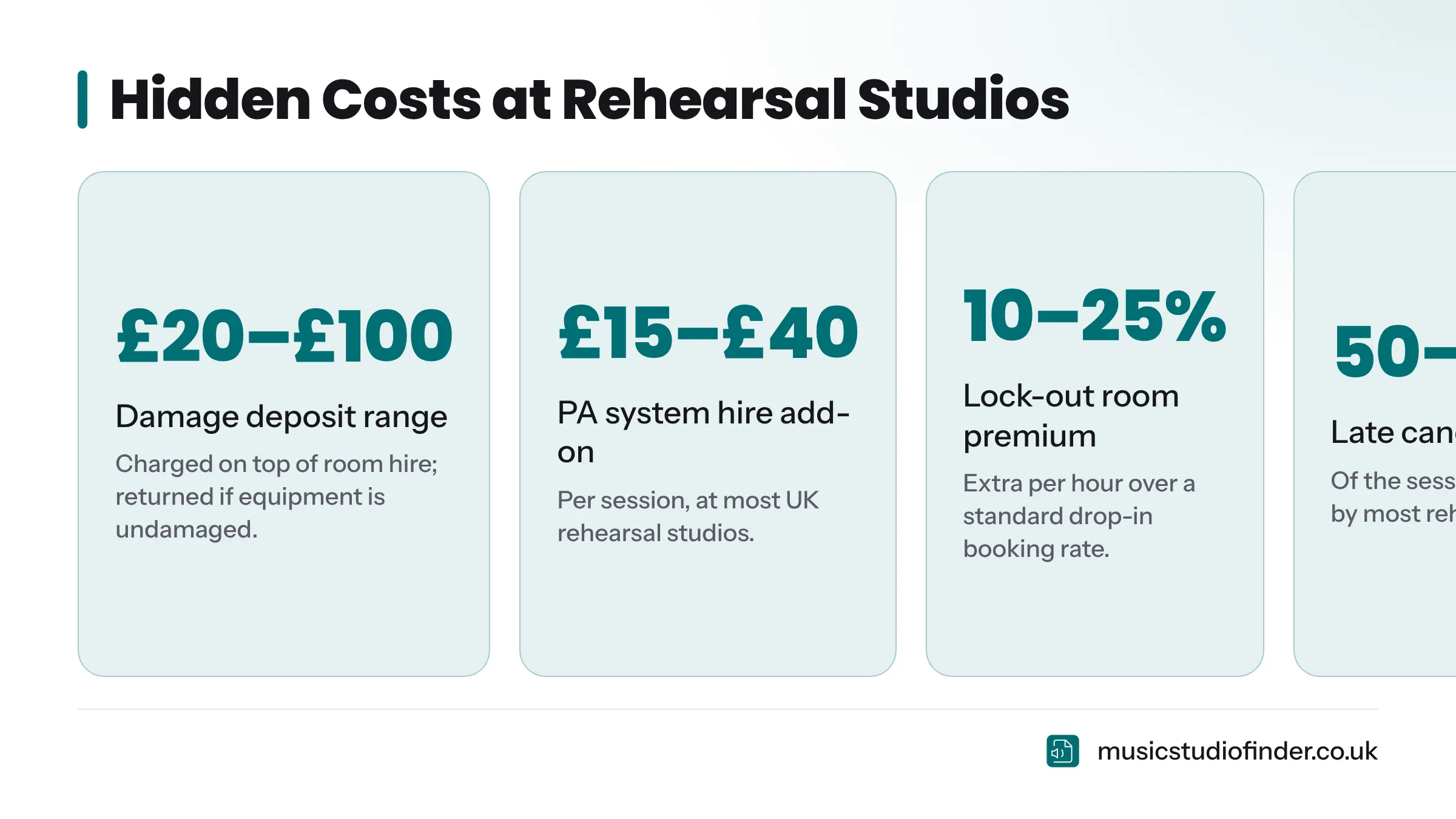
Many rehearsal studios require a cash or card damage deposit on top of the room hire rate, particularly if you're using their drum kit, PA system, or amplifiers. Deposits typically range from £20 to £100 and are returned after the session if equipment is undamaged. Clarify the policy before you arrive - some studios process card holds, others want cash only.
PA System and Monitoring Hire
Rehearsal rooms often advertise a basic rate that includes a drum kit and amplifiers but not a PA system for vocals or backing tracks. A PA with a mixer and monitors adds £15-£40 per session at most UK rehearsal studios. In-ear monitoring systems, if available, are a separate hire on top.
Lock-Out Rooms vs. Drop-In Bookings
A lock-out room is a rehearsal space booked exclusively for one band on a long-term contract - typically weekly or monthly. Lock-out arrangements guarantee you the same room at the same time each week and usually come with dedicated storage. They cost more per session than a standard drop-in booking (often 10-25% more per hour), but the premium buys you consistency and the ability to leave gear in the room. The differences between recording and rehearsal studios are worth understanding before you decide which arrangement suits your setup.
Late Cancellation Charges
Rehearsal studios run on tight margins. A last-minute cancellation leaves a room empty with no revenue. Most rehearsal venues charge 50-100% of the session fee for cancellations inside 24-48 hours, and many require a non-refundable deposit equivalent to one session to secure regular bookings. The full UK pricing picture for rehearsal rooms is covered in the rehearsal studio cost UK guide.
Questions to Ask Every Studio Before You Book
Save this list to your phone or copy it into an email enquiry. These questions cover every major hidden cost category and will get you the information you need before any money changes hands.
- Is this quote for the room only, or does it include a recording engineer?
- What does the session rate include after tracking is complete - editing, comping, and mixing?
- What is your overtime rate, and how is it calculated (per hour or per 30 minutes)?
- How many revision rounds are included in mixing? What do additional rounds cost?
- What file formats will I receive? Is stem export included, or is that charged separately?
- How long will you keep my session files? Is there a storage or archive fee?
- What is your cancellation and rescheduling policy?
- Is the deposit refundable? Under what conditions will you return it?
- Is VAT included in the quoted rate?
- Is parking available at or near the studio? Is it free?
- Is the drum kit and backline included, or are they hired separately?
- Do you register ISRC codes, and is that included in the rate?
For a deeper set of questions covering the studio's gear, team, and track record, the full questions to ask before booking a music studio resource is worth reading before any enquiry.
It's also worth considering a visit in person. Knowing whether you can tour a recording studio before booking is a practical step many musicians overlook, but a visit often reveals what a website will not.
How to Negotiate and Avoid Surprise Charges
Get a Written Itemised Quote
A verbal agreement or a website price list is not sufficient protection. Before you pay a deposit, ask the studio for a written itemised quote that specifies the room rate, engineer fee, included services, overtime rate, file delivery terms, and cancellation policy. Any reputable studio will provide this without hesitation. If a studio refuses to put the breakdown in writing, walk away.
Ask About Package and Block Booking Deals
Studios - particularly independent ones - often have more flexibility than their public rates suggest. If you need multiple days of studio time for an EP or album, ask whether they offer a block booking rate. Booking three or four days in advance often unlocks a 10-20% discount and may also bundle in services that would otherwise be charged separately, such as a rough mix, a set of stem exports, or extended storage. The guide to finding an affordable recording studio in the UK covers negotiation tactics in more detail.
Preparation Reduces Billable Time
Every minute you spend reworking arrangements, tempos, or lyrics in the studio is a minute you're paying for. Arriving with clearly rehearsed parts, a pre-agreed song structure, and reference tracks cuts session time considerably. A well-prepared band can track a full song in an hour; an underprepared one can burn three hours on the same material. The studio session prep checklist is the most practical tool for getting this right before you arrive.
Read the Booking Contract Before You Sign
Studio contracts are not standardised across the UK industry. Some are a single paragraph on an email; others run to several pages. Whatever the format, read it. Pay specific attention to:
- Overtime clauses and how overruns are triggered and billed
- Deposit terms and conditions for refund or forfeiture
- Ownership and delivery terms for session files
- Any NDA or confidentiality requirements (premium studios occasionally include these for high-profile clients)
If any clause is unclear, ask the studio to clarify it in writing before you sign. Your interests are worth ten minutes of careful reading.
What a Fair, Transparent Studio Quote Looks Like
A trustworthy studio quote specifies the hourly or day rate, states whether the engineer is included, lists every service included and its value, and clearly identifies any additional charges for mixing, mastering, stems, and file delivery. It confirms the overtime rate, the deposit amount, the refund conditions, and the VAT status of the price.
Good studios understand that transparency builds repeat bookings. They want you to come back, so they tell you the full cost upfront.
Red flags in a studio quote:
- Rate listed without specifying whether engineer is included
- No mention of overtime rates
- "Mixing available" without a price
- No written cancellation or deposit policy
- VAT status not stated
- Vague phrases like "additional fees may apply"
How to compare two quotes fairly:
List every service each quote includes, then add the market rate for anything one quote covers and the other doesn't. Two studios at the same room rate may have a £200 difference in total cost once you account for engineer fees, stem delivery, and revision rounds.
For a full breakdown of what should reasonably come with a studio hire, the what's included when you hire a recording studio guide lays it out clearly.
Music Studio Finder lists studios across the UK with verified pricing information, user reviews, and direct contact options - so you can browse, compare, and enquire without second-guessing what you're actually getting.
Frequently Asked Questions
What is not included in a standard recording studio hourly rate?
A standard recording studio hourly rate typically covers the live room and control room for the booked time. It usually does not include the recording engineer, mixing, mastering, stem exports, project file handover, backline hire beyond basic equipment, session musician fees, ISRC registration, extended file storage, or parking. Always confirm inclusions before booking.
Do recording studios charge VAT in the UK?
VAT-registered studios must charge 20% VAT on top of their quoted rates. Whether a price is shown inclusive or exclusive of VAT depends on the individual studio. Studios with annual turnover below the £90,000 VAT registration threshold may not charge VAT at all. Always ask: "Is VAT included in this quote?"
How much does mixing cost on top of a studio session?
Mixing is almost always charged separately from the session tracking rate. In the UK, expect to pay £50-£150 per track at budget and independent studios, and £150-£400 per track at mid-range and premium studios. Some studios charge per revision round beyond an included number.
What happens if my studio session runs over time?
Studios charge an overtime rate for sessions that run beyond the booked time, typically 1.5x to 2x the standard hourly rate, billed in 30-minute increments. Always confirm the overtime rate before your session starts and build buffer time into your booking to avoid it.
Are studio deposits refundable if I cancel?
Most UK recording studios operate a non-refundable deposit policy, particularly for cancellations inside 48-72 hours of the session. Some studios allow deposits to be transferred to a rescheduled date. Always read the cancellation terms before paying a deposit.
What is a backline charge at a recording studio?
A backline charge is a hire fee for physical instruments and amplifiers in the studio's live room - drum kits, guitar and bass amplifiers, keyboards, and similar equipment. Studios that list backline as a hire charge rather than an inclusion will bill you separately for using these items. Confirm whether backline is included in your rate or rented additionally.
How much does it cost to hire a session musician in the UK?
The Musicians' Union recommends minimum session rates for UK session musicians. As of 2026, a three-hour recording session starts at approximately £90-£120 under standard MU agreements, though experienced session players command considerably more. Budget £100-£300 per player per session day as a realistic planning figure.
What is an ISRC code and do I have to pay for it?
An ISRC (International Standard Recording Code) is a unique identifier for each sound recording, used by streaming platforms and collecting societies to track plays and allocate royalties. Some studios charge £5-£15 per track to register and embed ISRC codes. You can register codes yourself free of charge through PPL UK if you are a registered label, or through most music distributors.
How do I know if a studio quote includes the engineer?
Ask directly: "Is a recording engineer included in this rate?" If the answer is yes, confirm the engineer's level of experience and whether the same engineer covers the full session. If the answer is no, ask for the engineer's hourly rate to add to your total calculation. Never assume an engineer is included based on the room description alone.
What hidden costs should I look for when booking a rehearsal studio?
When booking a rehearsal studio, check for equipment damage deposits (£20-£100), PA system and monitor hire (£15-£40 per session), drum kit hire if not included, late cancellation charges (50-100% of the session rate), and lock-out vs. drop-in rate differences. Confirm whether VAT is included and what the parking situation is.