
Recording studio deposits are usually non-refundable once a specific cancellation deadline has passed - typically between one and four weeks before the session date. If the studio cancels, you are generally entitled to a full refund. The exact rules depend on the studio's written terms, and UK consumer law provides a meaningful safety net when those terms are absent or unfair.
That covers the basics, but if you are about to hand over money - or you are trying to recover money you have already paid - you need the full picture. This guide covers UK law, real-world studio policies, what to do when things go wrong, and the questions you should ask before you pay a penny.
It Depends on the Studio's Deposit Policy
Most UK recording studios ask for a deposit to secure a booking, and most of those deposits come with conditions attached. Whether you get that money back depends on three things: how the deposit is described in the studio's terms, how much notice you give when you cancel, and what caused the cancellation.
Key takeaway: A studio must clearly state its recording studio deposit policy and cancellation terms in writing before you pay. If it does not - or if the terms are buried in small print you were never shown - you may have stronger rights than you think. Always ask for written confirmation of the cancellation policy before you commit.
Deposit vs Retainer vs Booking Fee: What's the Difference?
This is the most misunderstood area of studio booking, and the wording matters enormously in law.
What Is a Deposit?
In English contract law, a deposit is a partial payment made upfront to confirm a booking. Legally, it signals commitment from both sides - you commit to attending, and the studio commits to holding the time. If you cancel, the studio may keep the deposit as compensation for the slot it can no longer fill. If the studio cancels, you are entitled to get it back because the studio has failed to deliver its side of the agreement.
What Is a Retainer or Non-Refundable Booking Fee?
A retainer - sometimes called a non-refundable studio deposit or holding fee - is a payment made purely to secure availability. Unlike a deposit, a retainer is explicitly non-refundable regardless of who cancels or why. Some studios use this structure to cover the administrative cost of reserving a slot. The key word is "non-refundable": if it is written clearly in the terms you agreed to, the studio is generally within its rights to keep it.
Why the Wording in Your Booking Contract Matters
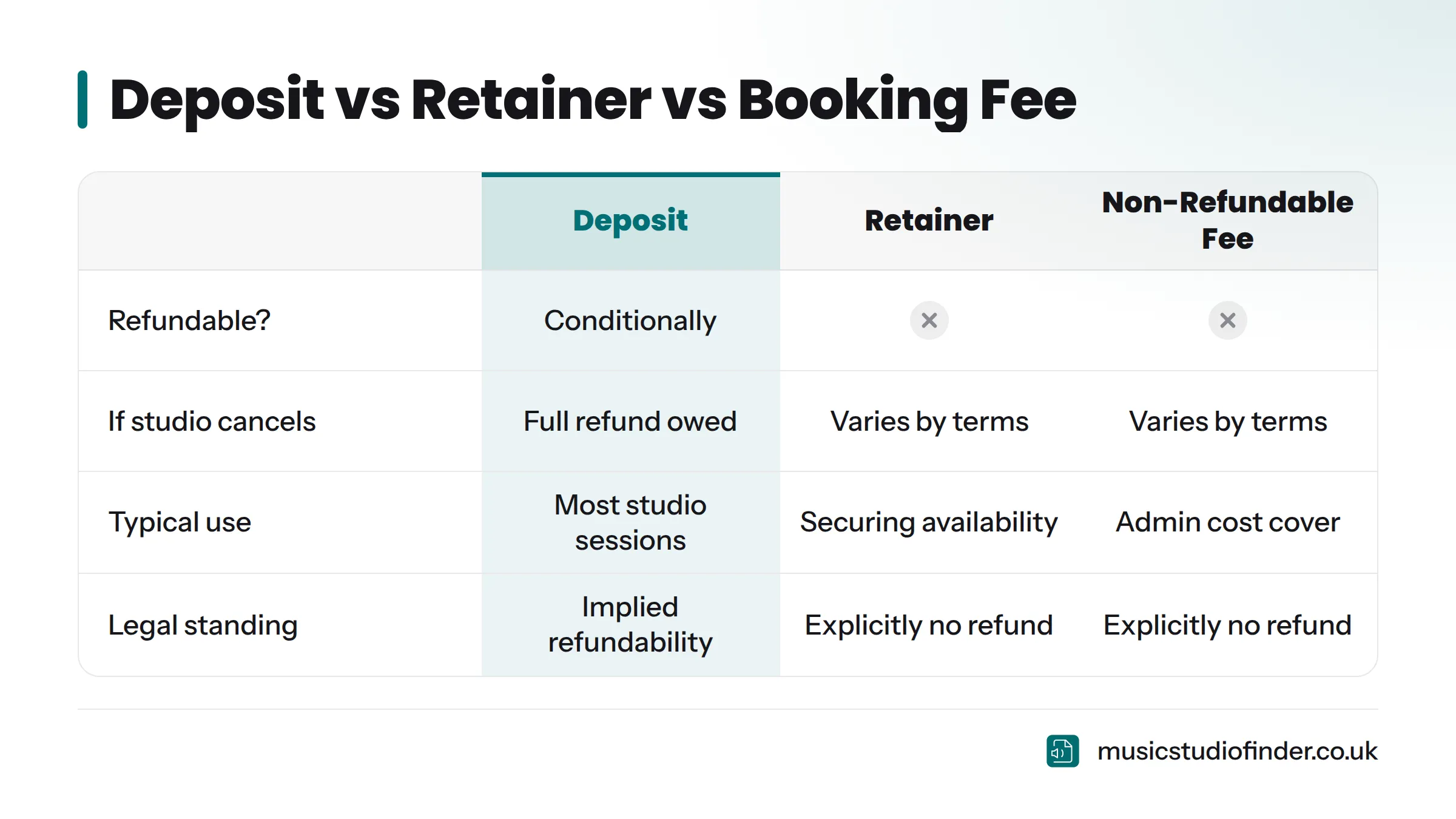
The label a studio puts on a payment shapes your legal position. A payment described as a "deposit" carries an implied expectation of potential refundability. A payment described as a "non-refundable booking fee" or "retainer" signals clearly that the money will not come back. Courts and consumer bodies look at the substance of the agreement, but the language used is a strong indicator of intent.
Here is a clear comparison:
| Term | Definition | Refundable? | Typical Use | Legal Standing |
|---|---|---|---|---|
| Deposit | Partial upfront payment securing a booking | Conditionally - depends on notice given | Most common for studio sessions | Refundable if studio cancels; may be forfeited if client cancels late |
| Retainer | Fee paid to secure availability, regardless of outcome | No - explicitly non-refundable | Ongoing studio arrangements, producer retainers | Non-refundable if clearly stated in writing |
| Non-Refundable Booking Fee | Flat fee to hold a time slot | No - explicitly non-refundable | Short sessions, busy studios | Non-refundable if agreed in writing before payment |
Always read the label on any payment you make. If the studio calls it a "deposit" but insists it is non-refundable under all circumstances, that tension is worth challenging.
What UK Law Says About Studio Deposits
The Consumer Rights Act 2015
The Consumer Rights Act 2015 applies to contracts between businesses (including recording studios) and consumers (individual musicians booking sessions for personal or artistic use). Under this Act, any term in a contract - including a studio cancellation notice period or deposit forfeiture clause - must be fair. A term is considered unfair if it creates a significant imbalance in the parties' rights and obligations, to the detriment of the consumer.
In practice, a studio cannot legally keep 100% of a large deposit if its actual loss from your cancellation was minimal. Cancel six weeks in advance and the studio re-lets the slot immediately? Keeping your full deposit could be challenged as a disproportionate penalty under the Act. Courts assess whether the amount retained genuinely reflects the studio's actual loss - not just what the contract says.
Consumer Contracts Regulations 2013 (Online Bookings)
Important: If you booked your studio session online - through a website, booking form, or email exchange - you may have additional rights under the Consumer Contracts Regulations 2013.
These regulations give consumers a 14-day "cooling-off" period for services contracted online. There is a significant caveat: if you explicitly agreed that the service could begin within that 14-day window (for example, by booking a session date that falls within two weeks of booking), you may waive your right to cancel without charge. Studios often include a clause asking you to waive this right as part of the booking confirmation. Read it carefully - once you waive it, you lose the automatic 14-day protection.
What Makes a Studio Booking Cancellation Policy "Unfair"?
Under UK consumer law, a studio booking cancellation policy can be challenged if it:
- Was never clearly communicated to you before payment
- Requires you to forfeit a deposit amount that bears no relation to the studio's actual losses
- Contains terms written in deliberately confusing or misleading language
- Imposes a penalty on you for cancelling but offers no equivalent compensation if the studio cancels
- Was hidden in fine print that a reasonable person would not have read before booking
If any of these apply to your situation, you have grounds to raise a dispute - and Citizens Advice is the right first port of call.
Common Recording Studio Deposit Policies in the UK
Typical Deposit Percentages
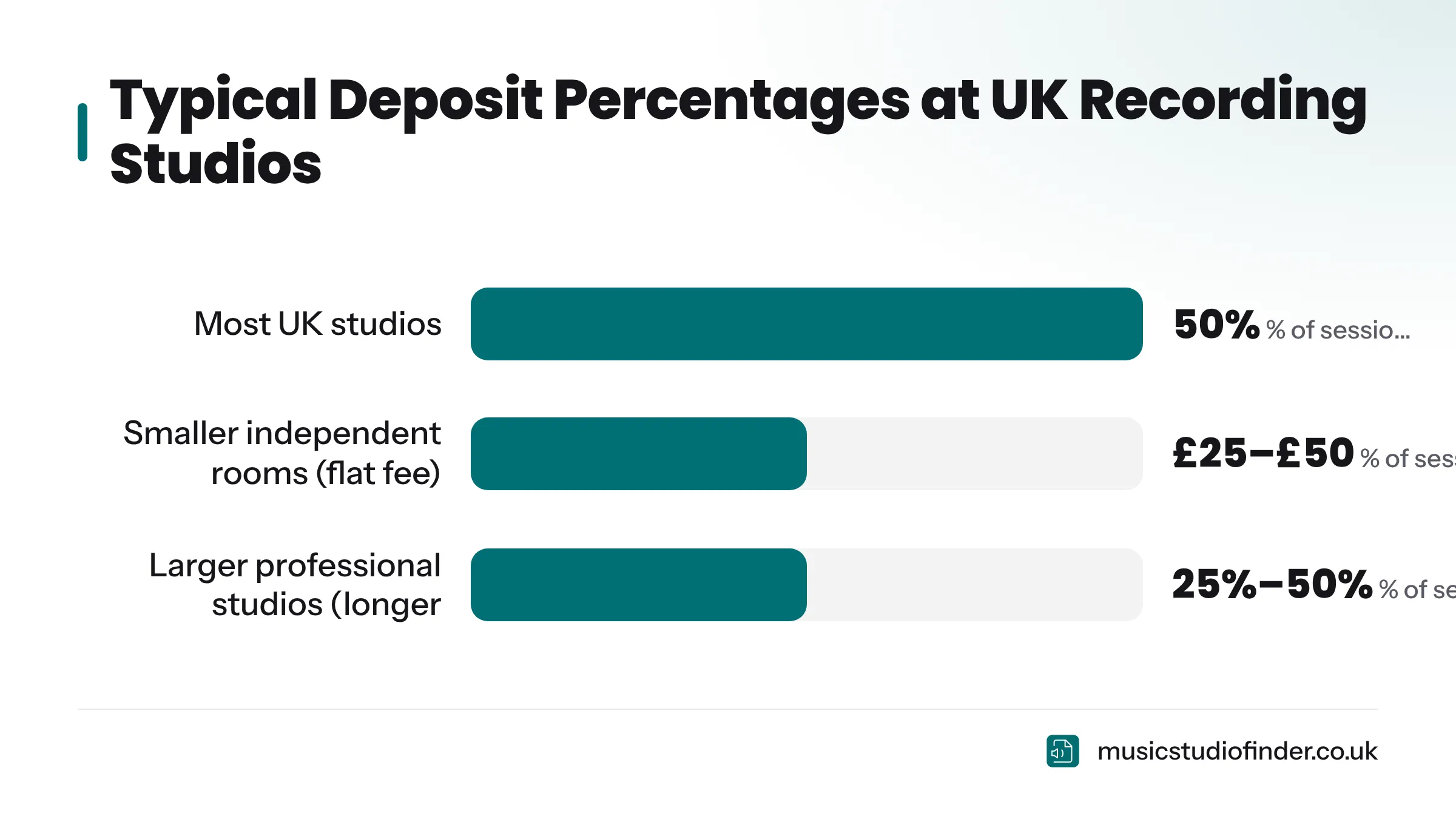
From our experience connecting musicians with studios across the UK at Music Studio Finder, the most common structure is 50% of the total session fee paid upfront, with the balance due on the day. Smaller independent rooms sometimes ask for a flat holding fee of £25 to £50 rather than a percentage. Larger professional studios with higher hourly or day rates sometimes request 25% to 50% upfront on longer bookings. Our recording studio cost UK guide gives a full breakdown of what sessions typically cost.
Standard Cancellation Windows and Notice Periods
Most UK studios operate a tiered recording studio cancellation fee structure based on how much notice you give. The further in advance you cancel, the more likely you are to recover some or all of your deposit.
| Notice Given Before Session | Typical Outcome for Deposit |
|---|---|
| More than 4 weeks | Full deposit refunded (or transferred to new date) |
| 2-4 weeks | Partial refund (50% of deposit) or transfer offered |
| 1-2 weeks | Deposit forfeited; no refund |
| Less than 48 hours | Full deposit forfeited; some studios charge the full session fee |
| No-show | Full deposit forfeited; possible additional charge for wasted engineer time |
These are indicative ranges drawn from policies across UK studios. Individual studios vary - which is exactly why you must read the specific terms before booking.
Scenario Guide: What Happens to Your Deposit?
Let's walk through the scenarios you are most likely to face.
You Cancel Well in Advance
Cancel outside the studio's stated cancellation window - typically more than two to four weeks before the session - and most studios will refund your deposit in full or offer to transfer it to a new date. Some studios are flexible and prefer a rescheduled session over a disputed refund. Always ask whether a date transfer is an option before pushing for a cash refund.
You Cancel Close to the Session Date
Cancelling within the studio's cancellation window - generally the final one to two weeks - almost always means losing your deposit. The studio's argument is legitimate: at that point, filling your slot is very difficult, and the engineer and room were reserved specifically for you. A clearly worded cancellation policy that you agreed to in writing is likely to be enforceable, even if it feels harsh.
You Don't Show Up
A no-show is the worst outcome. Virtually every studio treats one as a full deposit forfeiture, and some will invoice you for the entire session fee, arguing that their engineer's time was wasted entirely. If an emergency prevented you from attending, contact the studio immediately - many will exercise discretion if you communicate promptly and honestly.
The Studio Cancels on You
If the studio cancels your session for any reason, you are entitled to a full refund of your recording session deposit. The studio has breached the booking agreement. You should also ask whether the studio will cover any out-of-pocket costs you incurred in preparation - travel already booked, session musicians already paid. The studio is not automatically liable for consequential losses, but a reasonable studio will return your deposit without argument.
Force Majeure - Illness, Emergencies, Natural Events
Force majeure refers to events outside either party's control: serious illness, a natural disaster, a fire at the studio, or a public health emergency. Most studio contracts include a force majeure clause that suspends obligations - including the obligation to refund or perform - during such events. If neither party is at fault, the outcome often depends on whether the booking can be rescheduled. If rescheduling is impossible and the studio invokes force majeure to avoid refunding you, challenge it through Citizens Advice. A studio cannot hide behind force majeure to retain your money when the event that prevented the session was entirely within its control.
The Studio's Equipment Fails During Your Session
If the studio's equipment fails - making it impossible to record - the studio has failed to deliver the contracted service. Under the Consumer Rights Act 2015, you are entitled to a partial or full refund proportionate to the value of the service not delivered. Recorded for two hours of a booked four-hour session before equipment failure ended things? Expect a 50% refund of the total fee. The studio cannot keep money for a service it was unable to provide.
This video offers a useful perspective on how studios think about deposit clauses and session contracts:
How to Protect Yourself Before Paying a Deposit
Questions to Ask the Studio Before Booking
Before you pay anything, get clear answers to these questions - in writing, not just verbally:
- Is the deposit refundable, and under what conditions?
- What is your cancellation window for a full or partial refund?
- Can I transfer my deposit to a new date if I need to reschedule?
- What happens to my deposit if you (the studio) cancel?
- Do you have a force majeure clause, and what does it cover?
- Will you send me a written confirmation of the booking terms and conditions before I pay?
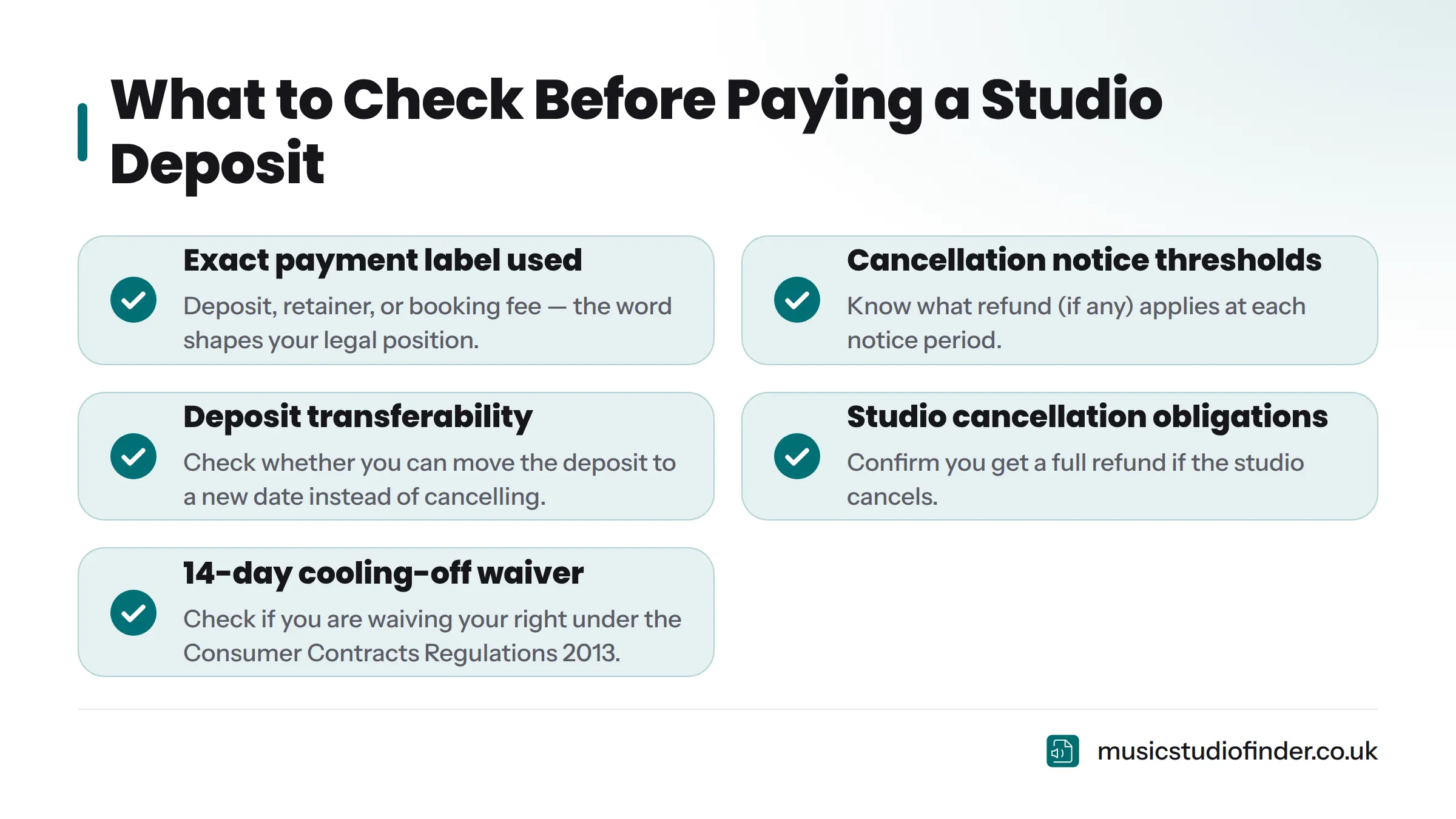
What to Check in the Studio Booking Terms and Conditions
When you receive the studio's terms and conditions, look specifically for these elements - and read our guide on what to look for when booking a recording studio for a broader pre-booking checklist.
- The exact word used to describe your payment (deposit, retainer, booking fee)
- The cancellation notice period and what happens at each threshold
- Whether the deposit is transferable to a new date
- What the studio's obligations are if it cancels
- Any waiver of your 14-day cooling-off right under the Consumer Contracts Regulations 2013
Always Confirm in Writing
A verbal agreement about deposit refundability is almost impossible to enforce. Request that the studio emails you a booking confirmation that includes the cancellation policy in full. If the studio only provides a link to a generic terms page, ask it to confirm in writing which specific terms apply to your booking. That email trail becomes your evidence if a dispute arises. You can also tour the studio before committing - our article on whether you can visit a recording studio before booking covers exactly how to do that.
Pre-booking deposit checklist:
- Asked the studio whether the deposit is refundable, and received a written answer
- Confirmed the exact cancellation notice period required for a full refund
- Confirmed the exact cancellation notice period required for a partial refund
- Asked whether the deposit can be transferred to a new date if I reschedule
- Asked what happens if the studio cancels - and whether I will receive a full refund
- Received a written booking confirmation that includes the cancellation policy
- Read the full terms and conditions before paying
- Checked whether the payment was described as a "deposit", "retainer", or "non-refundable booking fee"
- Confirmed whether I have waived my 14-day cooling-off right under the Consumer Contracts Regulations 2013
- Paid by credit or debit card to preserve chargeback rights if needed
What to Do If a Studio Refuses to Refund Your Deposit
Start With a Formal Written Request
Write to the studio by email - so you have a record - setting out clearly why you believe you are entitled to a refund. Reference the specific booking terms, the date of cancellation, and any relevant law (the Consumer Rights Act 2015 if the terms appear unfair; the Consumer Contracts Regulations 2013 if you booked online and were not offered a proper cancellation right). Keep the tone professional and factual. Give the studio a reasonable deadline - 14 days is standard - to respond.
Raise a Credit Card or Debit Card Chargeback
If you paid by credit or debit card and the studio refuses to engage, contact your card provider and ask to raise a chargeback claim. Under Section 75 of the Consumer Credit Act 1974, credit card purchases over £100 come with additional legal protection - your card provider shares liability with the merchant. For debit card payments, the Visa or Mastercard chargeback scheme (operated voluntarily by banks) gives you a similar route. Chargebacks are not guaranteed, but they are free to raise and often persuasive.
Contact Citizens Advice or Trading Standards
Citizens Advice provides free, independent guidance on consumer rights disputes in the UK, including withheld deposits. Trading Standards - accessible through Citizens Advice - can investigate businesses that routinely apply unfair contract terms. If the studio's cancellation policy appears systematically unfair, a Trading Standards referral can apply wider pressure beyond your individual dispute.
Make a Small Claims Court Claim
If the studio refuses to refund a deposit you believe you are owed and the amount is under £10,000 in England and Wales, you can make a claim through the small claims track at HM Courts and Tribunals Service. The process is designed for individuals without legal representation and costs between £35 and £205 in court fees depending on the claim amount. Before filing, send the studio a formal "letter before action" giving it a final opportunity to settle. Most disputes at this level resolve before reaching a hearing - the threat of court is often enough.
Advice for Studio Owners: Writing a Fair Deposit Policy
This section is for studio owners - because Music Studio Finder works with both sides of the booking relationship, and fair terms protect everyone.
Why Clear Terms Protect Both Parties
A clearly written cancellation policy reduces disputes, sets expectations before they become problems, and gives studios a legally defensible position when they do retain a deposit. Ambiguous or aggressive terms - particularly those that allow a studio to keep a disproportionate amount for minor cancellations - create resentment, generate negative reviews, and are vulnerable to challenge under the Consumer Rights Act 2015. Musicians who feel they have been treated fairly come back; musicians who feel they have been exploited tell other musicians. Find out more about what makes a great studio experience in our recording studio hire guide.
What Your Policy Must State to Be Legally Enforceable
A studio's deposit and cancellation policy should clearly include:
- The exact amount or percentage of the deposit required
- Whether the deposit is refundable, under what conditions, and after what notice period
- A tiered cancellation structure - different outcomes at different notice periods (e.g., full refund beyond 4 weeks, 50% refund at 2-4 weeks, no refund under 2 weeks)
- What happens if the studio cancels - specifically, that the client receives a full refund
- Whether the deposit is transferable to a new booking date
- Force majeure terms - what counts as a qualifying event and what happens to the deposit in that case
- The payment method accepted and whether refunds are returned by the same method
These terms must be presented clearly before the client pays - not buried in a link at the bottom of a booking confirmation email. If you list your studio on Music Studio Finder, including transparent booking terms in your profile builds trust with musicians before they even contact you.
Frequently Asked Questions
Are recording studio deposits refundable in the UK? Recording studio deposits in the UK are often refundable if you cancel with sufficient notice - typically more than two to four weeks before the session. If the payment was described as a "non-refundable booking fee" or "retainer" and that term was clearly communicated before you paid, the studio is generally within its rights to keep it. UK consumer law requires all cancellation terms to be fair and clearly communicated.
What is the typical deposit for a recording studio booking? Most UK studios ask for 50% of the total session fee as a deposit, paid at the time of booking. Smaller studios may use a flat holding fee of £25 to £50. Larger professional studios booking full-day sessions may request a higher percentage or a larger fixed amount. See recording studio prices UK for context on how session fees and deposits relate to each other.
Can a recording studio keep my full deposit if I cancel? A studio can keep your full deposit if you cancel within its stated cancellation window - provided that policy was clearly communicated before you paid. If you cancel with substantial notice and the studio re-lets your slot, keeping the full deposit may be disproportionate and challengeable under the Consumer Rights Act 2015. A studio can only retain an amount that reasonably reflects its actual loss.
What happens to my deposit if the studio cancels? If the studio cancels your session, you are entitled to a full refund of your deposit. The studio has failed to deliver the service you contracted and paid for. If it delays or refuses to refund, you can raise a card chargeback or contact Citizens Advice.
Is a "booking fee" the same as a deposit? No. A booking fee - particularly one described as "non-refundable" - is not a deposit in the legal sense. A deposit carries an implied conditionality; a non-refundable booking fee does not. Always check which term the studio uses, because the label determines your rights.
Can I get my studio deposit back through a credit card chargeback? You can attempt a chargeback if the studio has failed to deliver the service or if you believe the contract terms were unfair. Credit card purchases over £100 carry additional protection under Section 75 of the Consumer Credit Act 1974, meaning your card provider shares liability. Debit card chargebacks are available through Visa and Mastercard's voluntary schemes. Contact your bank to initiate the process.
How much notice do I need to give a recording studio to get my deposit back? Most UK studios require between two and four weeks' notice to refund a deposit in full. Cancellations inside that window typically result in partial or full forfeiture. Check the specific studio's terms - policies vary considerably.
Is it worth taking a recording studio to small claims court over a deposit? It depends on the amount and the strength of your case. The small claims process in England and Wales handles claims up to £10,000 and is designed for use without a solicitor. Court fees start at £35. If the studio clearly communicated a non-refundable policy that you agreed to, your claim is unlikely to succeed. If the terms were unfair, hidden, or the studio cancelled on you, a claim is well worth making - especially after sending a formal letter before action.
How do I know if a studio's cancellation policy is legally enforceable? A cancellation policy is more likely to be enforceable if it was shown to you before you paid, written in plain English, proportionate to the studio's actual losses, and consistent for both parties (i.e., it also compensates you if the studio cancels). A policy that is one-sided, disproportionate, or was never communicated in advance may be challenged as unfair under the Consumer Rights Act 2015.
What should I look for in a studio's terms and conditions before booking? Check for the exact word used to describe your payment, the cancellation notice periods and their consequences, whether the deposit is transferable to a new date, what happens if the studio cancels, and whether there is a force majeure clause. If any of these are missing or unclear, ask in writing before you pay. Our guide to how to choose a recording studio covers the broader booking process in full.
If you are ready to find a UK recording studio with clear, transparent booking terms, Music Studio Finder lists studios across the country so you can compare facilities, prices, and policies before committing. Start your search and book with confidence.