Booking studio time gets expensive fast when you pick the wrong pricing model. Choose hourly billing for a long session and you'll watch the meter tick while the engineer waits. Book a full day rate for a two-hour vocal session and you've paid for six hours you never used. Getting this decision right before you walk through the door is the difference between a relaxed, creative session and a stressful sprint against the clock.
This guide covers real UK price ranges for 2026, a worked break-even calculation you can apply to any studio, a decision framework mapped to common project types, and a plain-English explanation of what each pricing model actually covers. By the end, you'll know exactly when to book a recording studio day rate, when hourly billing is the smarter call, and how to negotiate either one.
How Hourly Studio Rates Work - and When They Make Sense
An hourly recording studio rate is exactly what it sounds like: a fixed price per hour, billed in increments of one hour or, at some facilities, 30 minutes. It is the default recording studio pricing model across the UK, and most studios lead with their hourly rate in their listings.
You book a slot - say, three hours on a Tuesday afternoon - and pay for those three hours. Finish early and you typically pay only for the time used, though many studios enforce a minimum booking of two hours. The clock starts when your session begins, not when you arrive, so turning up flustered and unprepared genuinely costs you money.
Hourly billing suits shorter, well-defined sessions. A solo vocalist recording a cover, a voice-over artist cutting a 60-second advert, a band laying down one tracking pass for a single - these projects have a clear scope, and paying by the hour keeps your recording studio session cost proportional to the work.
What a UK Hourly Rate Typically Covers
Most UK studios bundle the following into their hourly rate:
- Use of the control room and live room (or vocal booth)
- A house audio engineer to operate the desk and the Digital Audio Workstation (DAW) - commonly Pro Tools or Logic Pro
- The studio's outboard gear, microphones, and acoustic treatment
- Basic cabling, headphone mixes, and talkback
What is usually not included: post-session mixing and mastering, session musician fees, specialist instrument hire (a grand piano tuning, for instance), and any media charges. Before you commit to a booking, the what's included when you hire a recording studio guide on Music Studio Finder is worth reading in full.
Overtime on Hourly Bookings
Go over your booked slot and you'll pay the studio's overtime rate - often the same hourly rate, billed in 30-minute blocks. Some studios charge a 1.5x premium after a certain cut-off in the evening. At London studios with premium SSL or Neve consoles, that can mean £80-£100 per overtime hour on top of an already significant commitment. Always ask about the overtime policy before the session starts.
How Recording Studio Day Rates Work - and What They Cover
A recording studio day rate is a flat fee for a defined block of studio time, typically eight to ten hours. Rather than watching a running total accumulate, you arrive knowing your studio cost is fixed for the day. Some studios call this a lockout rate when the space is exclusively yours with no other clients coming and going.
The day rate structure exists for projects that need sustained, uninterrupted time: full-band tracking sessions, EP recording, album work, or any session where you need to set up, sound-check, run multiple takes, layer overdubs, and not feel pressured by the clock. Studios price the day rate at a discount relative to their hourly rate - typically 15-30% cheaper per hour than paying incrementally.
Most day sessions run from 10am to 6pm, 11am to 7pm, or a similar eight-hour window. Some studios define a "day" as ten hours. Confirm the exact hours when you book.
What a Day Rate Session Generally Includes
- Full exclusive use of the booked rooms (control room, live room, isolation booth as applicable)
- An in-house audio engineer for the full session
- All studio equipment, microphones, amps, and outboard gear listed in the studio's spec sheet
- Unlimited takes and punch-ins within the session window
- A rough bounce or mix-down at the end of the day (varies by studio - confirm this)
Mixing, mastering, and stem exports are almost always charged separately.
The Half-Day Rate - a Middle-Ground Worth Knowing
A half-day studio rate sits between hourly billing and a full-day commitment. Most UK studios offering this option price it at four to five hours for roughly 55-65% of the full day rate.
It is the right call when your project is too substantial for two or three hours of hourly billing but you genuinely don't need a full eight-hour day. A solo singer-songwriter recording three or four songs, a band laying down a tight EP with simple arrangements - these sessions fit naturally into a half-day. Many studios will apply your half-day payment against the full day rate if you decide to extend on the morning, but you should request that flexibility explicitly when you book.
Recording Studio Day Rate vs Hourly Rate: Head-to-Head Comparison
| Feature | Hourly Rate | Half-Day Rate | Full Day Rate |
|---|---|---|---|
| Typical UK cost (budget studio) | £20-£35/hr | £80-£120 | £150-£220 |
| Typical UK cost (mid-range studio) | £40-£65/hr | £140-£200 | £250-£380 |
| Typical UK cost (premium studio) | £70-£150/hr | £250-£400 | £450-£900 |
| Session length | 1-3 hrs typical | 4-5 hrs | 8-10 hrs |
| Engineer included? | Usually yes | Usually yes | Usually yes |
| Mixing included? | Rarely | Rarely | Rarely |
| Mastering included? | No | No | No |
| Overtime policy | Billed per hour | Converts to day rate | Charged at hourly rate |
| Flexibility | High | Moderate | Low |
| Best for | Singles, voice-overs, overdubs | Short EPs, 3-4 song sessions | Albums, full-band tracking, long projects |
When Hourly Billing Works in Your Favour
Short sessions with a predictable scope are where hourly billing earns its keep. Book two or three hours, do the work, leave. If you are recording a single vocal overdub, punching in on one instrument track, or testing a room ahead of a future project, hourly billing means you pay only for what you use.
It is also the right call when your schedule is uncertain. Paying a full day rate and then having to leave at lunchtime because a bandmate is unavailable means you've paid for hours the studio kept you from using.
When a Day Rate Saves You Money
A day rate becomes cheaper the moment your session pushes past the break-even threshold - the exact calculation is below. Beyond the raw numbers, there is a less obvious benefit: the time pressure disappears. When you are not watching an hourly meter, you take more second takes, experiment with microphone placement, and let the engineer try a different compression setting. That relaxed environment often produces better recordings than a stressed three-hour sprint.
UK Recording Studio Prices in 2026
Prices across the UK vary by studio tier and geography. London commands a significant premium over the rest of England; Scotland and parts of the North generally offer the most competitive rates for comparable studio quality.
The figures below reflect realistic market ranges drawn from active studio listings, including studios on Music Studio Finder.
| Studio Tier | Hourly Rate | Half-Day Rate | Full Day Rate |
|---|---|---|---|
| Budget - London | £30-£50/hr | £120-£180 | £220-£380 |
| Budget - Major UK Cities | £20-£35/hr | £80-£130 | £150-£240 |
| Budget - Rest of UK | £18-£28/hr | £70-£110 | £130-£200 |
| Mid-Range - London | £55-£90/hr | £200-£320 | £380-£600 |
| Mid-Range - Major UK Cities | £40-£65/hr | £140-£220 | £260-£400 |
| Mid-Range - Rest of UK | £30-£50/hr | £110-£170 | £200-£320 |
| Premium - London | £90-£200/hr | £320-£600 | £600-£1,200+ |
| Premium - Major UK Cities | £70-£130/hr | £250-£450 | £450-£800 |
| Premium - Rest of UK | £50-£100/hr | £180-£350 | £350-£650 |
Major UK Cities includes Manchester, Birmingham, Leeds, Bristol, Liverpool, and Cardiff. "Rest of UK" covers smaller cities and rural areas. Scotland sits broadly in the "Major UK Cities" band for mid-range and budget studios, with Edinburgh closer to the top of that range.
For a full breakdown of recording studio prices in 2026 across regions and room types, Music Studio Finder's pricing guide covers the complete picture.
Budget Studios: Hourly vs Day Rate
Budget studios - often run by one engineer in a converted commercial or residential space - are where the day rate premium shrinks the most. At £25/hr hourly and a day rate of £180, the break-even sits at just over seven hours. Planning a six-hour session? Pay hourly. Planning eight or more? Take the day rate.
Mid-Range Studios: Hourly vs Day Rate
Mid-range studios are the sweet spot for most independent artists and bands. Better microphone collections, more reliable monitoring, engineers with serious tracking experience. At £55/hr hourly and a day rate of £320, the break-even sits at around 5.8 hours - so if your session is going to run six hours or more, the day rate is clearly the better deal.
Premium Studios: Hourly vs Day Rate
Premium studios - SSL and Neve consoles, purpose-built live rooms, world-class monitoring - cost more, but the day rate discount is often proportionally larger. A premium London studio might charge £120/hr but price a full day at £700, which breaks even at under six hours. Split across a four-piece band, a full day in an elite room can be genuinely affordable.
When Does a Day Rate Become Cheaper? The Break-Even Calculation
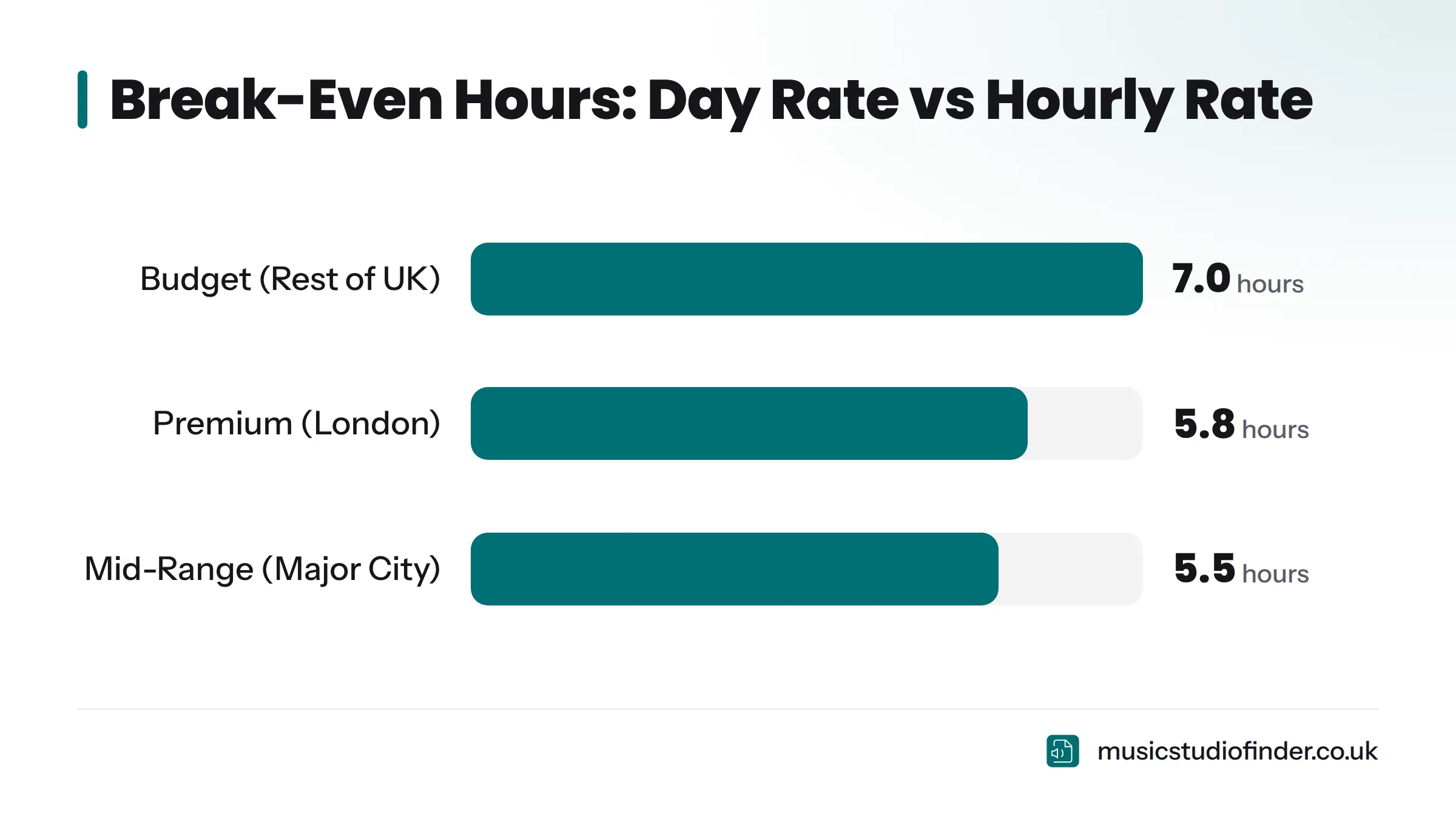
A day rate beats hourly billing the moment your cumulative hourly cost would exceed the flat day-rate fee. The exact hour threshold is different for every studio, and the calculation takes less than a minute.
How to Calculate the Break-Even Point for Any Studio
- Ask the studio for their standard hourly rate (£X/hr).
- Ask for their full day rate (£Y).
- Divide the day rate by the hourly rate: Y ÷ X.
- The result is the number of hours at which both options cost the same. Book longer than that and the day rate wins.
Formula: Break-even hours = Day rate (£) ÷ Hourly rate (£/hr)
Worked Examples: Budget, Mid-Range, and Premium Studios
| Studio Tier | Hourly Rate | Day Rate | Break-Even Point |
|---|---|---|---|
| Budget (Rest of UK) | £25/hr | £175 | 7.0 hours |
| Mid-Range (Major City) | £55/hr | £300 | 5.5 hours |
| Premium (London) | £120/hr | £700 | 5.8 hours |
Across all three tiers, once your session pushes past roughly six hours, the day rate almost always becomes the cheaper option. The crossover is even earlier at mid-range studios - which is why bands recording EPs and albums gravitate toward the day rate almost by default. When to book a day rate studio becomes an easy question once you run these numbers against your specific studio's pricing.
This video from Love Science Music walks through rate structures and price ranges in plain language, and pairs well with the worked examples above:
Which Pricing Model Fits Your Project?
The choice between hourly and day rate comes down to three variables: how long your session will realistically run, what you are recording, and how many people are splitting the cost. Use the framework below as your starting point, then run the break-even calculation against your specific studio's pricing to confirm.
For more detailed guidance on estimating session length before you book, the how many hours to book in a recording studio guide is a practical companion to this section.
Recording a Single Track
Recommended: Hourly rate in most cases.
A well-prepared solo artist or duo recording one song - lead vocal, two guitar passes, a bass DI, and simple percussion - can complete tracking in three to four hours. Add setup and a rough bounce and you are at five hours maximum. At a mid-range studio at £55/hr, that is £275 for five hours against a £300 day rate. Hourly billing wins, or it's close enough that the flexibility of not committing to a full day is worth the small difference.
The exception: if you are also recording a guide mix in the same session, or if you are a full four-piece band recording live takes, that five-hour estimate becomes optimistic quickly. Read how to record a professional song in one day to see what is genuinely achievable in a single studio day.
Recording an EP or Album
Recommended: Day rate, almost without exception.
An EP of four to six songs requires tracking, overdubs, and at minimum a rough mix for reference. A realistic minimum is one full studio day per two to three songs, depending on arrangement complexity and how well-rehearsed the band is. At that pace, hourly billing costs significantly more than booking by the day. Block booking several day-rate sessions in advance - see the negotiation section below - often unlocks a further discount.
For albums, the day rate is not just cheaper: it changes the creative atmosphere. The Musicians' Union UK recommends that artists budget properly for studio time rather than cutting corners on session hours, because rushed recordings almost always require costly re-tracking later.
Vocal Recording and Voice-Over Sessions
Recommended: Hourly rate for single-session vocal work; half-day rate for longer campaigns.
An experienced vocalist recording one song to a pre-recorded backing track can complete a quality tracking session in two hours. Voice-over artists recording a batch of short-form scripts - adverts, podcast intros, e-learning content - typically work through a 300-word script in 45 to 60 minutes of studio time. Three or four scripts in one session sits comfortably inside three hours of hourly billing.
Studios like Offbeat Recording Studio Edinburgh specialise in voice-over and ADR work and often publish session rates that are distinct from their music recording rates - worth asking about when you book.
Podcast and Spoken-Word Sessions
Recommended: Hourly rate for single episodes; half-day rate for batch recording.
A 45-minute podcast records in roughly 60 to 90 minutes of studio time once you account for setup, a brief sound check, and a simple edit. Batch recording three episodes back-to-back in a half-day session is often the smartest use of studio time for regular podcasters: you get a fixed recording studio session cost and leave with weeks of content done.
Band vs Solo Artist: How the Maths Change
The cost-per-person calculation shifts significantly. A £300 day rate split across four band members works out at £75 each for a full day's recording. A solo artist carrying the same £300 pays it alone. This is one reason solo artists lean toward hourly billing for shorter sessions and only take day rates when they are recording a genuinely full-length project.
What's Actually Included in Each Pricing Model?
Before you confirm any booking: always ask the studio to confirm in writing whether the engineer's time, mixing, mastering, and any instrument hire are included in the quoted rate. Assumptions cost money.
Engineer Fees - Included or Extra?
Most UK studios include a house engineer in both their hourly and day rates. The engineer operates the DAW, manages signal routing, and keeps your recordings technically clean. What the rate does not typically include is a separate music producer - someone who makes creative decisions about arrangement and performance. A producer is an additional fee, usually negotiated per project or per day.
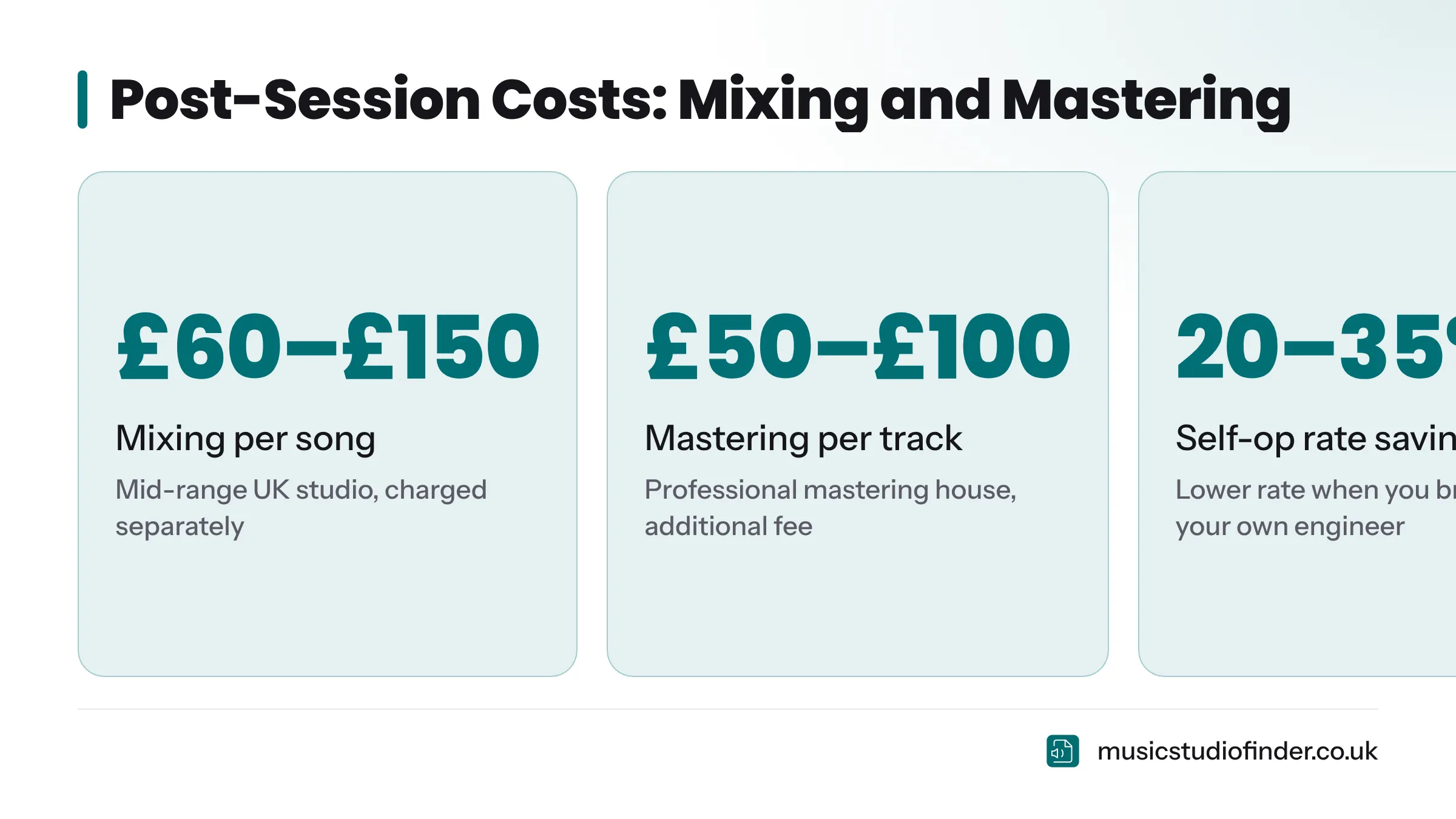
Some studios offer a self-op rate (also called a dry hire or engineer-free rate) where you bring your own engineer and operate the room yourself. Self-op rates are typically 20-35% lower than the standard engineered rate. If you have a trusted engineer or you are comfortable behind the desk yourself, this is a legitimate way to reduce your studio time rates.
Mixing and Mastering: What to Expect
Mixing and mastering are almost always charged separately, regardless of whether you book hourly or by the day. A mix session for a single track at a mid-range UK studio typically runs £60-£150 per song depending on complexity. Mastering is usually an additional £50-£100 per track at a professional mastering house.
Some budget studios bundle a rough mix into a day rate as a goodwill gesture - but a rough mix is not the same as a finished mix. Confirm exactly what deliverable you will receive at the end of the session.
Equipment and Instrument Hire
Standard studio equipment - microphones, stands, headphones, DI boxes, in-house instrument amplifiers - is included in both hourly and day rates at most UK studios. Specialist items like a grand piano, vintage outboard gear, or a specific synthesiser may carry a separate hire charge. Check the studio's equipment list before assuming everything in the room is available at no extra cost.
How to Get the Best Value from Either Rate
Negotiating the Day Rate
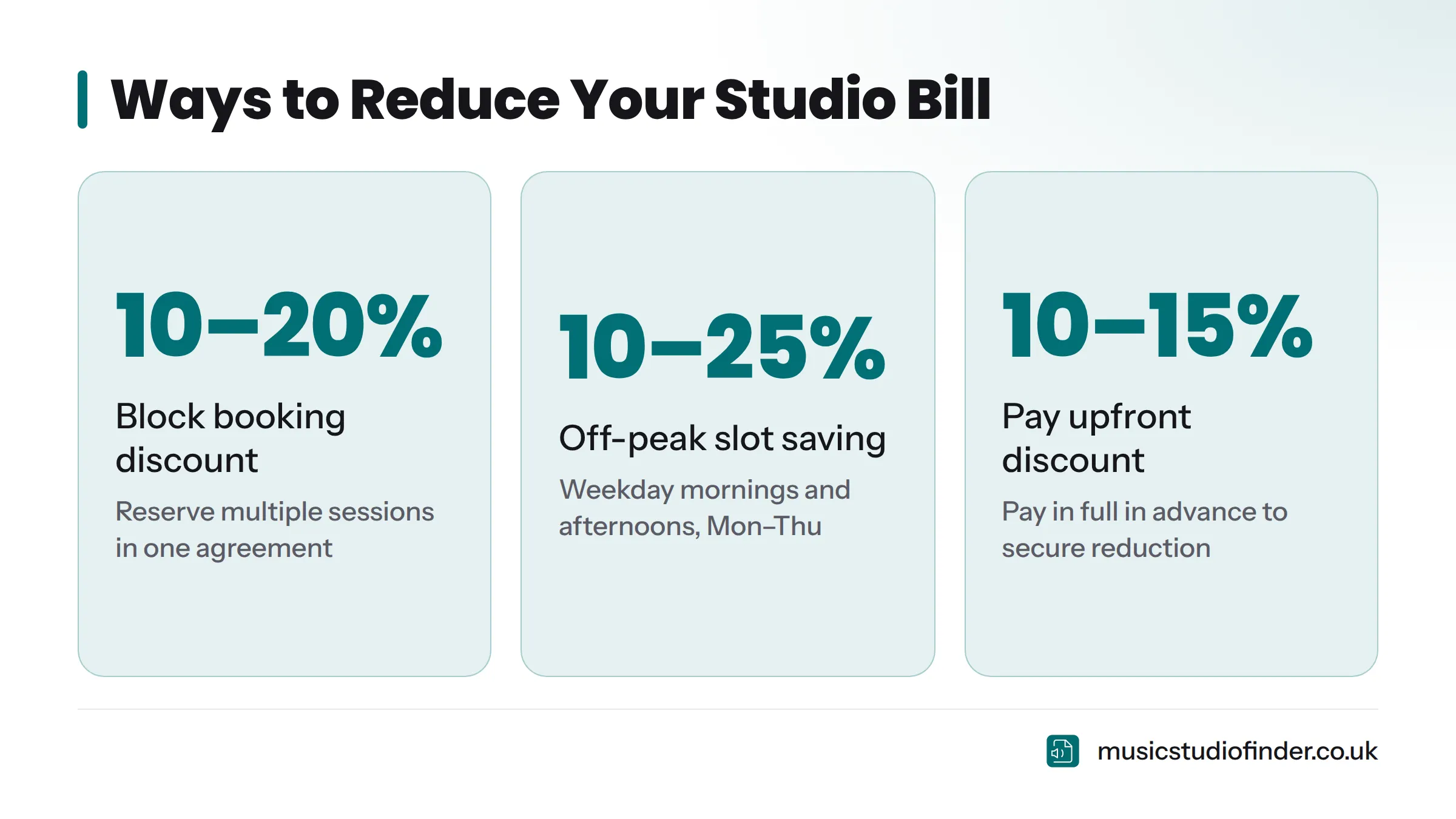
Day rates are more negotiable than studios' public pricing suggests. Studios price their day rate to reflect a typical mid-week booking. Here are three approaches that genuinely work:
- Book multiple days upfront. If you need three studio days for an EP, ask for a block rate across all three. Studios prefer guaranteed revenue to open diary slots.
- Offer to fill an off-peak slot. Monday mornings and mid-week daytime slots are often the hardest to sell. Offer to take these and you have real leverage.
- Pay in full in advance. Cash flow matters to studio owners. Paying upfront in exchange for a 10-15% discount is a common arrangement and one of the cheapest ways to book studio time.
Block Booking Discounts
A block booking discount applies when you reserve multiple sessions - or multiple days - in a single agreement. The discount typically ranges from 10% to 20% off the standard rate. Unlike a one-off day rate, a block booking locks in your studio time weeks or months ahead, which benefits both sides: you get a lower per-hour cost, the studio fills their calendar. This is the standard approach for artists recording full albums and for producers who use the same room regularly.
Off-Peak Slots and What They're Worth
Most studios run at full price during peak hours: weekday evenings and weekends. Off-peak slots - weekday mornings and afternoons from Monday to Thursday - often carry a reduced rate of 10-25% below the standard hourly or day rate. If your schedule has any flexibility, booking off-peak is one of the fastest ways to cut your studio bill without compromising on the room or the engineer.
Preparation: the Real Driver of Cost Control
Pre-production is the single biggest factor in recording studio cost per hour. Bands that arrive with a click-track demo, rehearsed arrangements, and a clear track list record faster, with fewer takes, and almost always within budget. Solo artists who have mapped out their vocal line and practised to the backing track spend their studio time performing, not learning.
The how to prepare for your first studio session guide covers the practical steps in detail. A few habits that save real money on any rate model:
- Tune instruments before you arrive, not when the clock starts
- Know your tempo and have a reference track ready
- Bring your own cables, picks, and spare strings
- Brief the engineer on your references by email the day before
- Agree the running order of tracks before you sit down
Questions to Ask Before You Confirm the Rate
Never confirm a booking - hourly or day rate - without getting clear answers to these questions:
- What hours does your day rate cover, and does it include setup time?
- Is the house engineer included, or is that billed separately?
- What is your overtime rate if we run over?
- Are mixing and mastering included, or are they charged per track?
- Do you offer a self-op rate if we bring our own engineer?
- What instruments and outboard gear are included, and is anything on the spec list hire-only?
- Do you offer a half-day rate, and can we convert to a full day on the morning if we need more time?
- Is there a block booking discount if we book multiple sessions?
- What is your cancellation and rescheduling policy?
- Can we get a studio tour before we confirm the booking?
For a broader checklist of what to look for before you commit, the what to look for when booking a recording studio guide on Music Studio Finder covers the full pre-booking process.
Frequently Asked Questions
In 2026, the recording studio cost per hour in the UK ranges from around £18 at a budget studio outside London to £200 at a premium London facility with a top-tier console and an in-house engineer. The most common range for a solid mid-range UK studio is £40-£65 per hour. London rates are typically 40-60% higher than equivalent studios in cities like Manchester, Leeds, or Birmingham.
Yes. Most professional UK recording studios offer a full day rate as a standard booking option. A studio day typically covers eight to ten hours of exclusive room access including the in-house engineer. Day rates exist precisely because extended sessions are the norm for band tracking, EP recording, and album projects.
No - a recording studio day rate is only cheaper than paying hourly once your session crosses the break-even threshold. Divide the day rate by the hourly rate to find that threshold (for example, £300 ÷ £55/hr = 5.45 hours). Sessions shorter than that threshold are cheaper on hourly billing. Sessions longer than it are cheaper on the day rate. For most UK studios, the break-even sits between five and seven hours.
A half-day studio rate is a fixed fee for a shorter block of studio time - typically four to five hours - priced at roughly 55-65% of the full day rate. It sits between the flexibility of hourly billing and the commitment of a full day. It suits solo artists recording three or four songs, voice-over sessions covering multiple scripts, or podcast batch recordings. Some studios will apply what you have already paid against the full day rate if you extend on the morning.
A recording studio day rate in the UK typically covers eight to ten hours. The most common format is an eight-hour working day - for example 10am to 6pm - though some studios offer ten-hour blocks. Always confirm the exact start and end times when you book, and ask whether setup time is included in your booked hours or comes out of them.
Yes, in most cases. Independent studios have real flexibility on day rates for off-peak bookings, multi-day block bookings, and clients who pay in full in advance. A direct conversation about your project and budget is usually well received - studios would rather fill a slow Monday at a small discount than leave the room empty at full price.
At the majority of UK recording studios, yes - the in-house audio engineer's time is included in both the hourly rate and the day rate. The engineer operates the desk, manages the recording chain, and keeps your session running technically. What is not included is a music producer (a separate creative role with a separate fee) or a mixing engineer for post-session work. Confirm engineer inclusion explicitly when you book, especially at smaller budget studios where the owner may be the engineer and may charge differently for extended sessions.
Going over - whether on an hourly session or a day rate - triggers the studio's overtime policy. On a day rate, overtime is almost always charged at the studio's standard hourly rate, billed in 30-minute increments. Some premium studios charge a 1.5x premium after a cut-off time in the evening. On an hourly booking, going over simply adds another hour (or half-hour) to your bill at the standard rate. Ask about the overtime policy before the session starts - knowing the safety net is far better than discovering a surprise charge on your invoice.