
Saving money on recording studio time comes down to three things: preparing thoroughly before you book, booking strategically, and working efficiently once the clock starts. UK studio rates typically range from £20 to £80 per hour - or £150 to £500 for a full day - which means every wasted minute is real money. The strategies below cover every phase of the process, from pre-production demos to post-session mastering, so you spend less and get more out of every session.
Here is a quick overview of the top strategies covered in full below:
- Record rough demos at home before you book
- Rehearse until the material is performance-ready, not nearly there
- Use a rehearsal studio to tighten arrangements cheaply
- Book a day rate for longer projects, hourly for shorter ones
- Choose off-peak slots (midweek, daytime) for lower rates
- Use block booking across multiple sessions to negotiate a discount
- Plan a detailed session running order before you arrive
- Bring charts, lyric sheets, and reference tracks on the day
- Use the hybrid approach: track drums professionally, overdub at home
- Manage mixing and mastering costs by agreeing revision rounds upfront
Why Studio Time Costs What It Does
Professional recording studios carry substantial overheads. The room itself often represents hundreds of thousands of pounds in acoustic treatment, construction, and equipment - SSL or Neve mixing consoles, outboard gear, condenser microphones, treated vocal booths. The UK recording studio cost reflects that investment, plus the engineer's time, electricity, software licences, and ongoing maintenance.
Hourly Rates vs. Day Rates in the UK
UK studio rates in 2026 sit in a wide band depending on location, facilities, and whether an engineer is included.
| Studio Tier | Typical Hourly Rate | Typical Day Rate (10 hrs) |
|---|---|---|
| Budget / home-converted | £20 – £35/hr | £150 – £250/day |
| Mid-range professional | £35 – £60/hr | £280 – £450/day |
| High-end / London commercial | £60 – £120+/hr | £500 – £900+/day |
London studios skew higher across all tiers, while studios in cities like Leeds, Birmingham, Edinburgh, and Manchester tend to offer better value at the mid-range. Studios outside major cities often provide serious equipment at budget-tier prices. See the full recording studio prices UK guide for a detailed regional breakdown.
Rates vary because of the console type, monitoring setup, included plug-ins, the engineer's experience, and the room's acoustic quality. The guide on why recording studio prices vary explains each factor in plain terms.
What's Included - and What Costs Extra
Most studios bundle the room and an in-house engineer into the quoted rate. What often costs extra includes mixing (a separate session after tracking), mastering, file export in specific formats such as stems or WAV at 24-bit/48kHz, session storage on the studio's server, and re-booking fees if you overrun. Always read what's included when you hire a recording studio before you sign anything.
The Hidden Costs Most Musicians Don't Expect
The rate on the website is rarely the final number. Studios may charge for:
- Mixing sessions billed separately at a different rate
- Mastering, either in-house or outsourced at your cost
- Overtime charges if you run past your booked slot
- File delivery in anything beyond a standard stereo bounce
- Re-recording sessions caused by preparation failures on the client's side
Go through recording studio hidden fees before you commit to a booking. Knowing what to ask eliminates nasty surprises on invoice day.
Before You Even Book: Preparation That Saves Money
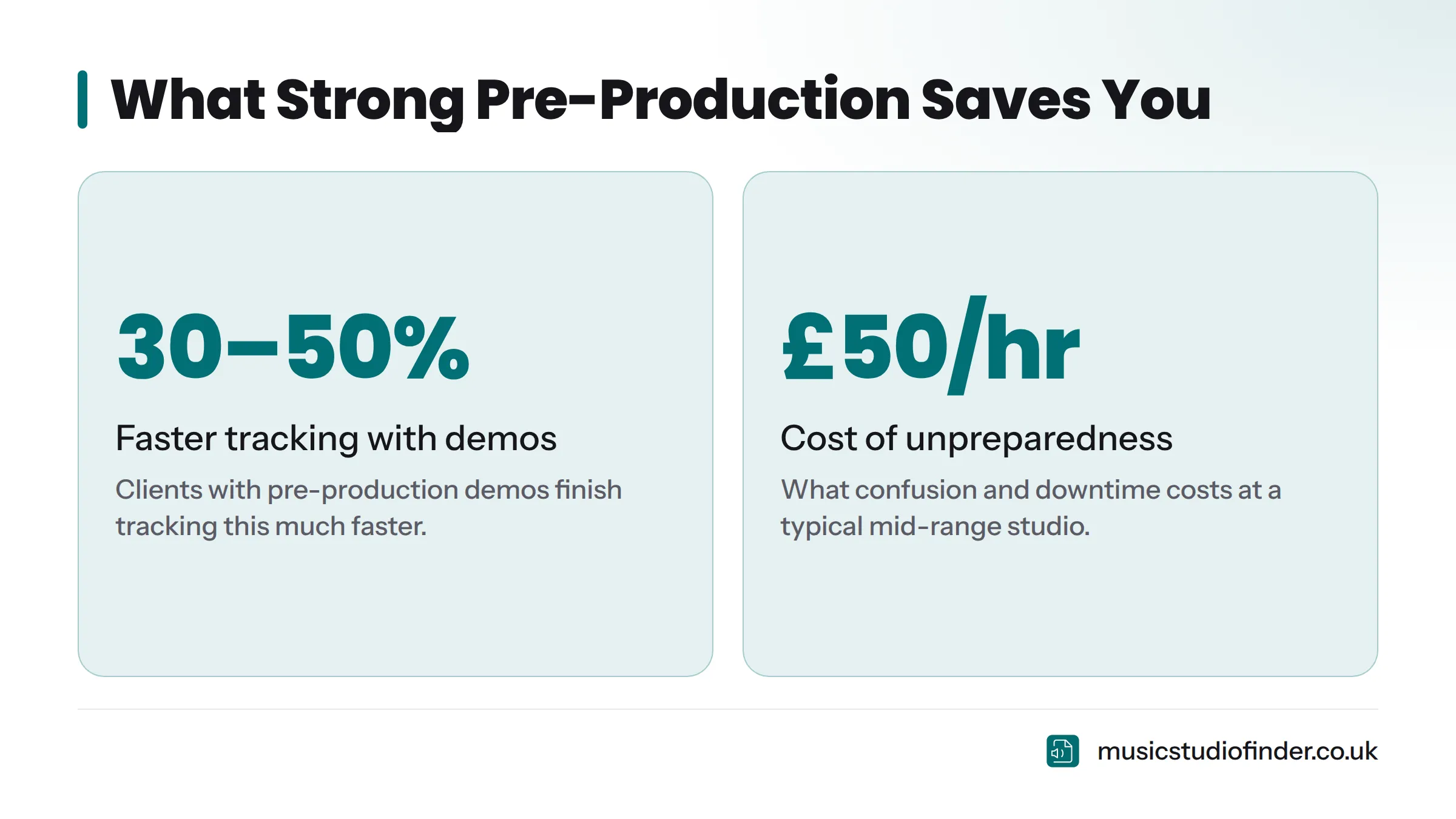
I've spoken to musicians who turned up to a session not fully knowing their own parts. The engineer sat waiting while the guitarist figured out a chord voicing. At £50 an hour, that's expensive confusion. The most reliable way to reduce your studio bill is to arrive with everything already solved.
Record a Rough Demo First
Pre-production means creating a rough version of your material before you enter the professional recording environment. You don't need expensive gear. Record a demo in GarageBand, Ableton Live, or even a voice memo app. The purpose is to identify problems - a verse that's too long, a tempo that doesn't sit right, a bridge nobody can agree on - while you're still paying nothing per hour.
A good pre-production demo answers these questions before the clock starts:
- What is the final arrangement for each song?
- What is the BPM and key?
- What is the running order of the session?
- Are there any parts that still need writing or rewriting?
Engineers and producers consistently say that clients who arrive with strong pre-production demos finish tracking 30-50% faster than those who don't.
Decide Exactly What You're Recording Before You Spend a Penny
Scope creep kills studio budgets. Decide upfront whether you're recording a single, an EP, or album tracks. Set a firm list of songs and stick to it. Adding a "quick extra track" mid-session is how budgets double. If you're unsure how many hours each format typically requires, the EP studio time estimates guide and the how much studio time to record an album resource both give realistic breakdowns.
Rehearse Until It's Performance-Ready, Not "Nearly There"
There's a meaningful difference between knowing a song and being able to perform it cleanly under studio conditions. Nerves, headphone mixes, and the pressure of a ticking clock affect performance. A part that sounds fine in your living room can fall apart in the vocal booth. Rehearse specifically for the studio: play to a click track, run parts at exactly the recorded tempo, and practice the transitions between sections that often cause problems.
The rule I'd use: if you can play the song ten times in a row without a significant mistake, you're studio-ready. If you can't, you're not.
Use Rehearsal Studios to Tighten Your Arrangements Affordably
Rehearsal studio time costs £10 to £25 per hour on average in the UK - a fraction of professional recording rates. Booking two or three rehearsal sessions in the weeks before your recording date lets a band lock in arrangements, iron out timing issues, and practice to a click without burning recording budget. Read more about the difference between the two environments in recording studio vs rehearsal studio.
Smart Booking Strategies to Reduce Your Studio Bill
Preparation gets you ready. Smart booking gets you a better deal before you even walk through the door.
Day Rate vs. Hourly Rate - Which Saves More Money?
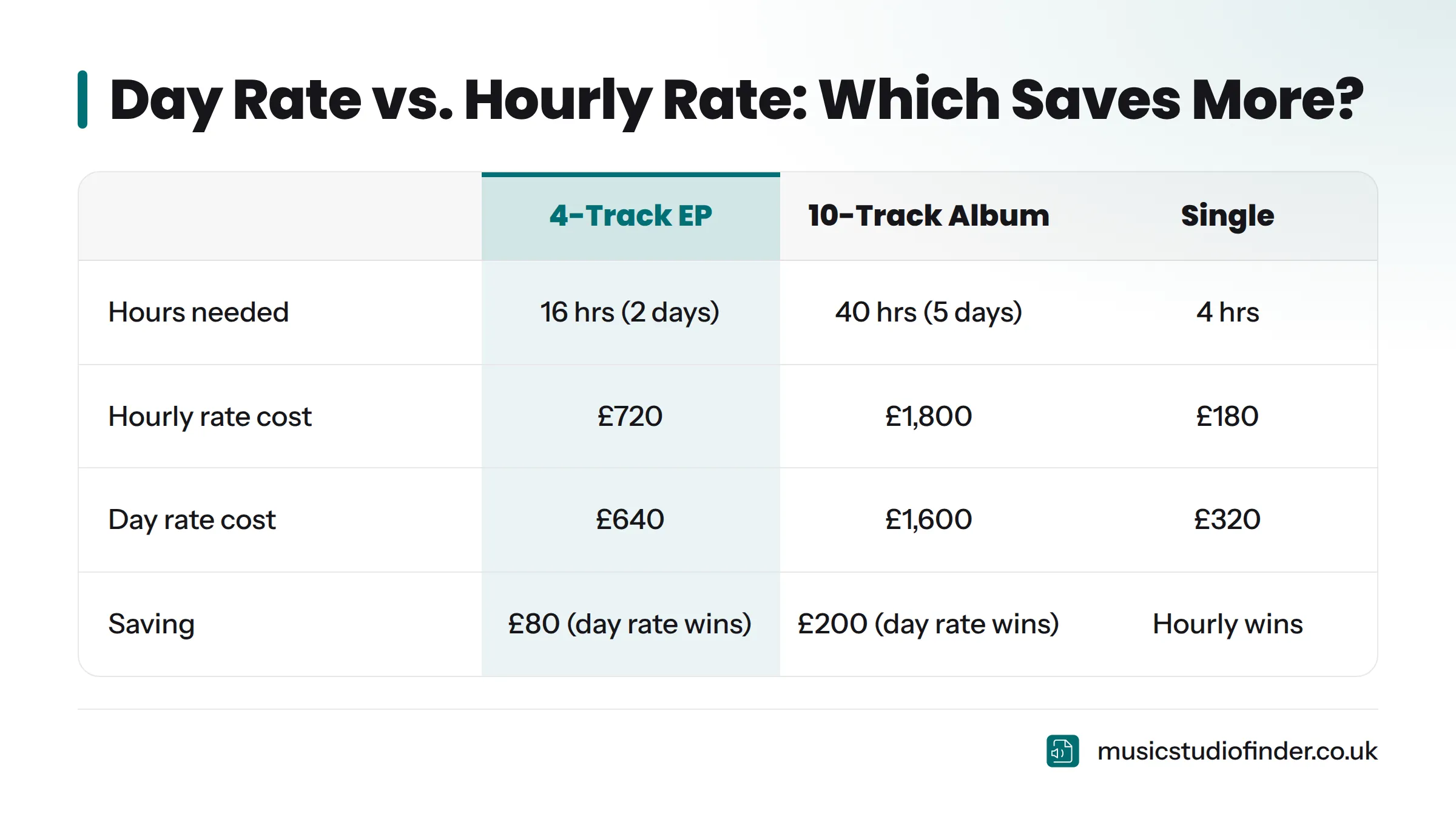
A day rate (typically covering 8 to 10 hours) almost always works out cheaper per hour than the hourly rate. Here's how the numbers look in practice:
| Scenario | Hourly Rate | Day Rate | Hours Needed | Hourly Cost | Day Rate Cost | Saving |
|---|---|---|---|---|---|---|
| Recording a 4-track EP | £45/hr | £320/day | 16 hrs (2 days) | £720 | £640 | £80 |
| Recording a 10-track album | £45/hr | £320/day | 40 hrs (5 days) | £1,800 | £1,600 | £200 |
| Recording a single | £45/hr | £320/day | 4 hrs | £180 | £320 | Hourly wins |
The pattern is clear: day rates win on longer projects, hourly rates win on short sessions of four hours or fewer. The full analysis of recording studio day rate vs hourly rate covers every scenario.
Off-Peak Slots: Midweek and Daytime Discounts
Studios fill up on evenings and weekends because that's when most people are free. Many studios offer reduced rates for daytime weekday slots - sometimes 15 to 25% lower than the standard rate - because demand is lower. If your schedule allows it, booking a Tuesday or Wednesday daytime session is one of the cheapest ways to access the same room and equipment at a lower price. Call the studio directly and ask what their quietest days are. The worst they can say is no.
Block Booking for Multi-Session Projects
If you need multiple sessions - say, four or five days across a month - ask about block booking. Studios often apply a discount of 10 to 20% when you commit to a block of time upfront. It benefits the studio (guaranteed revenue, easier scheduling) and it benefits you (lower rate, priority access to your preferred time slots). Always confirm in writing what the deposit structure looks like, and check whether recording studio deposits are refundable if your plans change.
Last-Minute Availability and How to Find It
Studios sometimes have cancellations and would rather fill the slot at a reduced rate than lose the revenue entirely. Following studios on social media, subscribing to their newsletters, or simply texting your studio contact to ask about last-minute availability can land a significant discount. This approach works best if you're flexible on exact dates and have your pre-production already complete - so you can say yes and walk in prepared.
How to Negotiate With a Studio
Most studios have more flexibility than their published rates suggest. Here's how to have that conversation without it being awkward:
- Research comparable studios in your area first so you have a realistic benchmark.
- Lead with commitment: "We're planning to record three to four days over the next two months. Is there a rate you'd offer for that kind of project?"
- Ask about package deals that bundle tracking and mixing at a combined rate.
- Offer to pay upfront or quickly - cash flow matters to small studio businesses.
- Ask if the engineer can be replaced by a self-op session (you operate the desk yourself) for a reduced rate, if you have the skills.
Politeness and genuine enthusiasm for the studio go a long way. Studios want repeat clients and word-of-mouth referrals.
Sharing Studio Time With Another Artist
Splitting a day rate with another artist is underused and genuinely clever. If you need four hours and another artist needs four hours, you each pay half a day rate and get the same studio access. This requires coordination - the other artist must be reliably prepared and punctual - but can cut your cost in half. Local music networks, online musician forums, and platforms like Music Studio Finder are good places to find compatible artists who might want to share a booking.
Choosing the Right Studio for Your Budget
Not every project needs Abbey Road. In fact, most independent releases sound better tracked somewhere that fits the budget and the vibe of the music.
Do You Actually Need a Top-Tier Studio?
A high-end studio makes sense when the project demands acoustic instruments recorded in a world-class room - orchestral sessions, full drum kits where room sound is part of the character - or when the label or the artist's profile justifies the spend. For most independent musicians recording guitar-based music, pop, hip-hop, or electronic tracks with live elements, a solid mid-range studio delivers results that are indistinguishable on a commercial release.
Ask yourself: will the sonic difference between a £50/hr studio and a £100/hr studio be audible in the finished mix on streaming platforms? In most cases, no - not if the performances are strong and the engineer is skilled.
What to Look for in an Affordable UK Recording Studio
When comparing options, check for:
- An acoustically treated recording room (not just a padded booth)
- A capable DAW running Pro Tools or Logic Pro
- A reliable audio interface and at least one quality condenser microphone
- An experienced engineer included in the rate
- Transparent pricing with no vague "additional fees may apply" language
The guide on how to find an affordable recording studio walks through each of these criteria in detail.
How to Compare Studios by Value, Not Just Price
Price per hour means nothing without context. A £30/hr studio with a skilled engineer who works fast may deliver more value than a £50/hr studio with an inexperienced operator. When comparing studios, look at:
- Included engineer experience (ask what projects they've worked on)
- Room sound and equipment quality relative to your genre
- Studio reviews and artist testimonials
- Whether mixing is included or billed separately
- Parking, public transport access, and load-in logistics (a band that spends 45 minutes finding parking has just wasted £35)
Use Music Studio Finder's recording studio listings to compare UK studios side by side - it's the fastest way to find studios that match both your budget and your musical needs.
How to Prepare for the Session to Get the Most from Every Minute
This is where most musicians leave money on the table. Preparation isn't just about knowing your songs - it's about arriving so organised that the session runs like a production line.
Create a Session Plan and Running Order
Write a document that lists every song, the order you'll record them, the approximate time allocated to each, and which parts each musician needs to be present for. Share it with everyone involved before the day. A session plan lets the engineer set up and prepare for each recording in advance rather than figuring it out as you go. If this is new territory, read how to prepare for your first studio session.
Prepare Charts, Lyric Sheets, and Reference Tracks
Every musician in the room should have their own printed charts or chord sheets. The engineer needs a reference track - a commercially released song that demonstrates the sound and feel you're aiming for. Bring three to five reference tracks and be specific about what you like: the drum sound, the vocal reverb, the low-end balance. This removes guesswork and saves back-and-forth during the session.
Warm Up Before You Arrive
Arrive at the studio warmed up. Singers should have been vocalising for at least 20 minutes before tracking starts. Instrumentalists should run through their parts at the recorded tempo. A cold vocal take takes far more attempts to get right than a warmed-up one. Warming up in the car park or in a stairwell is completely acceptable.
Tune Instruments, Check Equipment, Update Software
The number of sessions delayed by a guitarist whose intonation is out, a drummer whose kit needs extensive setup, or a laptop that starts downloading updates the moment it connects to the studio Wi-Fi is genuinely staggering. Before you arrive:
- Tune all instruments and check intonation on fretted instruments
- Replace strings or drum heads if they're old (old strings lose brightness and sustain)
- Charge all batteries - guitar pedals, wireless units, laptop
- Disable automatic updates on any device you're bringing
- Test that your software (Ableton Live, Logic Pro, etc.) opens and loads your project correctly
Coordinate Your Bandmates So No One Is Late
In a band context, one late member stops everyone else from starting. Establish a strict call time - typically 30 minutes before the booked session start - and treat it seriously. The recording studio etiquette guide covers exactly this kind of group coordination.
Complete Pre-Session Checklist
Before the day of your session, confirm you have:
- Final session running order (shared with the engineer)
- Charts or chord sheets for every song (one copy per musician)
- Printed lyric sheets for vocal sessions
- Reference tracks saved and accessible
- Rough pre-production demos (shared with engineer in advance)
- All instruments tuned, intonated, and ready
- Fresh strings, drum heads, or reeds (as applicable)
- All devices charged and automatic updates disabled
- Cables, picks, spare strings, capos, tuners, and any specialist equipment
- Confirmed call time with all bandmates
- Studio address, parking info, and load-in procedure confirmed
For a more detailed checklist, see what to bring to a recording studio session.
How to Behave in the Studio to Avoid Wasting Time
The clock starts the moment your booked time begins. How you use the first 15 minutes of a session often determines whether the whole day runs smoothly or grinds slowly.
Start Recording Immediately - Settle In Later
Resist the urge to chat, unpack slowly, or spend 30 minutes "getting comfortable." Set up, do a quick level check with the engineer, and start tracking. Breaks and conversation are fine mid-session when you've already made progress.
Limit Takes: Know When Good Enough Is Good Enough
Chasing a perfect take is expensive. Most professional engineers operate on a simple principle: if take three is good, don't burn time hunting for take seven. Use the comping) technique - record four or five takes and stitch together the best phrases afterward - rather than repeating full takes indefinitely. Set a maximum take limit for each section before the session starts. Three to five takes per section is a sensible ceiling for most parts.
Avoid Indecision in the Control Room
The control room is not a democracy during a recording session. Nominate one person as the decision-maker - usually the artist or the band leader - and trust them to make calls quickly. Endless group discussions about whether the snare needs more reverb or whether bar 12 should use a different chord consume enormous amounts of paid time.
Don't Over-Record - Focus on Fewer Songs Done Well
A common mistake is trying to track ten songs in a day rate intended for five. The result is rushed performances across all ten. Recording five songs with clean, confident takes is far more cost-effective than tracking ten songs where every track needs significant repair work in mixing.
Communicate Clearly With Your Engineer
Your recording engineer is a professional who wants the session to succeed. Tell them clearly what you want, what you don't want, and what the reference tracks tell you about the sound you're after. A good engineer will push back when needed and offer solutions you haven't considered. Trust that relationship - it's part of what you're paying for.
Managing Post-Session Costs: Mixing and Mastering
Tracking is only part of the bill. Mixing and mastering can equal or exceed the cost of your recording sessions if you don't plan for them upfront.
In-House Mixing vs. Hiring an External Mixer
Many studios offer in-house mixing at their standard rate. This is convenient but not always the best value. An external mix engineer hired per song or per project may deliver a superior result at a comparable or lower cost, particularly if they specialise in your genre. Get quotes from both before you commit. Sound On Sound regularly features profiles of mix engineers whose rates and credits you can research.
Online Mastering Services as a Cost-Effective Option
LANDR and similar AI-assisted mastering platforms offer fast, affordable mastering starting from a few pounds per track. The quality is not comparable to a skilled mastering engineer for complex or high-profile releases, but for demos, independent singles, and digital-only releases, the results are often perfectly adequate. A professional mastering engineer in the UK typically charges £50 to £150 per song - a cost worth paying for a commercial release, but potentially avoidable for earlier-stage recordings.
How to Manage Revision Rounds to Avoid Extra Fees
Mixing engineers typically include one or two revision rounds in their quoted fee. Each additional round often carries a charge. Before work begins, agree in writing:
- How many revision rounds are included
- What counts as a revision vs. a new mix
- The turnaround time for each revision
Send consolidated, specific feedback in a single document rather than drip-feeding comments over days. "The kick drum is too quiet in bar 24" is actionable. "It just doesn't feel right" triggers an expensive conversation that leads nowhere fast.
File Export and Delivery - What to Ask for Upfront
Request your files in a format suitable for both streaming and further editing: stereo WAV at 24-bit/48kHz as standard, plus stem files if your budget allows. Stems (grouped tracks like drums, bass, guitars, vocals) allow future remixing or replacement of individual elements without re-booking the studio. Clarify whether file delivery is included in the rate before the session ends.
The Hybrid Approach: Combining Home and Professional Recording
The hybrid approach is one of the most financially sensible strategies available to independent musicians in 2026. It treats the professional studio as a targeted tool rather than the only option.
What to Record in a Professional Studio vs. at Home
Professional studios genuinely earn their rate for:
- Acoustic drum kits (room sound and microphone placement matter enormously)
- Large-room string or brass recording
- Vocals in a properly treated vocal booth (home recording often introduces room noise and acoustic problems)
Home recording works well for:
- Electric guitar and bass DI or through a loadbox
- MIDI instruments and software synthesisers
- Overdubs of additional instrument layers after the core tracking is done
- Programmed drums as a placeholder or final element in electronic music
Tracking Drums Professionally, Overdubbing at Home
The most practical hybrid workflow for a guitar band: book one day at a professional studio to track live drums (and bass if the room allows it). Then take those recorded drum stems home and overdub guitars, additional bass parts, and vocals using a home interface and DAW. The result is a recording with professional drum sounds and controlled, budget-conscious overdubbing costs.
For a thorough comparison of the two environments, recording studio vs home studio covers the trade-offs honestly, without pretending one approach suits every situation.
Cost Comparison: Full Studio, Hybrid, and Home-Only Approaches
| Approach | Typical Cost (5-track EP) | Pros | Cons |
|---|---|---|---|
| Full professional studio | £600 – £1,500+ | Consistent quality, experienced engineer, treated room | Highest cost, time pressure |
| Hybrid (drums pro, overdubs home) | £250 – £600 | Professional drum sound, lower overdub cost | Requires home recording capability |
| Home-only | £0 – £200 (equipment) | No ongoing studio cost | Room acoustics, equipment quality limits |
The hybrid approach typically delivers 70-80% of the sonic quality of a full studio session at 30-50% of the cost - a compelling trade-off for independent artists.
How Much Should You Budget? A Simple Framework
Before you book anything, build a budget. That means estimating hours, applying a realistic rate, and adding a 15-20% contingency for the unexpected.
Estimating Hours by Project Type
| Project | Tracking Hours | Mixing Hours | Mastering | Total (approx.) |
|---|---|---|---|---|
| Single (1 song) | 3 – 6 hrs | 2 – 4 hrs | 1 hr | 6 – 11 hrs |
| EP (4–5 songs) | 12 – 25 hrs | 8 – 15 hrs | 4 – 5 hrs | 24 – 45 hrs |
| Album (10–12 songs) | 30 – 60 hrs | 20 – 40 hrs | 10 – 12 hrs | 60 – 112 hrs |
These are realistic ranges for bands and solo artists with solid pre-production. Poor preparation pushes every figure toward the upper end. The how many hours to book in a recording studio guide offers a more granular breakdown by instrumentation and genre.
UK Studio Rate Reference Ranges by City (2026)
| City | Budget Hourly | Mid-Range Hourly | Day Rate (mid-range) |
|---|---|---|---|
| London | £35 – £55 | £60 – £120 | £450 – £900 |
| Manchester | £25 – £40 | £40 – £70 | £280 – £500 |
| Birmingham | £20 – £35 | £35 – £60 | £250 – £450 |
| Edinburgh | £25 – £40 | £40 – £65 | £280 – £480 |
| Leeds | £20 – £35 | £35 – £60 | £250 – £420 |
| Bristol | £25 – £40 | £40 – £65 | £280 – £450 |
Rates reflect general market positioning and vary by studio. Always confirm current rates directly with studios - use Music Studio Finder to browse verified listings in your city.
Building Your Session Budget Before You Book
- List every song you plan to record.
- Estimate tracking hours using the table above.
- Decide whether mixing and mastering happen in-house or externally, and get quotes.
- Add 15-20% contingency.
- Set the total as your firm budget ceiling before you contact studios.
- Use that number to filter your studio search by what you can genuinely afford.
This prevents the common trap of falling in love with a studio that's £20/hr over budget and convincing yourself it'll be fine.
Frequently Asked Questions
Recording a single in the UK costs roughly £150 to £600 all-in - tracking, mixing, and basic mastering - depending on the studio tier and the number of hours needed. A well-prepared artist in a mid-range studio can track a song in 3 to 5 hours, spending £120 to £300 on studio time alone.
A fair rate for a solid mid-range professional studio in the UK is between £35 and £60 per hour in 2026, with an engineer included. Budget studios start around £20 to £30/hr. Anything over £80/hr sits at the premium end and is typically justified by exceptional equipment, room quality, or engineer reputation.
Book a day rate when your session runs five or more hours - the per-hour cost almost always works out lower. Book hourly for short sessions of four hours or fewer, where paying for a full day would be wasteful.
Commit to multiple sessions upfront, offer to pay quickly or in full at booking, ask about off-peak weekday slots, and research comparable studios so you negotiate from an informed position. Most studios have more flexibility than their listed rates suggest, especially for clients who represent repeat business.
Midweek daytime slots - Monday to Thursday, before 6pm - are typically the cheapest times to book. Demand drops on those days, and many studios offer discounts of 15 to 25% compared to evening and weekend rates.
A well-prepared solo artist or band typically needs 3 to 6 hours to track a single, plus 2 to 4 hours for mixing. Total: 5 to 10 hours. Poor preparation can double that figure.
Home recording has minimal ongoing cost once you own the equipment, but it requires acoustic treatment and technical knowledge. A professional studio costs more per session but delivers consistent quality without the setup investment. The hybrid approach - tracking drums professionally, overdubbing at home - offers the best financial balance for most independent artists.
Pre-production means completing your songwriting, arranging, and rough recording before you enter the professional studio. It eliminates writing time from your billable hours, ensures everyone arrives knowing their parts, and allows the engineer to prepare for each song in advance. Artists with strong pre-production typically finish recording 30 to 50% faster.
Block booking means committing to a set number of sessions - say, four or five days - with a studio in advance. Studios commonly offer a 10 to 20% discount on block bookings because the guaranteed revenue benefits their scheduling. For longer projects, it's one of the most straightforward ways to reduce your overall bill.
Agree revision rounds in writing before work starts, send consolidated feedback in one document, and consider AI mastering services like LANDR for digital releases where a full professional master isn't needed. For mixing, compare in-house rates with external mix engineers before you commit.
Overage charges typically apply at the full hourly rate and sometimes at a premium rate. The best prevention is a realistic session plan. If time is running short, prioritise: get the essential takes recorded and leave optional overdubs for another session rather than rushing everything and paying overage on top.
Sources
- Recording Studio Cost UK: 2026 Pricing Guide - Music Studio Finder
- Recording Studio Prices UK: 2026 Complete Guide - Music Studio Finder
- Recording Studio Day Rate vs Hourly Rate - Music Studio Finder
- Recording Studio Hidden Fees: What to Check First - Music Studio Finder
- How to Find an Affordable Recording Studio UK - Music Studio Finder
- How to Prepare for Your First Studio Session - Music Studio Finder
- What to Bring to a Recording Studio Session - Music Studio Finder
- How Many Hours to Book in a Recording Studio - Music Studio Finder
- EP Studio Time: How Many Hours Do You Need? - Music Studio Finder
- How Much Studio Time to Record an Album? - Music Studio Finder
- Recording Studio vs Rehearsal Studio - Music Studio Finder
- Recording Studio vs Home Studio - Music Studio Finder
- What's Included When You Hire a Recording Studio? - Music Studio Finder
- Recording Studio Deposits - Music Studio Finder
- Why Recording Studio Prices Vary So Much - Music Studio Finder
- Recording Studio Etiquette - Music Studio Finder
- Sound On Sound - soundonsound.com
- LANDR - Online Mastering Platform
- GarageBand - Apple UK