
Recording an album in the UK typically costs between £1,500 and £25,000+, depending on your studio tier, track count, region, and whether you hire a producer. A budget indie album usually runs £1,500–£3,500, a mid-range project sits at £4,000–£10,000, and a fully produced professional album can reach £15,000–£30,000 or beyond.
Quick Answer
Budget Level Estimated Total Cost Budget album (DIY-adjacent) £1,500 – £3,500 Mid-range indie album £4,000 – £10,000 Professional album £10,000 – £30,000+
Those ranges cover studio hire, a recording engineer, mixing, mastering, and basic post-production. Add a producer, session musicians, vinyl pressing, and a PR campaign, and the ceiling rises fast. Knowing exactly where each pound goes puts you firmly in control of your album production budget UK from day one.
What Drives the Album Recording Cost UK?
No two album projects carry the same price tag - and that is entirely normal. Several variables interact to push your total up or down significantly. Understanding why recording studio prices vary so much before you book a single session is one of the most valuable things you can do.
Track Count
Track count is the single most direct driver of studio cost. More songs mean more tracking sessions, more overdubs, more mixing stems, and more mastering passes. A ten-track album requires roughly twice the studio time of a five-track EP. Think of your track count as a multiplier applied to every other line in your budget.
Studio Tier
Budget, mid-range, and high-end studios charge meaningfully different rates and deliver meaningfully different results. The room, the console (whether a classic Neve or SSL), the microphone locker, and the resident engineer's experience all scale with price.
Location Across the UK
London studios command a substantial premium over regional UK cities. A studio in Manchester, Leeds, Bristol, or Glasgow offering comparable equipment and engineer quality will often charge 30–50% less per hour than its London counterpart. For a full album, that gap can represent thousands of pounds.
Genre and Instrumentation
A solo acoustic singer-songwriter records very differently from a seven-piece rock band. Full live-room tracking sessions with drums, bass, guitars, and keys simultaneously require larger rooms, more microphones, more outboard gear, and more time for sound-checking and comping. Electronic and hip-hop productions lean more heavily on DAW work inside the control room, which can reduce tracking time considerably.
Whether You Need a Producer
A recording engineer captures the sound. A music producer shapes the entire creative direction - the arrangements, the sonic palette, and the performance. Hiring a producer on top of studio hire adds a substantial line to your budget, but for many artists, it is what separates a good recording from a great one. The distinction between these roles is covered in more detail below, and you can read a full comparison in this guide to music producer vs recording engineer differences.
UK Recording Studio Rates in 2026
Studio hire cost UK-wide breaks down into three broad tiers. Most UK studios quote their rates either with or without VAT, so always confirm which applies when you receive a quote. For a deeper look at current pricing, the recording studio cost UK guide and recording studio prices UK breakdowns cover the current market in detail.
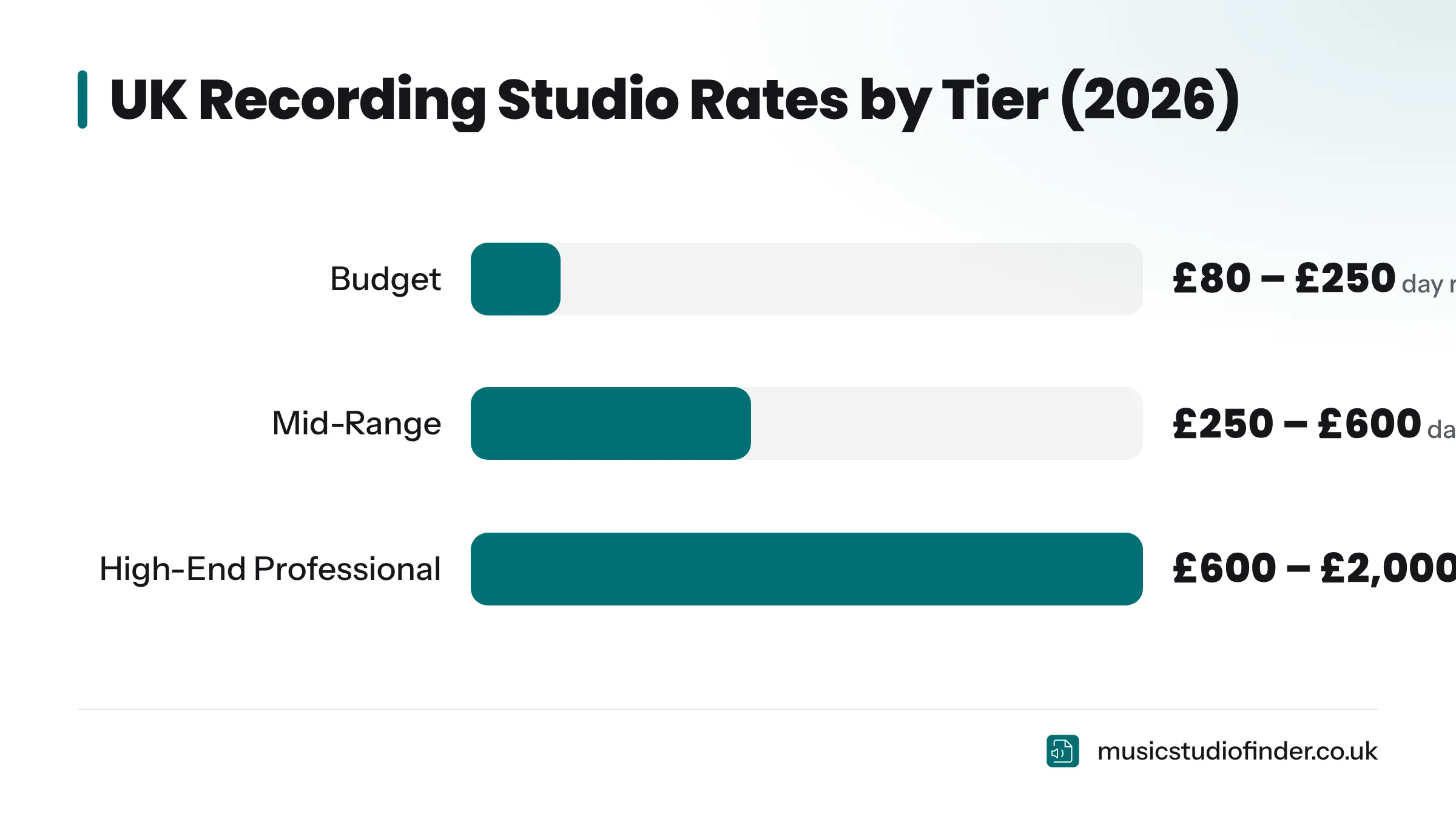
| Studio Tier | Hourly Rate (£) | Day Rate (£) | Typical Use Case |
|---|---|---|---|
| Budget | £15 – £40 | £80 – £250 | Demos, first albums, DIY indie projects |
| Mid-Range | £40 – £100 | £250 – £600 | Indie releases, semi-pro bands, singer-songwriters |
| High-End Professional | £100 – £300+ | £600 – £2,000+ | Commercial releases, major label projects, complex live recording |
Budget Studios (£15–£40/hour)
Budget studios are often owner-operated spaces with solid DAW setups, good condenser microphones, and competent engineers. They are well-suited to demos, first albums, and artists who arrive well-rehearsed and need minimal production input. The trade-off is that you may find smaller live rooms, fewer vintage microphones, and less outboard analogue gear.
Mid-Range Studios (£40–£100/hour)
This is where most independent UK artists record their albums. Mid-range studios frequently feature SSL or Neve consoles, multiple rooms (a live room, control room, and dedicated vocal booth), experienced in-house engineers, and quality monitoring systems. For the majority of indie and alternative releases in the UK, this tier produces commercially competitive results.
High-End Professional Studios (£100–£300+/hour)
Studios such as Abbey Road Studios, RAK Studios, Metropolis Studios, and Real World Studios operate at this level. Their day rates reflect world-class acoustics, peerless equipment, and engineers with major-label credits. If your budget is at this tier, you are almost certainly working with an independent label or have secured outside funding.
London vs. Regional UK Studio Rate Comparison
| City/Region | Average Hourly Rate (£) | Average Day Rate (£) |
|---|---|---|
| London | £70 – £200 | £400 – £1,500 |
| Manchester | £35 – £90 | £200 – £600 |
| Birmingham | £30 – £80 | £180 – £500 |
| Leeds | £25 – £75 | £150 – £450 |
| Bristol | £30 – £85 | £180 – £550 |
| Glasgow | £25 – £70 | £150 – £400 |
| Edinburgh | £30 – £80 | £180 – £500 |
These figures reflect typical recording studio rates UK-wide, drawn from active studio listings across the Music Studio Finder platform. Rates in regional cities are consistently 30–50% below London equivalents - a difference that compounds significantly across a full album project.
How Many Studio Hours Does an Album Take?
Time is money in a recording studio. The question of how much studio time it takes to record an album is closely tied to your preparation level, track complexity, and the number of musicians involved. As a working guide:
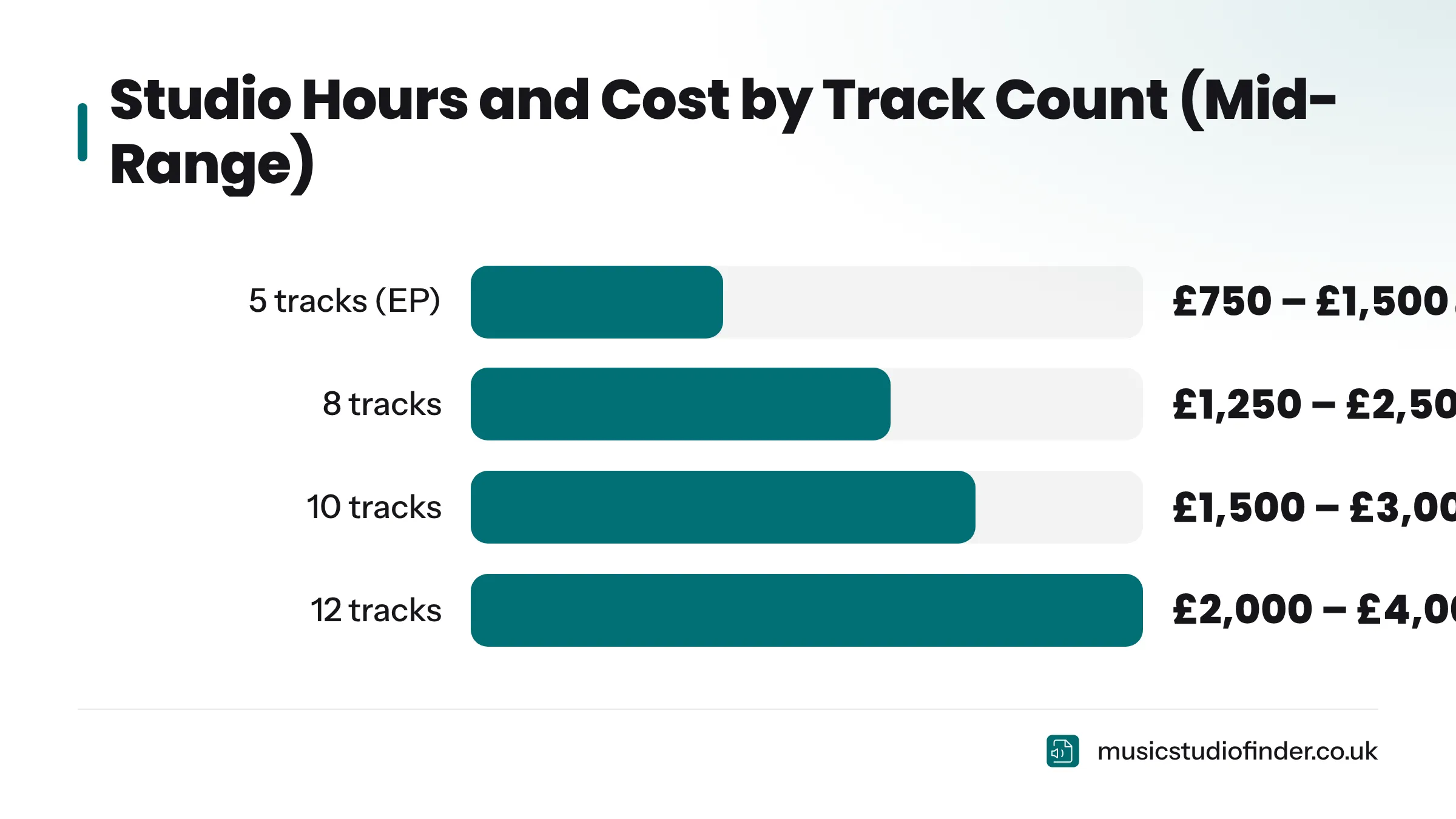
| Track Count | Estimated Studio Hours (Tracking + Overdubs) | Estimated Studio Cost at Mid-Range (£50/hr) |
|---|---|---|
| 5 tracks (EP) | 15 – 30 hours | £750 – £1,500 |
| 8 tracks | 25 – 50 hours | £1,250 – £2,500 |
| 10 tracks | 30 – 60 hours | £1,500 – £3,000 |
| 12 tracks | 40 – 80 hours | £2,000 – £4,000 |
These estimates assume a band that arrives prepared. Underprepared artists can easily double these figures. That is why pre-production time - rehearsing arrangements at home or in a rehearsal studio before entering the recording studio - is one of the highest-return investments you can make. Add mixing and mastering time separately; it typically adds another 20–40 hours for a ten-track album.
Producer Fees UK: What to Expect
Knowing what a recording engineer does versus what a producer brings helps you decide whether you actually need both. A recording engineer operates the technical equipment. A music producer guides your performances, challenges your arrangements, and ensures the finished recording serves the song rather than just capturing it.
Flat-Rate Producers
Many UK producers charge a flat per-track or per-album fee, particularly for indie and urban projects. This gives you budget certainty upfront.
Hourly Rate Producers
Studio-based producers who also engineer often charge an hourly rate bundled into the studio cost. This is common at mid-range and high-end studios where the in-house engineer doubles as a co-producer.
Royalty-Share Arrangements
Some emerging producers work for a reduced upfront fee in exchange for a percentage of streaming and sync royalties. This can reduce your immediate outlay but creates a long-term contractual relationship you should approach carefully and with proper legal advice.
| Producer Tier | Fee Structure | Typical Cost Range (£) |
|---|---|---|
| Emerging / local | Flat per track | £100 – £400 per track |
| Established indie | Flat per track or album | £500 – £2,000 per track / £3,000 – £10,000 per album |
| High-end / credited | Day rate or royalty + advance | £500 – £2,000+ per day |
| Royalty-share only | % of royalties (0–25%) | Minimal upfront cost |
Session Musician Costs in the UK
Not every band arrives at the studio with every instrument covered. Session musicians fill those gaps, and their rates in the UK are guided by the Musicians' Union (MU), which publishes rate cards to protect working musicians.
For 2026, MU-recommended minimum rates for session recordings are broadly in the range of £170–£220 for a three-hour studio session, though experienced session players with significant credits command considerably more. Here is a working guide to typical rates:
| Instrument / Role | Rate Per Session (3 hrs, £) | Day Rate (£) |
|---|---|---|
| Drummer | £180 – £450 | £350 – £900 |
| Bassist | £160 – £400 | £300 – £800 |
| Guitarist | £150 – £400 | £300 – £800 |
| Pianist / Keyboardist | £150 – £400 | £300 – £800 |
| String player (per musician) | £200 – £500 | £400 – £1,000 |
| Session vocalist | £150 – £500 | £300 – £1,000 |
| Brass/woodwind (per musician) | £180 – £450 | £350 – £900 |
For a ten-track album that requires a full live rhythm section across all songs, session musician fees alone could reach £2,000–£5,000. Smart arrangement and pre-production can reduce this significantly - for example, looping or programming certain percussion elements rather than booking a drummer for every track.
Mixing and Mastering Cost UK
Mixing and mastering are distinct post-production stages, each with its own cost. If you are unsure how they relate to each other, the guide to recording vs mixing vs mastering explains the full workflow clearly.
Mixing Engineer Fees
A mixing engineer takes the raw recorded stems and balances them into a finished, cohesive stereo track. In the UK, mixing rates in 2026 typically look like this:
- Budget mix (online, emerging mixer): £50 – £150 per track
- Mid-range mix (experienced independent mixer): £150 – £500 per track
- High-end mix (credited, major-label experience): £500 – £2,000+ per track
Most mixers include one or two rounds of revisions in their fee; additional revision rounds typically attract extra charges.
Mastering Engineer Fees
Mastering applies the final polish - EQ, limiting, loudness optimisation - and prepares your tracks for distribution. UK mastering rates per track in 2026:
- Online automated mastering (LANDR, eMastered): £5 – £20 per track (subscription or per-track pricing)
- Independent mastering engineer: £50 – £150 per track
- High-end studio mastering (Metropolis, Air Studios): £150 – £400 per track
Online Mastering vs. UK Engineers
Services like LANDR and eMastered offer instant AI-driven mastering at low cost. For a budget debut album aimed at streaming platforms, they can deliver a passable result. For a release intended for vinyl, sync licensing, or radio play, a human mastering engineer who can communicate with you and adjust to the specific sonic character of your record is worth the extra spend.
| Service Type | Cost Per Track (£) | Full 10-Track Album (£) |
|---|---|---|
| Automated online mastering (e.g., LANDR) | £5 – £20 | £50 – £200 |
| Independent mastering engineer | £50 – £150 | £500 – £1,500 |
| Premium studio mastering | £150 – £400 | £1,500 – £4,000 |
| Mixing + mastering bundle (independent) | £150 – £500 | £1,500 – £5,000 |
Bundling your mixing and mastering with one engineer or studio often earns a 10–20% discount versus booking them separately.
Additional Album Production Costs to Budget For
Studio hire, mixing, and mastering are the core costs. The following line items are equally real and equally worth planning for before you start spending.
Album Artwork and Design (£150–£1,500)
Your album artwork is your most visible marketing asset outside the music itself. A freelance graphic designer in the UK typically charges £150–£600 for a full artwork package (front cover, back cover, spine, and digital assets). Established creative studios or art directors with music industry portfolios charge £600–£1,500+.
Vinyl Pressing and CD Duplication in the UK
The UK vinyl revival is real and ongoing. According to the BPI, vinyl album sales in the UK have grown for 16 consecutive years. Pressing costs in 2026 through UK-linked pressing services - many UK labels use facilities such as GZ Media, Optimal, or the Vinyl Factory - run approximately:
- 500 x 12" vinyl LPs (black, standard sleeve): £1,800 – £2,800
- 1,000 x 12" vinyl LPs (black, standard sleeve): £2,500 – £4,000
- 250 x CD digipack (full colour, 4-panel): £400 – £700
- 500 x CD jewel case: £350 – £600
Lead times for vinyl pressing currently run 10–20 weeks from approved artwork, so plan this well in advance of your release date.
Digital Distribution Costs
Services such as DistroKid, TuneCore, and Amuse distribute your album to Spotify, Apple Music, and other platforms. Costs vary by model:
- DistroKid: approximately £19/year for unlimited releases
- TuneCore: approximately £29.99 per album per year
- CD Baby (one-time): approximately £35–£50 per album
ISRC codes, which identify each track for royalty tracking, are typically issued free through your distributor or through PPL.
Photography and Press Shots (£200–£800)
Professional press photography is essential for PR, editorial, and streaming profile assets. An experienced music photographer in a regional UK city charges £200–£400 for a half-day shoot including edited digital images. London-based photographers with editorial credits typically charge £400–£800+.
Marketing and PR (£500–£5,000+)
A freelance music PR consultant in the UK charges roughly £500–£1,500 per month for an album campaign. Specialist music PR agencies start at £1,500–£3,000 per month. Even a modest, self-managed digital campaign will incur advertising costs of £200–£500 across Meta and playlist pitching platforms.
Copyright Registration: PRS and PPL
Registering your album with PRS for Music as a songwriter/composer costs nothing - PRS membership is free, and registering your works is free. The PPL registers the rights of performers and record labels in the master recording; PPL registration is also free. If you exploit your music commercially (through sync, broadcast, or physical sales), you will also need an MCPS mechanical licence, administered through PRS for Music. These registrations cost you time rather than money, but they are non-negotiable steps for any commercially released UK album.
Does VAT Apply to Recording Studio Hire in the UK?
Yes, in most cases. UK recording studios that are VAT-registered - broadly those with annual turnover above £90,000 as of 2026 - add 20% VAT to their quoted rates. Many smaller, owner-operated budget studios operate below the VAT threshold and quote VAT-inclusive or VAT-exempt prices.
Always ask studios whether their quoted rates include or exclude VAT before you commit. For a £3,000 studio hire invoice, VAT adds £600 on top - a figure that catches many first-time album makers off guard. If you are VAT-registered yourself (for example, through a limited company), you can reclaim the input VAT; if you are recording as an individual artist without VAT registration, you cannot.
Total Album Recording Cost: Three UK Budget Scenarios
Here is how the full cost stack looks across three realistic scenarios for a ten-track UK album in 2026.
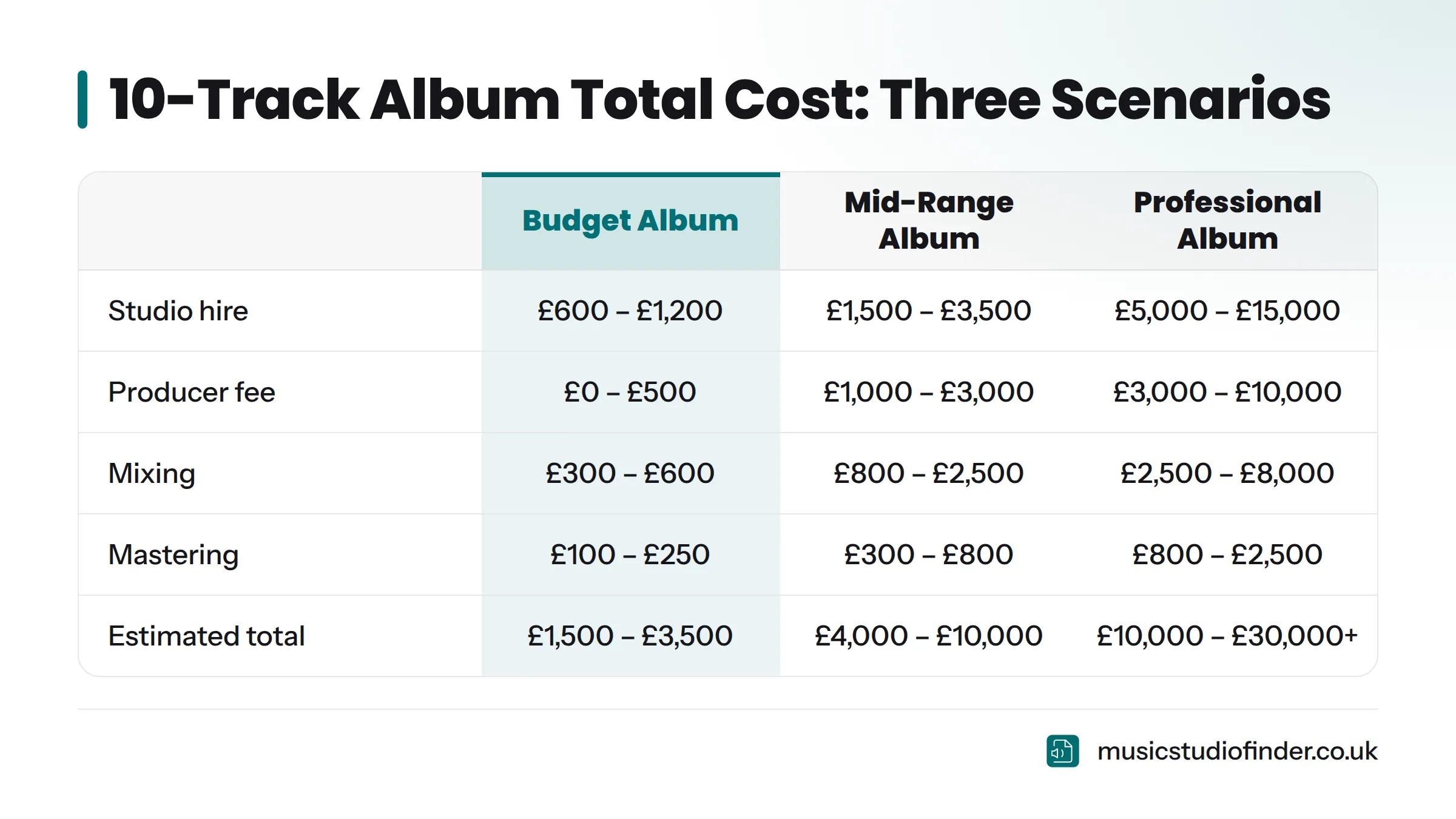
| Cost Category | Budget Album | Mid-Range Album | Professional Album |
|---|---|---|---|
| Studio hire (tracking) | £600 – £1,200 | £1,500 – £3,500 | £5,000 – £15,000 |
| Producer fee | £0 – £500 | £1,000 – £3,000 | £3,000 – £10,000 |
| Session musicians | £0 – £500 | £500 – £2,000 | £2,000 – £6,000 |
| Mixing | £300 – £600 | £800 – £2,500 | £2,500 – £8,000 |
| Mastering | £100 – £250 | £300 – £800 | £800 – £2,500 |
| Artwork / design | £150 – £300 | £300 – £600 | £600 – £1,500 |
| Photography | £0 – £200 | £200 – £400 | £400 – £800 |
| Distribution | £20 – £50 | £20 – £50 | £50 – £150 |
| Estimated Total | £1,500 – £3,500 | £4,000 – £10,000 | £10,000 – £30,000+ |
Budget Album (£1,500–£3,500): What You Get
At this level, you are likely recording in a well-equipped budget studio, handling most of the arrangement and production decisions yourself, and either mixing in-the-box with a junior engineer or using an online mastering service. The result can be entirely release-worthy - particularly for folk, acoustic, singer-songwriter, or lo-fi genres where a certain rawness is an asset rather than a liability. Tight pre-production is essential here: arriving perfectly rehearsed is what makes this budget work.
Real example: a £2,500 budget album A solo artist with ten original songs might spend: £900 on three studio days at a regional mid-budget studio (£300/day), £400 on online mixing through a freelance mixer, £100 on LANDR mastering, £600 on artwork and design, £300 on photography, and £200 on digital marketing. Total: £2,500.
Mid-Range Album (£4,000–£10,000): What You Get
This is the realistic target for most self-funding indie artists and bands in the UK in 2026. At this budget you can access a genuinely good studio for five to ten studio days, work with an experienced independent mixing engineer, afford a proper mastering session, commission quality artwork, and cover essential photography. If your genre requires drums or additional instrumentation you cannot play yourselves, you can bring in one or two session musicians without breaking the budget.
Professional Album (£10,000–£30,000+): What You Get
Professional-tier albums recorded at high-end UK studios with experienced producers and full session musician rosters sit at this level. This is where you book residential recording studios, consider analogue recording through Neve or SSL consoles, and hire mastering engineers with chart credits. If you are pursuing sync licensing, radio play, or a label relationship, this is the tier that produces the results those gatekeepers expect.
For comparison, residential recording studio options add accommodation and full-day availability to the equation; the guide to residential recording studios explores whether that investment is worth it for your project.
Funding Your Album: UK Grants and Financial Support
One of the biggest gaps in most articles covering how much to record an album UK-wide is the near-total absence of funding information. If you are a UK-based independent artist, you have genuine options.
Help Musicians UK
Help Musicians UK runs several funding programmes specifically for recording projects. Their Do It Differently fund and Making Music fund have supported independent artists with grants towards recording costs. Eligibility and round dates change throughout the year, so check their website for current opportunities.
PRS Foundation
The PRS Foundation offers multiple funding strands for UK songwriters and composers, including the Open Fund for Music Creators, which can contribute towards recording budgets. You must be a PRS for Music member to apply.
Arts Council England / Creative Scotland / Arts Council of Wales
Arts Council England offers National Lottery Project Grants to individual artists and organisations across England, with music recording projects regularly among the funded work. Creative Scotland provides equivalent funding for Scottish artists, and the Arts Council of Wales covers Welsh artists. Grant amounts typically range from £1,000 to £15,000 for recording projects, depending on scale and artistic ambition.
Crowdfunding Platforms
Kickstarter and Indiegogo have both been used successfully by UK artists to fund album recordings directly from their fanbase. Bandcamp's direct-to-fan model also allows pre-sale campaigns that can contribute meaningfully to recording budgets before you spend a penny in the studio.
Ten Practical Ways to Reduce Your Album Recording Budget
Spending less on recording your album does not mean compromising the quality of the finished music. It means being smarter about where your studio time goes. These are concrete steps that work in the UK studio market right now:
- Pre-produce at home before entering the studio. Record scratch tracks and demos of every arrangement at home using a basic audio interface and DAW. Know exactly what you are recording before the clock starts.
- Rehearse until your parts are second nature. Every take you need to redo costs money. A band that can nail a live take in two attempts rather than ten saves hours of studio time.
- Use your studio session prep checklist before every session. Confirm tunings, spare strings, drum heads, and any equipment the studio does not supply.
- Book block sessions. Many UK studios offer a reduced hourly rate when you book five or more days in a block. Ask directly - studios frequently advertise their standard day rate but offer block discounts to serious projects.
- Record outside London. Based on the regional rate comparison above, you can save 30–50% on studio costs by recording in Manchester, Leeds, or Glasgow versus a comparable London studio.
- Bundle recording, mixing, and mastering with one studio or engineer. Studios that offer all three stages in-house often discount the total package.
- Use online mastering for budget projects. For a streaming-first release on a tight budget, automated mastering services deliver an acceptable result at a fraction of the cost of a human mastering session.
- Limit session musician requirements through smart arrangement. Ask yourself whether that string section genuinely needs to be live, or whether a well-programmed virtual instrument serves the song equally well at this stage.
- Ask about off-peak and overnight rates. Some studios offer significantly reduced rates for bookings that run outside their standard weekday business hours.
- Search specifically for affordable studios using the guide to how to find an affordable recording studio in the UK.
For your first studio session in particular, preparing thoroughly in advance is the most cost-effective thing you can do.
DIY Home Studio vs. Professional Studio: A Cost Comparison
A common question from independent UK artists is whether building a home studio pays off over time compared to hiring professional studio time. The honest answer: it depends entirely on how prolific you are and how complex your recordings need to be. The recording studio vs home studio comparison breaks this down in full, but here is a practical overview:
| Setup Type | Initial Cost (£) | Ongoing Cost | Best For |
|---|---|---|---|
| Basic home recording setup (interface, microphone, DAW) | £500 – £1,500 | Low (software subscriptions) | Songwriting demos, vocals, acoustic guitar |
| Mid-range home studio (acoustic treatment, monitors, plugins) | £2,000 – £5,000 | Low–Medium | Producer-style productions, solo electronic artists |
| Professional home studio (high-end gear, full treatment) | £10,000 – £30,000+ | Medium (maintenance, upgrades) | Full-time producers, composers, home-based session artists |
| Budget professional studio hire | £80 – £250/day | Per-project | First albums, demos, occasional recording |
| Mid-range professional studio hire | £250 – £600/day | Per-project | Indie albums, semi-professional releases |
For most independent UK artists recording their first album, the maths favours professional studio hire. Spending £3,000–£6,000 on studio time delivers a finished album with professional acoustics, quality monitoring, and an experienced engineer. Spending the same amount building a home studio gives you a setup that still requires years of learning to use competently.
That said, if you are a producer, beatmaker, or electronic artist who creates music regularly, the home studio investment pays off faster. Many artists split the difference: recording and producing at home, then booking a professional studio for final tracking, vocal booth sessions, and mixing.
Finding the Right Recording Studio in the UK
Armed with a realistic album recording budget, the next step is finding a studio that matches it. The Music Studio Finder platform lists recording studios across the UK, filtered by location, price range, and studio type - making it straightforward to compare options in your city or region without cold-calling individual venues.
When evaluating studios, the guide on how to choose a recording studio walks you through the key questions: room acoustics, the in-house engineer's credits, what equipment is included in the hire rate, and what the booking process looks like. Understanding what's included when you hire a recording studio saves you from unexpected costs - not every studio includes an engineer in their day rate, for example.
The how many hours to book in a recording studio guide gives you a practical framework for estimating your session requirements before you approach any studio. Going in with a clear sense of your hour and day requirements puts you in a much stronger position to negotiate rates, ask about block booking discounts, and avoid overspending on time you do not need.
Frequently Asked Questions
How much does it cost to record a ten-track album in the UK in 2026? A ten-track album in the UK costs approximately £1,500–£3,500 at the budget end, £4,000–£10,000 at mid-range, and £10,000–£30,000+ for a fully produced professional project. The exact figure depends on studio tier, region, whether you hire a producer, and your session musician requirements.
How much does a recording studio cost per hour in the UK? UK recording studio hourly rates in 2026 range from £15–£40 per hour at budget studios, £40–£100 per hour at mid-range studios, and £100–£300+ per hour at high-end professional studios. London studios typically sit at the upper end of each tier.
How much does it cost to mix and master a full album in the UK? Mixing a ten-track album with an independent UK engineer costs roughly £800–£2,500. Mastering the same album costs £300–£800 with an independent mastering engineer, or as little as £50–£200 with an automated online service. Combined, expect £1,100–£3,300 for mixing and mastering a full album at the mid-range.
How much cheaper is recording outside London compared to in London? Regional UK studios - in cities such as Manchester, Leeds, Bristol, and Glasgow - typically charge 30–50% less per hour and per day than comparable London studios. On a ten-track album requiring eight studio days, that regional discount can represent a saving of £1,500–£4,000 or more.
Does VAT apply to UK recording studio hire? Yes, VAT-registered studios (those above the £90,000 annual turnover threshold) add 20% VAT to their quoted rates. Smaller owner-operated studios may be VAT-exempt. Always confirm whether the quoted rate includes VAT before signing a booking agreement.
What grants are available to help fund album recording in the UK? UK artists can apply to Help Musicians UK (Do It Differently and Making Music funds), the PRS Foundation (Open Fund for Music Creators), Arts Council England National Lottery Project Grants, Creative Scotland (for Scottish artists), and the Arts Council of Wales. Grants typically range from £1,000 to £15,000 for recording projects.
How much does pressing vinyl cost in the UK in 2026? Pressing 500 x 12" vinyl LPs through a UK-linked pressing service costs approximately £1,800–£2,800. Pressing 1,000 units typically costs £2,500–£4,000. Lead times currently run 10–20 weeks, so plan your press well ahead of your release date.
When should I hire a producer rather than just a recording engineer? Hire a recording engineer when you know exactly what you want and simply need someone to capture it accurately. Hire a music producer when you want an outside creative perspective on your arrangements, performances, and overall sonic direction - particularly for a debut album where your recorded sound is not yet fully defined.
What hidden costs should I watch out for when recording an album? The most common hidden costs include VAT on studio hire quotes, overtime charges if sessions run past the booked end time, revision round fees from mixers and mastering engineers, travel and accommodation costs for recording at a residential studio, equipment hire for instruments the studio does not stock, and graphic design revision fees if artwork directions change mid-process.
Is a home studio cheaper than a professional studio in the long run? For prolific producers and electronic artists who record continuously, a mid-range home studio (£2,000–£5,000 setup cost) can pay for itself within two to three album projects. For a band that records one album every two or three years, professional studio hire is almost always the more cost-effective option, since the per-project studio cost is lower than the amortised cost of building, maintaining, and learning to operate a home studio.
Sources
- Musicians' Union - musiciansunion.org.uk
- PRS for Music - prsformusic.com
- PPL (Phonographic Performance Limited) - ppluk.com
- Help Musicians UK - helpmusicians.org.uk
- PRS Foundation - prsfoundation.com
- Arts Council England - artscouncil.org.uk
- Creative Scotland - creativescotland.com
- BPI (British Phonographic Industry) - bpi.co.uk
- Wikipedia - Vinyl revival