
Booking the wrong studio costs more than money. It costs you the session day, the momentum, and sometimes the recording itself. Whether you are cutting your debut EP or tracking vocals for a full album, the studio you pick shapes the entire outcome - and most musicians approach that decision with nothing more than a Google search and a vague sense of what looks professional.
This guide gives you a working system for how to compare recording studios online across eight factors: equipment and facilities, audio engineer credentials, session rates and packages, acoustic quality, genre fit, location and access, client reviews and audio samples, and overall professionalism. By the end, you will have a recording studio checklist you can use today, and a clear method for narrowing dozens of options to the two or three that actually suit your project.
Use a dedicated studio directory like Music Studio Finder to view structured listings side by side. It is the fastest way to begin a recording studio comparison without hunting across separate websites.
If you are still at the very start of your search, the Music Studio Finder guide on how to find a recording studio near you is worth reading before you begin comparing in detail.
Why a Structured Comparison Beats Guesswork
Booking a studio without research is roughly equivalent to renting a flat without viewing it. You might get lucky. You might also arrive on the day to find a cramped live room, an engineer who has never worked in your genre, and a desk that belongs in a museum.
Musicians who spend even a few hours researching studios online - checking gear lists, listening to portfolio recordings, reading client reviews - consistently report better sessions, fewer surprises, and more confidence in what they are paying for. The process does not need to be exhaustive. It needs to be deliberate.
Online research tells you a great deal: equipment, rates, room size, engineer credits, genre fit, client testimonials, and audio samples. What it cannot fully tell you is the feel of a room, the working style of an engineer, or the subtle acoustic character of a space. That is why direct contact - and ideally a studio visit or trial session - should always close the process. The online comparison narrows the field; the conversation confirms your choice.
Step 1 - Start With a Trusted Studio Directory
What to Look For in a Studio Listing
Not all studio listings carry the same detail. A genuinely useful listing tells you the studio's location, room types (control room, live room, vocal booth), equipment overview, session rates, engineer availability, genres catered for, and user ratings. Photos and audio or video examples should also be present.
Generic directories like Google Maps can surface local studios but rarely carry enough technical detail to support a real recording studio comparison. Social media pages are inconsistent. A specialist studio directory gives you structured, comparable information across multiple studios in a single place - the difference between comparing like-for-like and comparing apples with oranges.
How Music Studio Finder Makes Comparison Easy
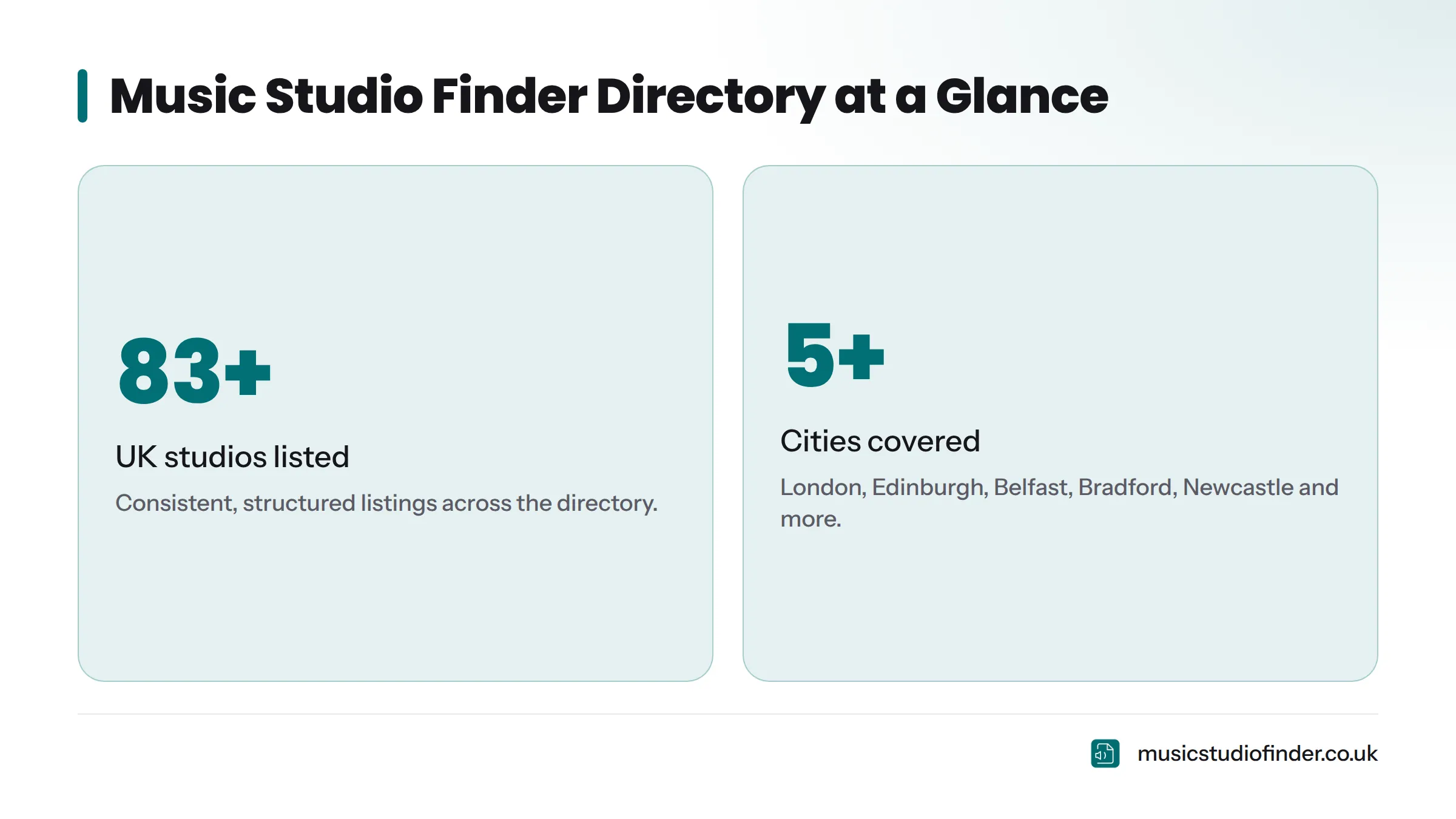
Music Studio Finder lists over 83 UK recording studios with descriptions, ratings, locations, and direct booking enquiry options. Every listing follows a consistent format, so you can compare studios across cities - London, Edinburgh, Belfast, Bradford, Newcastle - without switching between separate websites.
Take Hohm Recording Studio in Bradford and Salt Recording LTD in Newcastle as examples. Both appear on the same platform, under the same categories, with the same structure. A side-by-side assessment takes minutes rather than hours.
Start your comparison here: Music Studio Finder lists 83+ UK studios with ratings, descriptions, and locations - browse the full directory at musicstudiofinder.co.uk.
Step 2 - Define Your Project Requirements Before You Browse
Before you open a single listing, get clear on what you actually need. Studios that look impressive online can be entirely wrong for your project if the fundamental fit is off.
Genre and Style Fit
A studio that specialises in orchestral recording is not the right home for a grime EP, and vice versa. Look at the genres listed on a studio's profile and, more importantly, listen to the published work. Studios that regularly work with artists in your genre understand your sound, know how to position microphones for your instruments, and produce mixes that translate well to streaming platforms.
Offbeat Recording Studio in Edinburgh, for example, is known for vocal work, audiobook production, ADR, and voiceover. That specialist focus tells you immediately whether the studio matches your project. If you are tracking a live band, you would filter for studios with larger live rooms rather than vocal isolation booths.
Session Type: Tracking, Mixing, Mastering, or All Three?
These are distinct disciplines, and not all studios offer all three. Tracking studios focus on capturing live performances - they need great microphones, a capable live room, and an engineer who excels at getting sounds right at source. Mixing studios prioritise the control room, the console, and monitor accuracy. Mastering studios are a different category entirely: a highly treated room, precision monitors, and specialist outboard gear.
Some projects need all three in sequence. Others - especially those working with a remote producer - may only need a tracking room. A studio with a world-class live room but no mastering suite may still be exactly right for your project, depending on your workflow.
The Types of Recording Studios Explained (2026) guide covers the full spectrum clearly if you want a deeper look.
Band Size and Live Room Requirements
A duo recording acoustic guitar and vocals needs very different space from a five-piece rock band tracking live together. Check room dimensions where listed - studios often specify square footage or the number of musicians they can accommodate simultaneously. If you need isolation booths for simultaneous live tracking, confirm the studio has them before it goes on your shortlist.
Turnaround Time and Availability
Studio availability matters as much as quality when you are working to a release deadline. Studios in high demand - particularly those in London, Manchester, and Edinburgh - may have limited slots at short notice. Check whether the studio lists its availability calendar online, or whether you need to enquire directly.
Before You Compare Studios - Your Project Requirement Checklist:
- Genre and musical style confirmed
- Session type identified: tracking / mixing / mastering / all three
- Number of musicians performing simultaneously
- Live room size required (solo, small band, full band)
- Vocal booth needed: yes / no
- Estimated number of recording days
- Target release or delivery date
- Budget range per day or per session
- In-house engineer preferred or bringing your own
- Analogue signal chain preferred or digital workflow is fine
Step 3 - Evaluate Studio Equipment and Facilities Online
How to Read a Studio Gear List
Most professional studios publish a gear list on their website or directory listing. You do not need deep technical knowledge to read one usefully. Focus on four categories: the recording console, the microphone selection, the outboard gear, and the digital audio workstation (DAW). These four elements define the character and capability of a studio more than anything else.
Key Equipment to Look For
Consoles: A studio running an SSL (Solid State Logic), Neve, or API console is investing seriously in its signal chain. These are the desks behind thousands of major-label recordings. Their preamps, EQs, and compressors carry a sonic character that digital emulations reproduce well but never quite replicate. A quality analogue console signals a commitment to professional sound.
Microphones: Look for Neumann microphones - particularly the U87, the industry standard for lead vocals, acoustic instruments, and room recording. AKG microphones (the C414 is widely used) and Shure (SM7B for vocal and broadcast work; SM57 for guitar cabs and snares) are reliable supporting options. A studio with a wide microphone locker gives you more flexibility on the day.
Outboard Gear: Outboard gear refers to hardware signal processors - compressors, equalisers, preamps, limiters - that sit outside the DAW and process audio in the analogue domain. Universal Audio, Neve, and API units are among the most sought-after. Studios with strong outboard collections can shape sounds in ways that software alone cannot.
DAW: Pro Tools (by Avid) is the industry standard for professional recording in the UK and globally. Logic Pro (Apple) and Ableton Live are also common, particularly in studios working with electronic or hybrid productions. The DAW matters less for pure tracking but becomes relevant when you consider file compatibility with your producer or mix engineer.
For broader context on how studio equipment fits into the overall recording environment, Understanding Recording Studios: Function & Operations is worth reading.
Acoustic Treatment and Room Quality
Acoustic treatment is what separates a professional recording environment from a room with foam tiles stuck to the ceiling. Proper treatment involves bass traps in corners, broadband absorbers on parallel walls, diffusers to preserve some natural liveliness, and a control room designed for flat monitoring response.
From photos, look for professional acoustic panels rather than DIY solutions, a clearly separated control room and live room, and evidence of purpose-built construction. Room shape and size matter too - irregularly shaped live rooms with high ceilings produce more interesting natural reverb than small, square boxes.
What Studio Photos and Videos Reveal
A tidy, well-maintained control room with quality monitors, a well-stocked gear rack, and professional cabling suggests an organised operation. A cluttered room with mismatched furniture and visible floor cables is a mild warning sign. Videos - particularly walkthrough tours or session footage - show you the live room in use, the acoustic panels in context, and the engineer's working style. Studios that publish session footage are giving you a genuine window into how they operate.
| Equipment Category | Essential | Nice to Have |
|---|---|---|
| Console / Mixing Desk | Quality desk (analogue or high-spec digital) | SSL, Neve, or API console |
| Microphones | Neumann U87 or equivalent large-diaphragm condenser | Wide locker: ribbons, dynamics, multiple LDCs |
| DAW | Pro Tools, Logic Pro, or Ableton | Pro Tools HDX (hardware-accelerated) |
| Monitors | Genelec, Yamaha NS10, ATC, or similar | Multiple monitor systems for reference checks |
| Outboard Gear | Hardware compressor and EQ in the signal chain | Universal Audio, Neve, or API hardware |
| Acoustic Treatment | Professional bass traps and broadband absorbers | Purpose-built room design by an acoustic consultant |
| Live Room | Dedicated, acoustically separated space | Variable acoustic panels; high ceilings |
| Vocal Booth | Isolated booth or well-treated corner | Multiple isolation spaces for simultaneous tracking |
The Analogue vs Digital Recording Studios: Which Is Right? guide breaks down that particular question honestly if it is a deciding factor for your project.
Step 4 - Assess the Audio Engineer
In-House Engineer vs. Bring Your Own
Most UK recording studios include an in-house engineer in the session rate. Some require it. Others let you bring your own. Knowing this upfront avoids awkward conversations later.
An in-house engineer knows the room in a way no visitor can match quickly. They know where the problem frequencies sit, how the live room behaves in different configurations, and how to get the most from the studio's specific gear. That knowledge has real value on a tight session schedule.
Bringing your own engineer makes sense when you have an ongoing working relationship with someone who understands your sound and your production preferences. The trade-off is that an unfamiliar engineer in an unfamiliar room takes longer to dial in sounds on the day.
The Do Recording Studios Include an Audio Engineer? article covers how this works across UK studios if you want to explore it before deciding.
How to Evaluate an Engineer's Credits and Portfolio Online
An engineer's credits are the clearest indicator of their experience. Look for named artist credits - if the engineer has worked with artists in your genre whose recordings you admire, that is a strong signal of relevant expertise.
Many studios publish engineer profiles on their website or link to work on SoundCloud, Bandcamp, or Spotify. Listen critically. Does the vocal sit well in the mix? Does the low end translate on earbuds as well as studio monitors? Does the overall sound feel current and clean, or dated and cluttered? Your ears are your best comparison tool here.
Genre Specialisation: Why It Matters
A mastering engineer who has spent a decade on classical recordings may struggle to make a grime track hit right. Different styles demand different production values, different spatial decisions, different loudness targets - measured in LUFS, the loudness standard used across streaming platforms - and different tonal priorities.
Ask directly: "Have you worked with artists in my genre? Can you share examples?" A professional engineer will welcome the question and answer it confidently.
Step 5 - Compare Pricing and Session Packages
Understanding Hourly Rates vs. Day Rates vs. Project Packages
UK recording studios typically price sessions in one of three ways:
- Hourly rate: Pay per hour, usually with a minimum booking of two to four hours. Best for short, focused sessions - overdubs, vocal takes, or quick mix revisions.
- Day rate: A fixed price for a full day, usually eight to ten hours. Day rates almost always represent better value per hour than hourly bookings and suit full tracking sessions or intensive mixing days.
- Project package: A flat fee covering the entire production - tracking, mixing, and sometimes mastering. Suited to albums, EPs, or artists who want a predictable total budget.
A day rate at a recording studio is the all-in fee for a full studio day, typically covering the room, in-house engineer, and all equipment for an agreed number of hours. It removes the clock-watching pressure of hourly billing and lets sessions breathe more naturally.
What's Typically Included in a UK Studio Rate
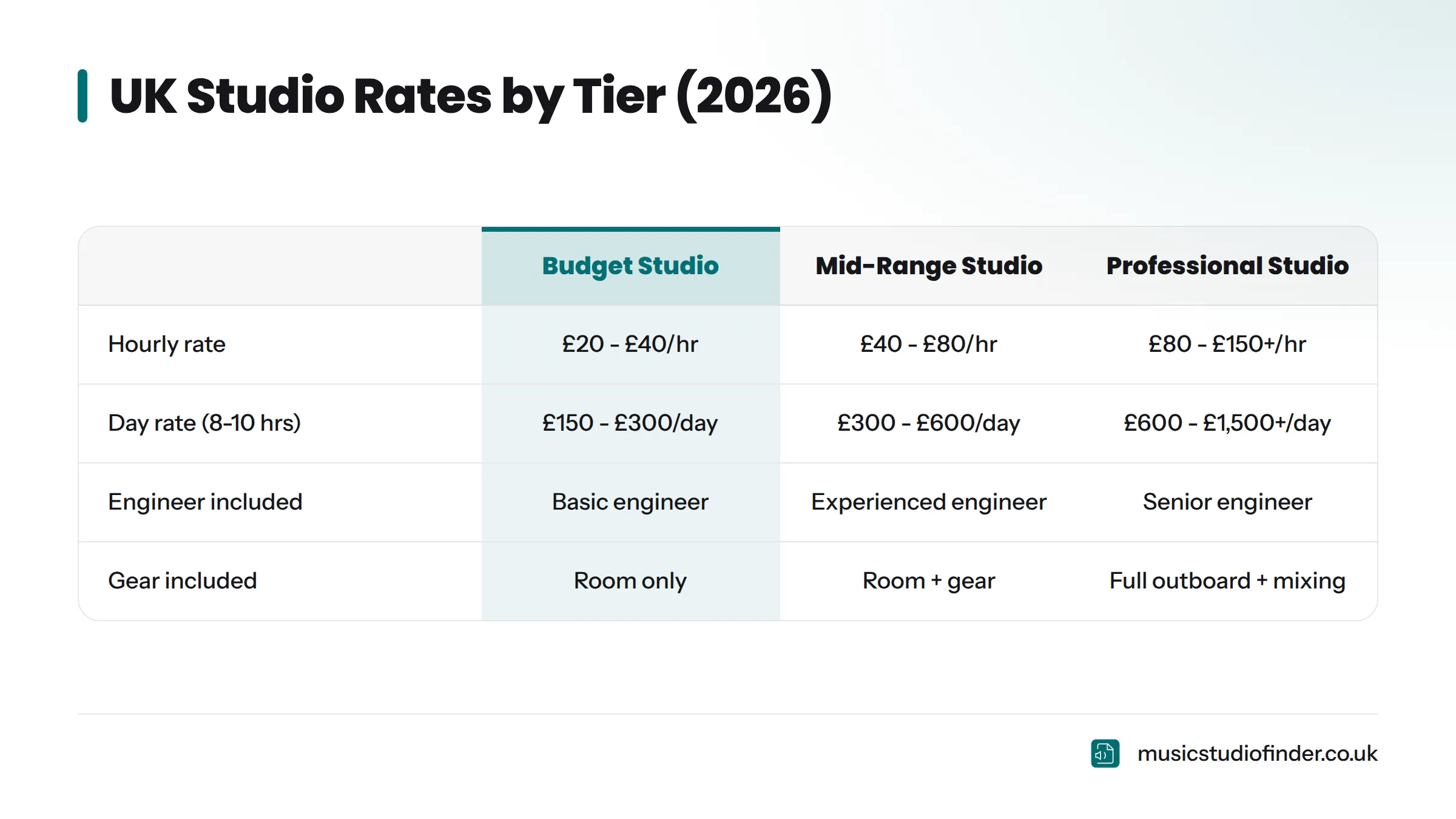
UK studio rates vary considerably by region, facility level, and included services. Based on listings across the Music Studio Finder platform, here is a general framework for 2026:
| Rate Type | Budget Studio | Mid-Range Studio | Professional Studio |
|---|---|---|---|
| Hourly Rate | £20 - £40/hr | £40 - £80/hr | £80 - £150+/hr |
| Day Rate (8-10 hrs) | £150 - £300/day | £300 - £600/day | £600 - £1,500+/day |
| What's Included | Room + basic engineer | Room + experienced engineer + gear | Room + senior engineer + full outboard + mixing |
How much is a 2-hour studio session? At a budget studio, expect to pay £40-£80 for two hours. At a mid-range professional studio, the same two hours typically costs £80-£160. City-centre London studios may charge more. Always confirm what is included - some studios charge separately for the engineer.
The Recording Studio Cost UK: 2026 Pricing Guide covers the full picture with current figures broken down by region and studio type.
Red Flags in Studio Pricing
- No prices published online, with reluctance to share them on enquiry
- Rates that seem unusually low with no explanation of what is excluded
- Hidden charges for engineer time, equipment hire, or file export
- Minimum booking conditions buried in small print
- No clear cancellation or rescheduling policy
Can you negotiate? Yes, in many cases. Studios with gaps in their calendar - particularly mid-week slots - are often willing to offer a discount for block bookings or repeat clients. The Musicians' Union advises members on fair rates and contractual expectations, which is a useful reference point before you start a negotiation.
Step 6 - Read Reviews and Listen to the Work
Where to Find Honest Studio Reviews Online
Google Business profiles carry verified reviews and are one of the most reliable sources of honest feedback. Music Studio Finder listings include user ratings based on real bookings. Social media - particularly Instagram and Facebook - often surfaces unfiltered client reactions in comments and tagged posts.
Look for patterns, not individual data points. One negative review in a sea of positives tells you very little. Five reviews mentioning the same problem - poor communication, equipment failure, an engineer who seemed disengaged - tells you something worth taking seriously.
How to Evaluate Studio Audio Samples and Portfolios
Ask every studio you are seriously considering for audio samples in your genre. Most professional studios will have a portfolio page, a SoundCloud account, or examples they can share on request.
Listen on multiple playback systems - studio-quality headphones, consumer earbuds, a Bluetooth speaker, your phone. A professional mix should translate across all of them. If the bass disappears on earbuds or the vocals are harsh on cheap headphones, the mixing environment may not have the monitoring accuracy you need.
Redbox Recording Studios in Belfast and Blast Recording in Newcastle are examples of studios with established regional reputations - the kind where portfolio work and client history are worth examining before you book.
What to Look for in Studio Testimonials
Genuine testimonials are specific. They name the project type, describe the experience in personal terms, and often mention the engineer by name. A generic five-star review that says nothing more than "great studio!" carries far less weight than one that says "tracked drums and bass simultaneously in the live room, engineer nailed the sound in the first take."
Listen before you book - always ask for a produced sample in your genre. Any professional studio will be happy to share one.
Step 7 - Consider Location, Access, and Logistics
Travel Time and Parking
A studio an hour away is manageable for a single session. For a five-day tracking project, that travel time compounds quickly in both cost and fatigue. Factor in the realistic journey time, not just the distance on a map.
Parking is a genuinely underrated consideration, especially for bands with instrument cases, amplifiers, and drum kits. City-centre studios often have no dedicated parking; studios in industrial estates or suburban areas usually do. Check whether loading access is confirmed and whether parking is free or metered.
Studio Hours and Flexibility
Some studios operate fixed business hours. Others offer evening, weekend, or overnight sessions at different rates. If you do your best work late at night or need a Sunday session, studio hours matter enormously. Confirm flexibility during your first enquiry.
Residential Studios: Are They Worth It?
Residential studios offer something no day-rate studio can: total immersion. You live on-site, sleep on-site, and record around the clock without commuting. For ambitious projects - full albums, intensive writing and recording sessions - the creative and logistical benefits can be considerable.
The trade-off is cost and availability. Residential studio rates are substantially higher than standard day rates, and they suit a specific type of project. Residential Recording Studios: Are They Worth It? covers the question directly if you are weighing that option.
Step 8 - Make Contact and Assess Professionalism
Questions to Ask Before Booking
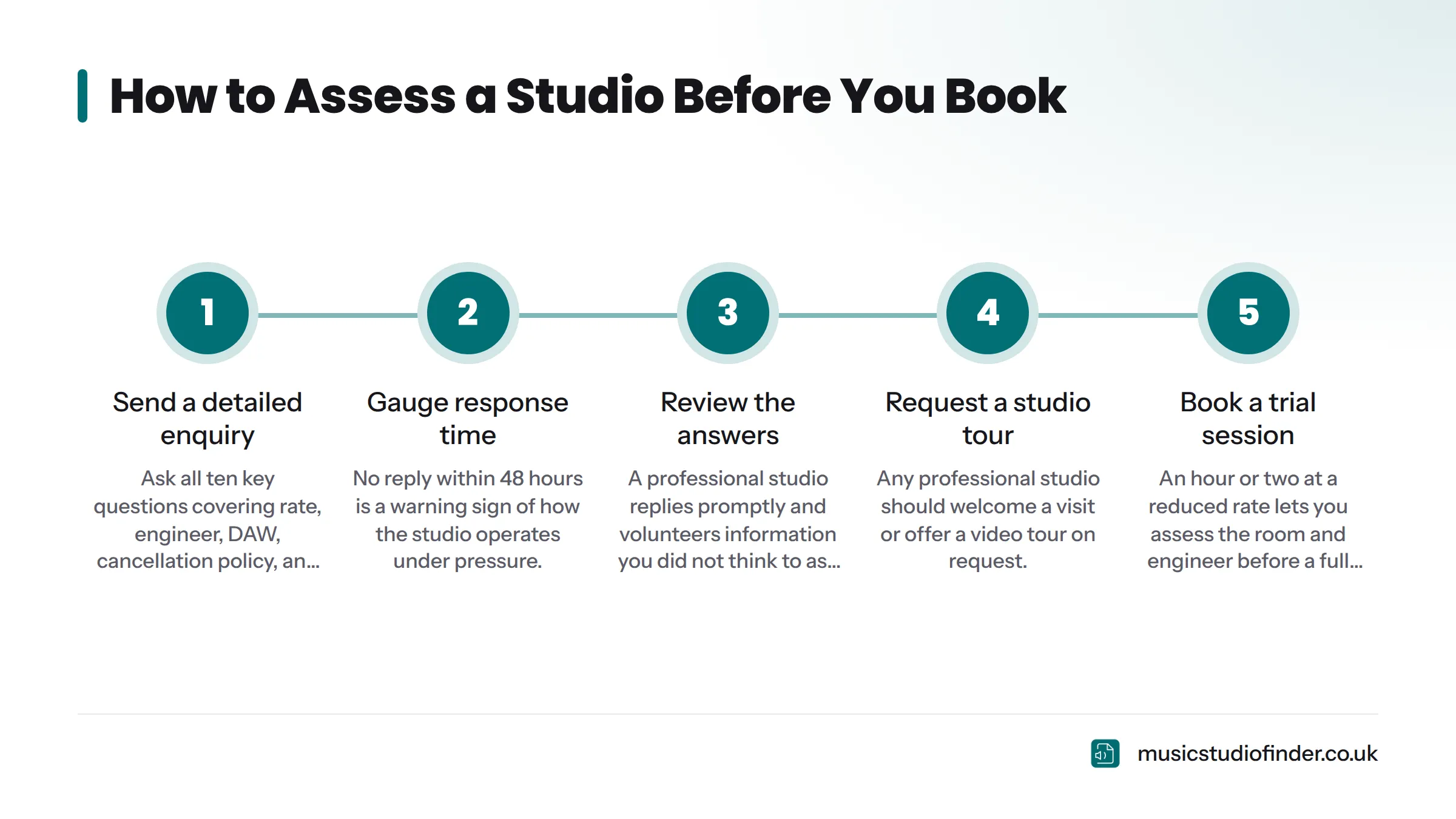
The way a studio responds to your enquiry tells you more than the enquiry itself. A professional studio replies promptly, answers your questions completely, and volunteers information you did not think to ask for. Here is what to ask:
10 Questions to Ask a Recording Studio Before You Book:
- What is included in your session rate - engineer, equipment, mixing?
- Do you have experience recording artists in my genre? Can you share examples?
- What DAW do you use, and can you work with files prepared in [your DAW]?
- What is the capacity of your live room? Can my full band track simultaneously?
- Do you have a vocal isolation booth?
- What is your cancellation and rescheduling policy?
- Is parking available on-site?
- Can I arrange a studio visit or tour before booking?
- Do you offer block booking discounts for multiple sessions?
- What happens if equipment fails during our session?
How to Interpret a Studio's Response
A studio that answers all ten questions clearly and confidently knows its operation well and values your business. A studio that gives vague answers, takes days to respond, or deflects pricing questions is showing you something important about how it operates under pressure.
Response time matters. An initial enquiry that goes unanswered for more than 48 hours is a warning sign - if they are slow before you have paid, they will likely be slower once you have.
Trial Sessions and Studio Tours
Many studios offer short trial sessions - an hour or two at a reduced rate - that let you experience the room, work with the engineer, and assess the acoustic character before committing to a full booking. This is one of the most practical comparisons you can make, and it costs very little relative to the risk it removes.
If a studio tour is available, take it. What you see in person - the condition of the equipment, the cleanliness of the space, the engineer's approach - will either confirm or contradict everything you assessed online.
Green Flags and Red Flags When Comparing Studios Online
| Green Flag | Red Flag |
|---|---|
| Full gear list published with named equipment | No gear list, or vague references to "professional equipment" |
| Audio portfolio with genre-relevant examples | No audio samples published or available on request |
| Prompt, detailed responses to enquiries | Slow or incomplete replies to basic questions |
| Named engineer with verifiable credits | No engineer information provided |
| Clear, itemised pricing with what's included | No pricing published; evasive about costs |
| Professional, high-quality room photos | Low-resolution or absent photos |
| Specific, detailed client testimonials | Generic or absent reviews |
| Stated cancellation and rescheduling policy | No booking terms available |
| User ratings on a trusted directory | No reviews on any platform |
| Studio tour or trial session offered | Resistant to visits or trials before booking |
| Active social media showing recent sessions | Dormant or absent social presence |
| Acoustic treatment clearly visible in photos | No acoustic treatment visible; foam tiles on bedroom walls |
Your Studio Comparison Checklist
Work through this checklist for each studio you are seriously considering, then compare your answers side by side.
Directory and Listings:
- Studio found on a trusted directory with structured listing (e.g., Music Studio Finder)
- Location confirmed - realistic travel distance for your sessions
- User ratings checked and reviewed
Project Fit:
- Studio offers the session type you need (tracking / mixing / mastering)
- Genre fit confirmed - portfolio includes work in your style
- Live room size adequate for your band configuration
- Vocal booth available if needed
- Availability confirmed for your required dates
Equipment and Facilities:
- Full gear list reviewed - console, microphones, outboard, DAW identified
- Acoustic treatment visible and professional in photos
- Control room and live room are separate, dedicated spaces
- DAW is compatible with your files or production workflow
Audio Engineer:
- In-house engineer confirmed (or bring-your-own policy checked)
- Engineer credits reviewed - genre-relevant experience verified
- Audio portfolio listened to on multiple playback systems
Pricing:
- Rate type confirmed - hourly / day rate / project package
- What is included clearly stated (engineer, equipment, mixing)
- No hidden charges identified
- Cancellation and rescheduling policy reviewed
Reviews and Social Proof:
- Google reviews checked - pattern assessed, not just overall score
- Studio testimonials reviewed for specificity and credibility
- Social media checked for recent session activity
Location and Logistics:
- Parking or loading access confirmed
- Studio hours match your preferred working schedule
- Residential option considered (if relevant to project scale)
Communication:
- Enquiry sent and response time noted
- All ten questions answered clearly and completely
- Studio tour or trial session arranged (where possible)
Frequently Asked Questions
How do I compare recording studios if I can't visit in person? Use a structured directory like Music Studio Finder to view listings side by side. Review gear lists, listen to audio portfolios, read client testimonials, and check Google reviews. Send a detailed enquiry and assess how promptly and thoroughly the studio responds. Asking for a video tour is a reasonable request from any professional studio.
What is a reasonable hourly rate for a recording studio in the UK? In 2026, hourly rates across the UK range from approximately £20-£40 per hour at budget studios to £80-£150+ per hour at top-tier professional facilities. Mid-range studios typically charge £40-£80 per hour. Day rates almost always offer better value. Rates vary by region - London studios generally charge more than studios in Bradford, Dundee, or Belfast.
Do I need to bring my own audio engineer to a recording studio? Not usually. Most UK studios include an in-house engineer in the session rate. Some require it; others give you the choice. Bringing your own engineer makes sense when you have an established working relationship with someone who understands your sound, but the in-house engineer's room knowledge often compensates for that familiarity.
How can I tell if a recording studio has good acoustics from photos? Look for purpose-built acoustic panels - broadband absorbers and bass traps - rather than foam tiles. A dedicated, separated control room and live room is a strong signal. High ceilings and non-parallel walls in the live room suggest thoughtful acoustic design. Avoid studios where the "live room" appears to be a standard rectangular room with minimal treatment.
What's the difference between a tracking studio and a mixing studio? A tracking studio is designed to capture live performances - it prioritises great microphones, a capable live room with good acoustics, and an engineer skilled at getting sounds right at source. A mixing studio prioritises the control room, the console, and the monitor accuracy needed to balance and shape recorded tracks. Some studios do both well; others specialise in one.
How many studios should I compare before booking? Compare at least three, ideally five. Three gives you a genuine reference point for pricing, facilities, and engineer quality. Beyond five, diminishing returns set in - you end up comparing studios that are broadly equivalent rather than meaningfully different. Narrow to your top two or three and make direct contact with each before deciding.
What should I listen for in a studio's portfolio recordings? Listen for clarity and separation - can you hear each instrument distinctly? Check whether the low end translates across speakers and earbuds. Assess the vocal presence: is it clear and forward without sounding harsh? Listen for dynamic range and whether the mix feels natural or over-compressed. If the work sounds like music you aspire to make, that is the clearest signal of all.
Is it better to book a local studio or travel to a city studio? It depends on your project. Local studios are more convenient, often more affordable, and easier to revisit for overdubs. City studios - particularly in London, Manchester, or Edinburgh - may offer higher-specification equipment and more experienced engineers, but the cost and travel overhead can be substantial. Weigh the specific quality gap against the practical cost for your project.
Can I negotiate recording studio rates in the UK? Yes, particularly for block bookings, mid-week sessions, or off-peak slots. Many studios will offer a discount for booking multiple consecutive days or for committing to a project package upfront. Be straightforward about your budget - professional studios would rather negotiate than lose a booking entirely.
What is a day rate at a recording studio? A day rate is a fixed fee for a full studio day - typically eight to ten hours - covering the room, in-house engineer, and all listed equipment. It removes the pressure of watching the clock during an hourly session and generally offers better value per hour than booking by the hour. Day rates in the UK range from approximately £150 at budget studios to £1,500+ at high-end facilities.
Find and Compare UK Recording Studios on Music Studio Finder
Every step in this guide is useful only if you apply it. The fastest way to start is to open Music Studio Finder and browse the full directory of 83+ UK studios - each with a structured listing covering location, facilities, ratings, and direct enquiry options.
Whether you are looking for a specialist vocal studio like Offbeat Recording Studio in Edinburgh, a city-centre option like Salt Recording LTD in Newcastle, or a regional studio like Hohm Recording Studio in Bradford, the directory gives you the structured, comparable information you need to make a confident booking decision.
Use the checklist in this guide. Ask the ten questions. Listen to the portfolio. When you find the right studio, book it knowing you chose smart.
The Choose the Best Recording Studio Near You guide picks up where this comparison framework leaves off.
Sources
- Recording Studio Cost UK: 2026 Pricing Guide - Music Studio Finder
- Do Recording Studios Include an Audio Engineer? - Music Studio Finder
- Types of Recording Studios Explained (2026) - Music Studio Finder
- Analogue vs Digital Recording Studios: Which Is Right? - Music Studio Finder
- Residential Recording Studios: Are They Worth It? - Music Studio Finder
- Understanding Recording Studios: Function & Operations - Music Studio Finder
- How to Find a Recording Studio Near You (2026) - Music Studio Finder
- The Best 10+ Recording Studios in United Kingdom - Music Studio Finder
- Musicians' Union - Official Website
- LKFS / LUFS Loudness Standard - Wikipedia
- Pro Tools - Avid
- Solid State Logic (SSL) - Official Website