Recording an EP in the UK typically costs between £300 and £3,000 or more, depending on studio tier, track count, location, and whether mixing and mastering are included. A budget studio session for a 3-track solo EP may come in at £300–£600, while a full-band 5-track EP recorded at a professional London studio with mixing and mastering can comfortably exceed £3,000. That range is wide, and knowing what drives it is exactly what this guide is for.
An EP (extended play) typically contains 3–5 tracks and sits between a single and a full-length album. It is the most common first release format for independent artists in the UK, and it demands careful budget planning - because unlike recording one song, an EP compounds every cost across multiple tracks and multiple sessions.
Studios across the UK list rates from under £15 per hour at community and project studios to over £150 per hour at flagship London facilities. Understanding where your project sits in that range - and what you can do to get the most from your budget - is the difference between a release you are proud of and one you wish you had planned better. For a broader look at recording studio costs in the UK, our full pricing guide covers the wider picture.
What the EP Recording Cost Actually Covers
The headline price you get from a studio rarely tells the whole story. EP recording costs in the UK break down into several distinct components, and you need to budget for each one separately unless a studio explicitly bundles them.
Here is what the total EP production cost typically covers:
- Studio hire (live room and control room time, billed hourly or as a day rate)
- Recording engineer fees (sometimes included in the studio rate, sometimes charged separately)
- Music producer fees (if you hire a producer - not the same as an engineer)
- Mixing (usually charged per track, after recording is complete)
- Mastering (charged per track or per EP, the final stage before release)
- Session musician fees (if you need hired players)
- Additional editing costs (vocal comping, punch-ins, timing correction)
- Travel and accommodation (if you use a residential or out-of-town studio)
Let's break each one down.
Studio Hire: Hourly Rates and Day Rates
UK recording studios generally price their rooms in one of two ways: an hourly rate or a day rate (typically 8–10 hours). For an EP project, day rates almost always offer better value.
| Studio Tier | Typical Hourly Rate | Typical Day Rate | What's Usually Included |
|---|---|---|---|
| Budget / Project Studio | £15–£35/hr | £100–£250/day | Room, basic gear, often engineer included |
| Mid-Tier Professional | £35–£80/hr | £250–£600/day | Room, quality gear, SSL/Neve desk, engineer often included |
| Premium / Commercial | £80–£200+/hr | £600–£1,500+/day | World-class gear, full-time engineer, possibly mixing suite |
Budget studios are often run by working musicians or producers from converted spaces. They typically deliver solid results for straightforward guitar-based or electronic music. Mid-tier professional studios represent the sweet spot for most independent artists - good rooms, experienced engineers, and equipment that makes a genuine difference to the final sound. Premium studios like Abbey Road Studios in London charge accordingly, but they deliver a level of sonic quality and prestige that some projects genuinely justify.
For a detailed look at what factors cause those prices to vary so dramatically, our guide on why recording studio prices vary so much is worth reading before you book.
Recording Engineer Fees
A recording engineer operates the equipment, sets up microphones, runs the DAW (Digital Audio Workstation) - typically Pro Tools, Logic Pro, or Ableton Live - and captures your performances in the best possible way. At many UK project and mid-tier studios, the engineer's time is built into the room rate. At premium studios, engineers may be charged separately at £30–£80 per hour on top of the room hire.
Always confirm whether an engineer is included before you book. If you want to understand exactly what a recording engineer brings to your session, our article on what a recording engineer does covers the role in full.
Music Producer Fees: Do You Actually Need One?
A recording engineer captures the sound. A music producer shapes the song - arrangement, performance direction, sonic identity. These are genuinely different roles, though a talented engineer can often provide light production guidance during tracking.
For an EP, hiring a dedicated producer is optional but can be meaningful for artists who are still developing their sound. Producer fees in the UK typically fall into one of three models:
- Flat day rate: £150–£600 per day, depending on track record and reputation
- Per-track fee: £200–£1,000+ per finished track
- Points (royalty percentage): A producer takes 2–4% of royalties in lieu of or alongside a reduced cash fee - common with more established producers
If you are recording straightforward live music and know your arrangements inside-out, you can absolutely book a recording studio without a producer and work directly with the engineer. For artists making their first EP without a clear sonic direction, investing in a producer often pays back in the quality of the final release.
Mixing Costs Per Track in the UK
Mixing is a separate process from recording. After tracking is complete, a mixing engineer balances every element - levels, EQ, compression, reverb, spatial placement - to create a cohesive, polished stereo file for each track. This is a skilled, time-consuming process, and it is not automatically included in your studio hire rate.
Typical mixing costs in the UK in 2026:
- Budget / freelance online: £50–£150 per track
- Mid-tier mixing engineer: £150–£400 per track
- High-end / London-based mixing engineer: £400–£1,000+ per track
For a 4-track EP, that is £200–£1,600 in mixing fees alone at the budget-to-mid-tier level - a cost that catches many first-time artists off guard. Our guide on recording vs. mixing vs. mastering explains what each stage involves if you want to go deeper.
Mastering: The Final Stage Before Release
Mastering is the last step before distribution. A mastering engineer takes the finished mixed files and optimises them for playback across streaming platforms, radio, and physical formats - adjusting loudness, tonal balance, and ensuring sonic consistency across your EP's tracks. That consistency matters especially for an EP, where listeners hear all the songs as a body of work.
UK mastering costs in 2026:
- Automated / AI-assisted online mastering (e.g., LANDR or eMastered): £5–£20 per track
- Independent mastering engineer: £40–£100 per track
- High-end mastering engineer: £100–£300+ per track
For a 4-track EP, professional mastering typically adds £160–£400 to your budget. Online automated mastering is a reasonable starting point for a first release on a tight budget, but a human mastering engineer will reliably deliver better results - particularly for nuanced or genre-specific work.
Additional Costs to Factor In
An honest EP budget accounts for the extras that often go unmentioned:
- Session musicians: If your EP needs live drums, bass, keys, or strings that you cannot play yourself, you will need session players. The Musicians' Union publishes recommended minimum session rates - currently around £200–£260 per session for a 3-hour studio call for an MU member. Rates vary by player experience and project type.
- Vocal comping and audio editing: Comping the best composite vocal from multiple takes is time-consuming. Some engineers include light editing in their rate; others charge separately. Budget an extra hour or two of engineer time per vocal track.
- Studio time for overdubs: Tracking bass, then guitars, then keys in separate sessions adds up. A well-planned recording schedule avoids expensive revision sessions.
- Duplication and travel: Residential studios in scenic locations charge for accommodation on top of the studio rate - anywhere from £50 to £200 per person per night. Worth checking our guide on residential recording studios before committing.
How Many Hours Does It Take to Record an EP?
Studio time is money, so understanding how long your EP realistically takes to record is one of the most useful things you can do before you book. Our dedicated guide on how many studio hours you need for an EP goes into real detail - but here is the core framework.
A solo vocalist recording over pre-produced backing tracks works much faster than a 5-piece band tracking live in a room together. Genre matters too: a stripped-back acoustic EP moves quicker than a layered indie-rock record with drum overdubs, guitar re-amping, and stacked backing vocals.
| Track Count | Solo Artist (hrs) | 2–3 Piece Band (hrs) | 4–5 Piece Band (hrs) |
|---|---|---|---|
| 3-track EP | 4–8 hrs | 8–14 hrs | 14–20 hrs |
| 4-track EP | 6–10 hrs | 10–18 hrs | 18–28 hrs |
| 5-track EP | 8–14 hrs | 14–24 hrs | 24–36 hrs |
These are tracking-only estimates. Add mixing and mastering time separately - mixing typically takes 2–6 hours per track in the studio (or is done offline by a mixing engineer), and mastering is usually 1–2 hours per track.
If you are curious how EP studio time compares to recording a full record, our piece on how much studio time it takes to record an album shows how the numbers scale up quickly.
A well-rehearsed band is the single biggest time-saver in the studio. Knowing your parts cold, having a clear arrangement, and being ready to record from the first hour means you spend your time making music instead of making decisions.
EP Recording Costs by UK Region
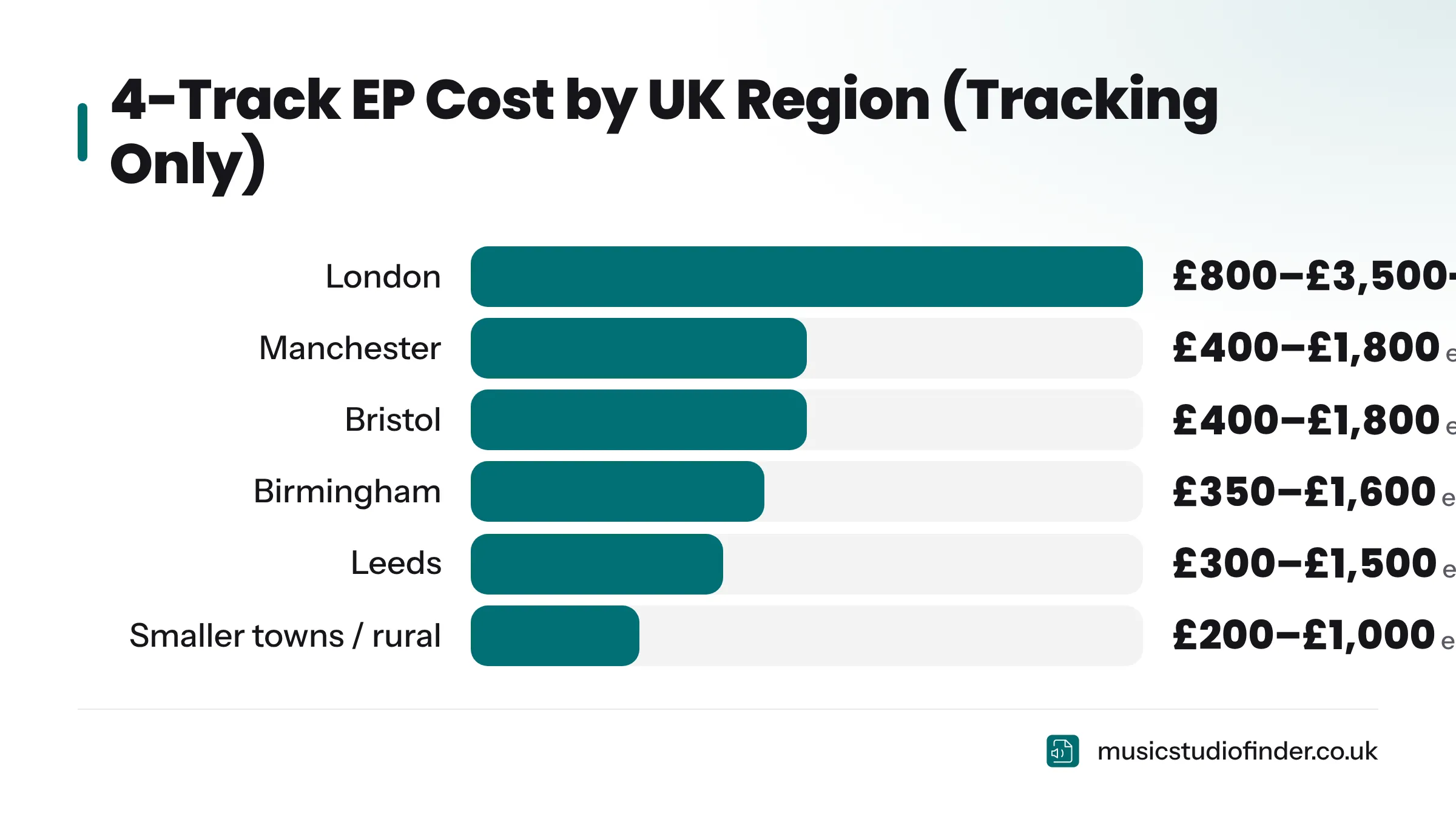
Location is one of the most significant cost drivers for an EP recording budget. London studios command the highest rates in the country - driven by property costs, running overheads, and the concentration of high-budget clients in the capital. Outside London, the same level of technical quality and professional engineering experience is available at substantially lower prices.
| Region | Typical Budget Studio Rate | Typical Mid-Tier Studio Rate | Estimated 4-Track EP Cost (tracking only) |
|---|---|---|---|
| London | £40–£90/hr | £80–£200/hr | £800–£3,500+ |
| Manchester | £20–£45/hr | £45–£100/hr | £400–£1,800 |
| Birmingham | £15–£40/hr | £40–£90/hr | £350–£1,600 |
| Leeds | £15–£40/hr | £40–£85/hr | £300–£1,500 |
| Glasgow / Edinburgh | £15–£40/hr | £40–£90/hr | £350–£1,600 |
| Bristol | £20–£45/hr | £45–£100/hr | £400–£1,800 |
| Smaller towns / rural | £10–£25/hr | £25–£60/hr | £200–£1,000 |
The gap between London and the rest of the UK is substantial, but the quality gap is not. Many artists travel from London to record in Manchester, Leeds, or Bristol specifically to get more hours in the studio for the same spend - and come back with a better-sounding EP as a result.
Budget, Mid-Tier, and Premium EP Recording: What Do You Get?
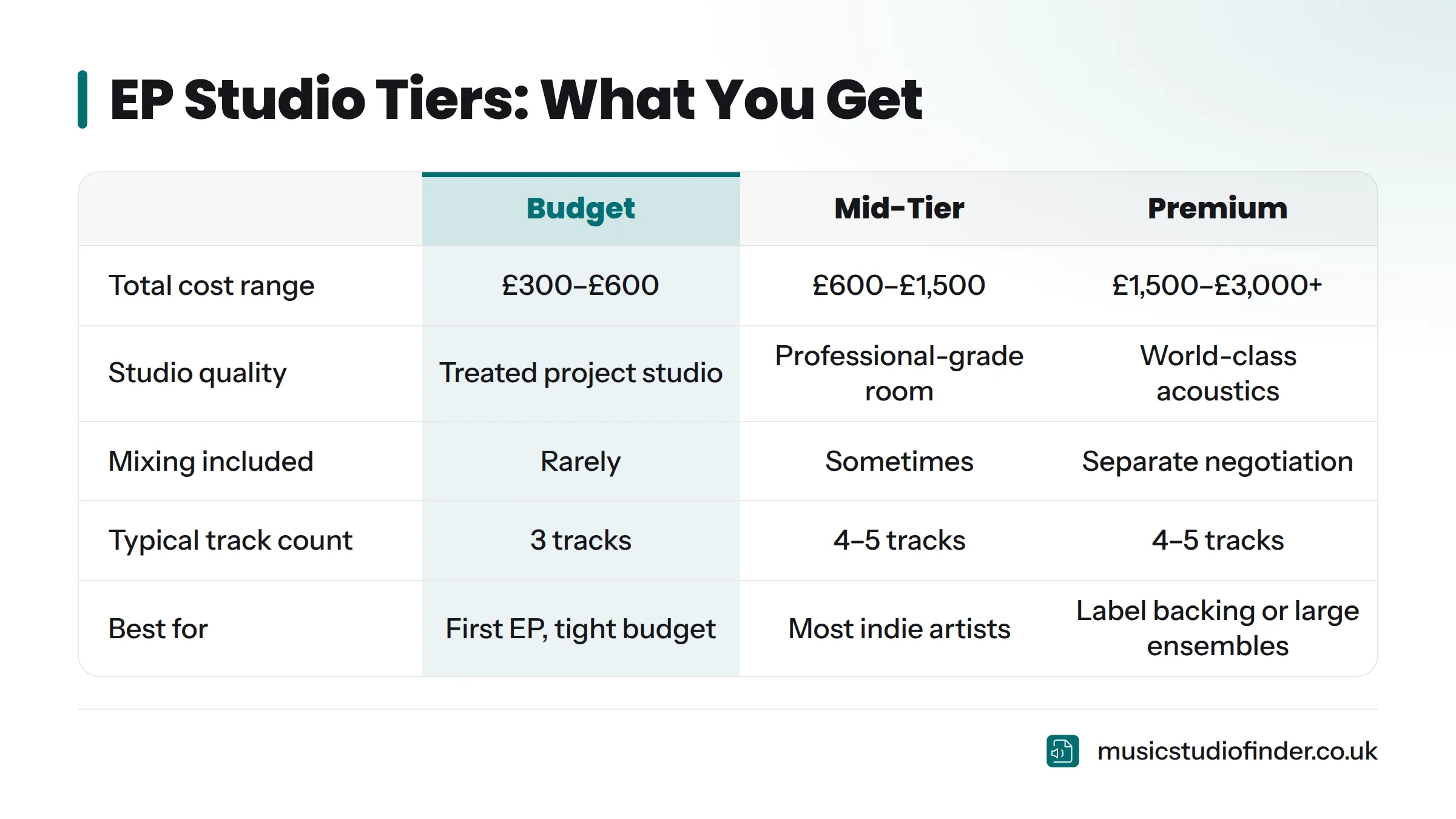
Choosing your studio tier is a genuine creative and financial decision, not just a money question. Here is a clear-eyed comparison of what each level delivers.
| Feature | Budget (£300–£600 total) | Mid-Tier (£600–£1,500 total) | Premium (£1,500–£3,000+) |
|---|---|---|---|
| Studio quality | Solid project studio, treated room | Professional-grade room, quality monitoring | World-class acoustics, SSL/Neve console |
| Engineer experience | Competent, often owner-operator | Experienced, genre-aware | Highly experienced, possibly credited |
| Equipment | Interface, decent mics, DAW | High-quality mics, outboard gear | Top-tier microphones, analogue signal chain |
| Mixing included? | Rarely | Sometimes (check before booking) | Often a separate negotiation |
| Best for | First EP, acoustic/electronic, tight budget | Most independent artists, most genres | Artists with label backing or high commercial ambitions |
| Typical track count delivered | 3 tracks | 4–5 tracks | 4–5 tracks (more time per track) |
The budget tier is not a compromise if your songs are strong and you are well-prepared. Some of the most compelling independent releases in the UK are made in modest studios by artists who arrive rehearsed and focused. The premium tier makes sense when you have a substantial audience already, label interest, or a project that demands acoustic spaces you simply cannot replicate anywhere else - think live orchestral arrangements or large-ensemble recordings.
Worked Examples: What a Real EP Budget Looks Like
Abstract figures only go so far. Here are three realistic EP budgets for different scenarios in 2026.
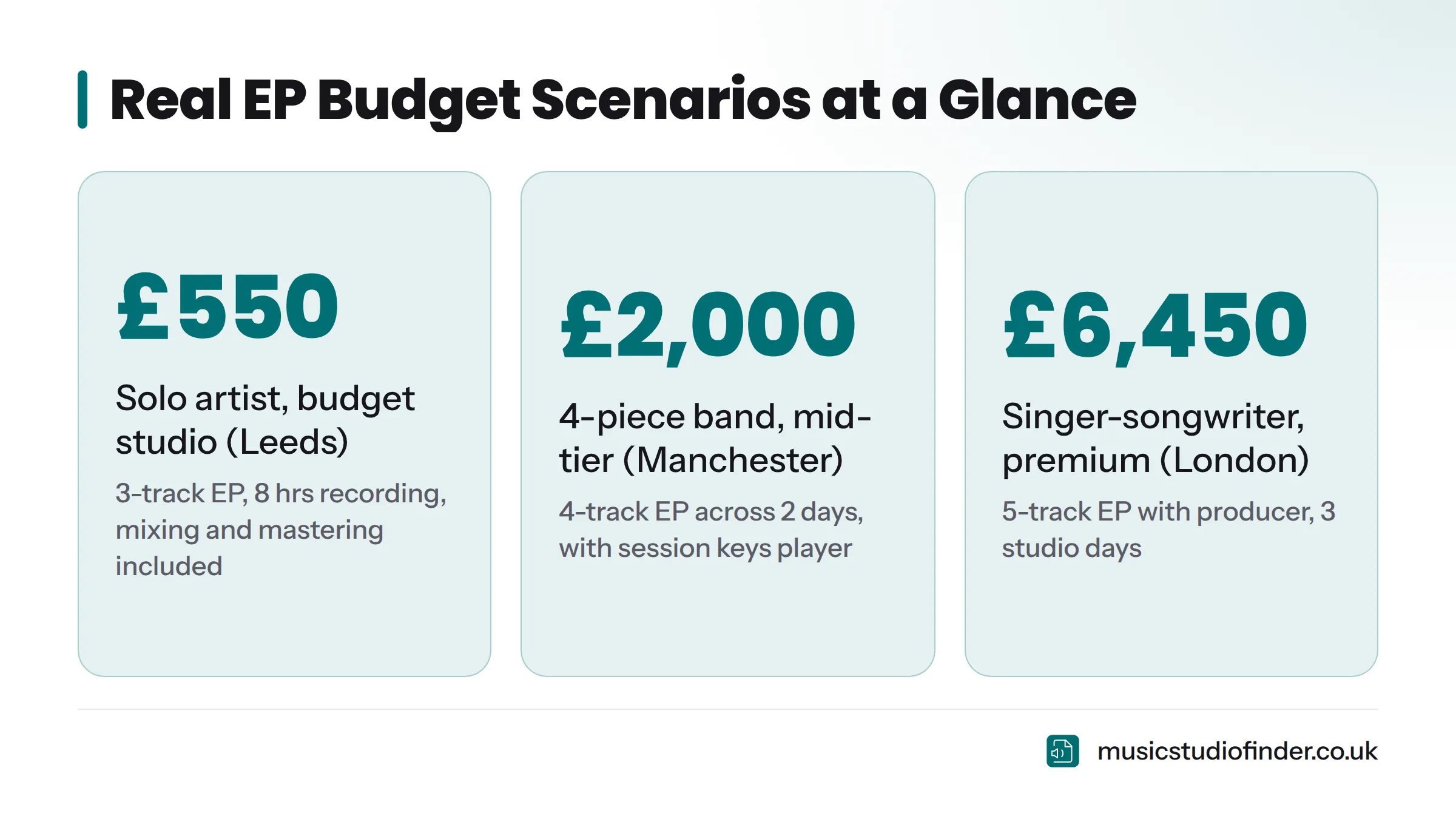
Scenario A: Solo Vocalist, 3-Track EP, Budget Studio Outside London
A singer-songwriter recording three original songs over pre-produced backing tracks at a project studio in Leeds.
| Cost Component | Estimate |
|---|---|
| Studio hire (8 hours at £20/hr) | £160 |
| Engineer (included in rate) | £0 |
| Mixing (3 tracks at £80/track) | £240 |
| Mastering (3 tracks at £50/track) | £150 |
| Total | £550 |
Scenario B: 4-Piece Band, 4-Track EP, Mid-Tier Studio in Manchester
A guitar-bass-drums-vocals band recording four tracks across two full days, with the engineer included in the day rate.
| Cost Component | Estimate |
|---|---|
| Studio hire (2 days at £350/day) | £700 |
| Engineer (included) | £0 |
| Mixing (4 tracks at £200/track) | £800 |
| Mastering (4 tracks at £70/track) | £280 |
| Session keys player (1 session) | £220 |
| Total | £2,000 |
Scenario C: Singer-Songwriter, 5-Track EP, Premium London Studio
An established independent artist recording five introspective tracks at a high-spec London studio with a producer attached.
| Cost Component | Estimate |
|---|---|
| Studio hire (3 days at £700/day) | £2,100 |
| Producer fee (5 tracks at £400/track) | £2,000 |
| Mixing (5 tracks at £350/track) | £1,750 |
| Mastering (5 tracks at £120/track) | £600 |
| Total | £6,450 |
Scenario C illustrates why premium EP production can climb well above the £3,000 headline figure - the producer alone is a substantial line item. Artists at this level typically have touring income, grants, or label support to absorb those costs.
Home Studio vs. Professional Studio: Cost Comparison for an EP
Recording your EP at home is a genuinely viable option in 2026 - but it comes with its own cost structure and trade-offs. Our full breakdown of the recording studio vs. home studio comparison covers this in depth. Here is the essential version.
A home studio setup capable of producing a release-ready EP typically requires:
- Audio interface: £150–£400 (e.g., Focusrite Scarlett or Universal Audio Volt)
- Condenser microphone: £100–£500 (e.g., Audio-Technica AT2020, Rode NT1)
- Studio monitors: £200–£600
- DAW software: £0 (GarageBand) to £500 (Logic Pro, Pro Tools)
- Acoustic treatment: £100–£500+
- Total initial setup: £550–£2,000+
Once that infrastructure is in place, additional EPs cost very little to record - just your time. The catch is that the quality ceiling for home recording is real. Untreated rooms introduce acoustic problems that even skilled mixing engineers struggle to fully fix. Drum recording at home is impractical for most artists. Without the neutral reference environment of a treated control room with calibrated studio monitors, your mixes may not translate well on other playback systems.
The honest decision framework:
- Choose home studio recording if you are making electronic, acoustic, or vocal-led music; you have basic acoustic treatment; and you are comfortable engineering your own sessions.
- Choose a professional studio if your music involves live drums, a full band, or you want a neutral, trusted reference environment and an experienced engineer in the room.
Many artists use both: tracking drums and live instruments at a professional studio, then returning home to overdub vocals and production elements. This hybrid approach is increasingly common and often the most cost-effective path to a quality EP.
Eight Ways to Cut Your EP Recording Costs Without Sacrificing Quality
You do not need a big budget to make a good EP. You need a smart budget. Here are eight proven ways to bring costs down without compromising the result.
- Arrive fully rehearsed. Studio time billed at £30–£80 per hour is not the place to work out your parts. Nail your arrangements in the rehearsal room first. Our studio session prep checklist walks through exactly how to prepare.
- Book day rates over hourly rates. Most studios offer a meaningful discount for a full-day booking. A day rate of £280 for 10 hours beats paying £35 per hour for 10 hours individually.
- Record outside London. As the regional pricing table above shows, you can get the same quality for 30–50% less in Manchester, Leeds, Birmingham, or Bristol compared to equivalent London studios.
- Book off-peak slots. Mid-week days (Tuesday to Thursday) are quieter than weekends at most UK studios. Some studios offer a 10–20% discount for off-peak booking without advertising it - just ask.
- Separate tracking from mixing. You do not have to mix in the same studio where you record. Track at an affordable local studio, then send stems to a freelance mixing engineer online for a lower rate.
- Use online mastering for a first release. Services like LANDR and eMastered offer automated mastering for a few pounds per track. The results are good enough for Spotify and Apple Music distribution via DistroKid or TuneCore, especially for a debut EP where you are building an audience rather than chasing radio play.
- Bundle mixing and mastering with one person. Many UK engineers offer a combined mixing and mastering rate that is cheaper than hiring two separate people. The sonic consistency benefit of having one person handle both stages is a genuine bonus.
- Cut track count or instrument complexity. A focused 3-track EP recorded well is worth more than a sprawling 6-track EP recorded under time pressure. Fewer tracks mean fewer studio hours, lower mixing fees, and a tighter listening experience.
For more strategies on finding value without cutting corners, our guide on how to find an affordable recording studio in the UK is a practical next read.
Here is a quick run of the approach to recording an EP on a budget, covering the core cost categories:
Questions to Ask a Recording Studio Before Booking Your EP Session
Walking into a studio booking conversation informed saves you money and prevents nasty surprises. These are the questions every artist should ask before signing off on a booking. For the full list, our article on questions to ask before booking a recording studio covers the topic thoroughly.
On pricing and inclusions:
- Is the recording engineer included in the studio rate, or charged separately?
- Do you offer a day rate for EP recording, and what hours does it cover?
- Can mixing and mastering be bundled at a reduced rate?
- Are there off-peak or midweek discounts available?
On the studio itself:
- What DAW and monitoring setup do you use?
- Do you have a dedicated vocal booth and live room?
- Can I hear examples of EPs you have recorded in a similar genre?
On logistics and policy:
- What is your cancellation and rebooking policy?
- Do you offer block-booking discounts across multiple sessions?
- Is there a separate mixing room, or is mixing done in the same room as tracking?
A studio that answers these questions openly and confidently is one you can trust. If a studio is vague about inclusions or reluctant to show you work in your genre, that tells you something worth knowing before you hand over a deposit.
Frequently Asked Questions About EP Recording Costs in the UK
A 4-track EP in the UK costs between £600 and £3,500 all-in, depending on studio tier and location. At a budget studio outside London with mixing and mastering included, you can complete a solo artist's 4-track EP for around £700–£900. A full band recording at a mid-tier studio in Manchester with professional mixing and mastering typically lands between £1,500 and £2,500. A premium London studio with a producer attached will cost £3,000 or more.
Yes, significantly. Studio rates in Manchester, Leeds, Birmingham, Glasgow, and Bristol are typically 30–60% lower than equivalent London facilities. You can get a professional-quality recording at a mid-tier Manchester studio for £45–£100 per hour, compared to £80–£200 per hour in London for a comparable setup.
No. Many excellent EPs are recorded with just an engineer. A producer adds creative direction, arrangement input, and sonic shaping - which is valuable when an artist is still developing their identity or wants a distinctive, crafted sound. If you know your songs, your arrangements, and the sound you want, an experienced engineer is all you need.
The cheapest approach is to record at a home studio if your genre allows it (vocal, acoustic, or electronic music primarily), handle your own mixing, and use an automated mastering service. For artists who need a live room, booking a budget project studio outside London during off-peak midweek hours, arriving fully rehearsed, and sending your files to a freelance mixing engineer online will keep a 3-track EP below £500.
A solo artist typically needs 4–14 studio hours to track a 3–5 track EP, depending on complexity. A full band recording live needs 14–36 hours for the same track count. These figures cover tracking only - mixing adds time on top, though it is usually done in a separate session or offline by a mixing engineer.
Rarely, unless the studio explicitly offers an EP package that bundles all three stages. Most UK studios charge for the room and engineer by the hour or day, with mixing and mastering quoted separately. Always ask before booking - the assumption that mixing is included is one of the most common and costly mistakes first-time artists make.
A solo artist recording over pre-produced backing tracks can realistically track a 3-track EP in a single day. A full band recording four or five live tracks will almost always need at least two full days. Our article on recording a professional song in one day explores the factors that determine how much you can achieve in a single session.
For a 4-track EP, budget £300–£900 for mixing (£75–£225 per track at mid-range) and £160–£400 for mastering (£40–£100 per track). Combined, that is £460–£1,300 for mixing and mastering alone. If your overall EP budget is tight, prioritise spending on a good mix - a well-mixed track on automated mastering sounds better than a poorly mixed track on expensive mastering.
Find a Recording Studio for Your EP in the UK
Planning an EP is the exciting part. Finding the right studio to make it real is where Music Studio Finder comes in. We list recording studios across the UK - from budget project studios in smaller towns to fully-equipped professional facilities in every major city - with real rates, room details, and equipment information so you can compare before you commit.
Use the platform to filter by location, budget, and studio type. Whether you are a solo vocalist in Bristol looking for a vocal booth and a half-day rate, or a 4-piece band in Manchester needing a full-day session with a live room, drum kit, and experienced engineer, Music Studio Finder makes finding and comparing UK studios straightforward.
Before you book, our guide on how to choose a recording studio gives you a clear framework for evaluating your options. Once you have a studio in mind, check our recording studio prices UK guide to make sure the rate you are being quoted is in line with the market.
After you record, remember to register your songs with PRS for Music as a songwriter and composer, and register your recordings with PPL UK as a performer - both organisations collect royalties on your behalf whenever your music is played or broadcast in the UK. It is a simple, free process that most independent artists overlook on their first release.
Sources
- Musicians' Union - Session Musician Rates
- PRS for Music - Songwriter and Composer Registration
- PPL UK - Performer and Recording Rights
- Abbey Road Studios - Official Website
- LANDR - Automated Mastering Service
- eMastered - Online Mastering
- DistroKid - Music Distribution
- TuneCore - Music Distribution
- Avid Pro Tools - DAW
- Apple Logic Pro
- Ableton Live