

Off-peak recording studio sessions genuinely save money - typically between 20% and 40% compared to weekend or evening rates at UK recording and rehearsal studios. The slots are there, the savings are real, and with the right timing and a direct conversation with the right studio, you can secure professional studio time at a fraction of the standard price without touching quality.
That said, off-peak booking is not automatically the right move for every musician. Let's break down exactly what it means, how much you can save, when to book, and when it might not be worth it.
What "Off-Peak" Actually Means for Music Studios
An off-peak studio booking is any session scheduled during the times a studio is least in demand - when the room would otherwise sit empty, costing the owner money. Studios price these slots lower to fill the diary and keep revenue flowing.
Off-Peak Hours vs. Off-Peak Days
Most UK studios experience peak demand in the evenings (roughly 6pm to 10pm) and at weekends, particularly Saturdays. Off-peak, by contrast, typically covers:
- Weekday mornings: 9am to 1pm, Monday to Thursday
- Weekday afternoons: 1pm to 5pm, Monday to Thursday
- Sunday evenings: Some studios treat Sunday late-night as quieter than Saturday
The mid-week daytime window - Tuesday to Thursday, 10am to 4pm - is widely considered the quietest slot across UK studios of all sizes.
Seasonal and Calendar Off-Peak Periods
Beyond the weekly rhythm, the calendar matters too. The quietest months for studio bookings in the UK tend to be:
- January and February: Post-Christmas, budgets are tight and many musicians pause until spring
- August: Surprisingly quiet for recording studios, as bands scatter for festivals and holidays
- Mid-term weekdays during the academic year: When student bands and hobbyist musicians are occupied with college or university
The Musicians' Union notes that the UK music calendar clusters heavily around spring and autumn release cycles, leaving winter and midsummer comparatively thin for studio demand.
How Studios Define Their Quiet Times
Studios are businesses, and their quiet times reflect their client mix. A studio serving mostly gigging bands will be quiet during weekday mornings when those musicians are at work. A studio catering to producers and solo artists might be busier mid-week and quieter at weekends. It's always worth asking any studio directly when their diary is typically lightest - the answer will shape your best booking opportunity.
How Much Can You Actually Save? UK Pricing Breakdown
Here is the honest picture of UK studio pricing in 2026, drawn from rates visible across studios listed on Music Studio Finder and published rate cards from independent UK studios.
Typical Peak-Time Studio Rates in the UK
Peak rates apply during evenings, Fridays, and weekends. As a general benchmark for 2026:
- Recording studio (hourly, peak): £40-£90 per hour depending on location and specification
- Recording studio (day rate, peak): £300-£600 for an 8-10 hour session
- Rehearsal studio (hourly, peak): £15-£35 per hour for a room accommodating a standard band
London studios sit at the higher end of these ranges. Studios in cities like Manchester, Bristol, Birmingham, and Edinburgh typically price 20-35% lower than equivalent London rooms. For a detailed breakdown, our Recording Studio Cost UK: 2026 Pricing Guide covers the full picture by region and room type.
Typical Off-Peak Studio Rates in the UK
Off-peak rates vary, but the discount is consistent enough to plan around:
- Recording studio (hourly, off-peak): £25-£60 per hour
- Recording studio (day rate, off-peak): £200-£400
- Rehearsal studio (hourly, off-peak): £10-£22 per hour
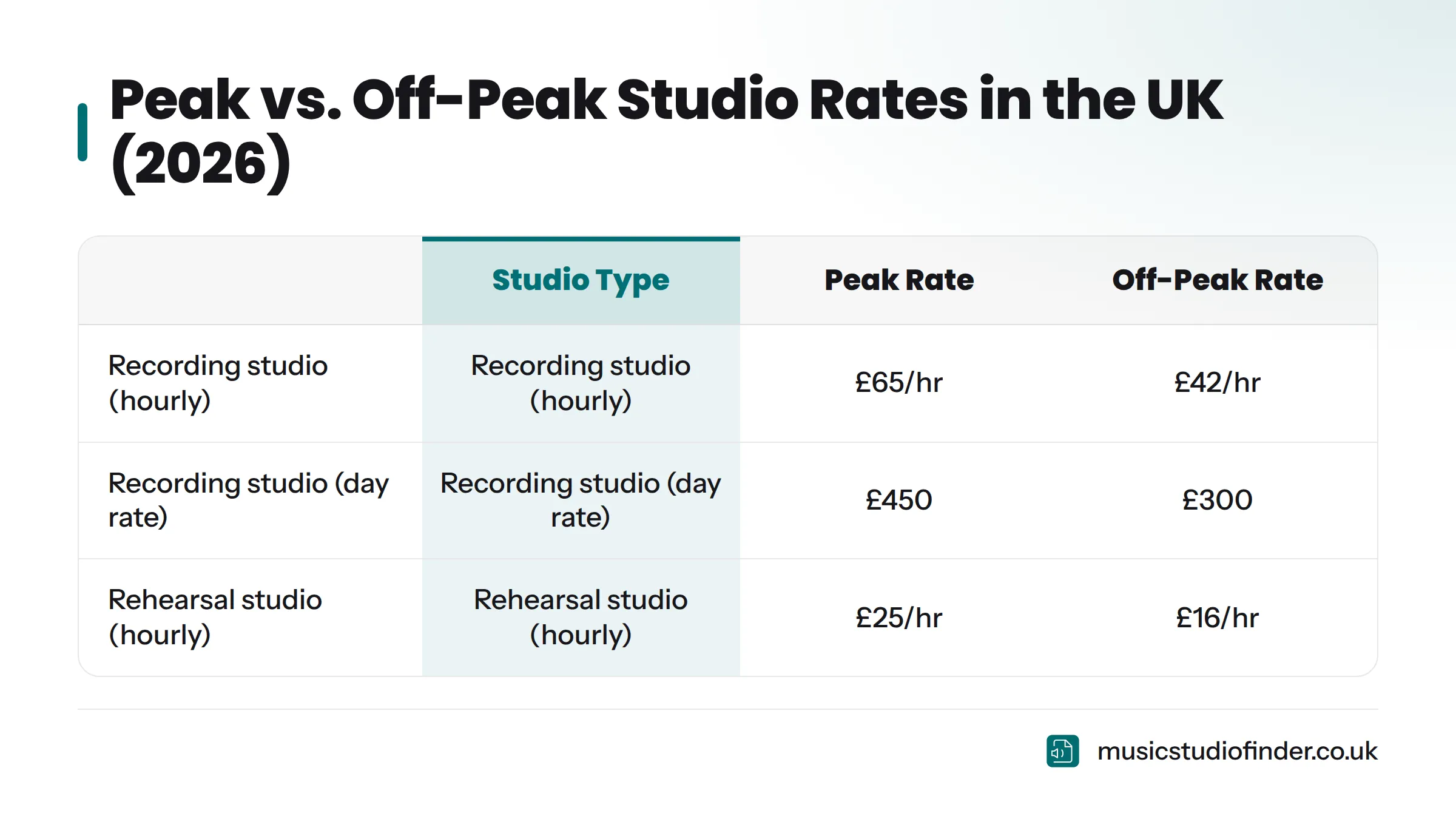
Peak vs. Off-Peak Rate Comparison
| Studio Type | Peak Rate (avg.) | Off-Peak Rate (avg.) | Typical Saving |
|---|---|---|---|
| Recording studio - hourly | £65/hr | £42/hr | ~35% |
| Recording studio - day rate | £450 | £300 | ~33% |
| Rehearsal studio - hourly | £25/hr | £16/hr | ~36% |
Rates are illustrative averages for the UK market in 2026. Actual rates vary by location, room specification, and individual studio policy.
Before you book, it's worth working out whether an hourly rate or a day rate gives you better value for your specific project - that decision can shift your total cost as much as the off-peak timing itself.
Recording Studio Off-Peak Savings: Example Scenarios
Scenario 1 - Solo artist recording an EP: Booking 10 hours of recording time on a Saturday evening at £65/hr costs £650. The same 10 hours split across two Tuesday mornings at £42/hr costs £420. That's a saving of £230 - enough to cover mixing or mastering.
Scenario 2 - Four-piece band laying down demos: A Saturday afternoon session of 6 hours at £60/hr comes to £360. A Wednesday afternoon at £38/hr comes to £228. The band saves £132 on a single session. Do that four times across a year and they've kept over £500 in their pocket.
Rehearsal Studio Off-Peak Savings: Example Scenarios
Scenario 3 - Band rehearsing weekly: A band booking a 3-hour Saturday slot at £28/hr pays £84 per week. Switching to a Thursday morning at £16/hr drops that to £48 - a saving of £36 per week, or nearly £1,900 over a year. For an unsigned band, that number matters. For the full context on rehearsal costs, see our Rehearsal Studio Cost UK: 2026 Pricing Guide.
When Are Music Studios Typically Off-Peak?
Timing your booking well is the single biggest lever you have on cost. Here's how to read it.
Best Days of the Week to Book
The clearest answer: Monday to Thursday. These four days consistently represent the cheapest booking windows across UK studios. Friday starts to pick up from early afternoon as weekend demand kicks in. Saturday is the most expensive day at almost every studio in the country. Sunday sits somewhere in between - cheaper than Saturday, but busier than mid-week.
Best Times of Day for Cheaper Studio Hire
Within any given day, mornings are cheapest. Specifically:
- 9am-1pm on weekdays: The quietest window in most studios
- 1pm-5pm on weekdays: Still cheaper than evenings, though demand picks up slightly after 3pm
- After 10pm on weekdays: Some studios offer late-night or overnight rates that can be very cheap - but check engineer availability carefully before committing
Quick Reference: The Off-Peak Sweet Spot for UK Studios
| Time | Day | Demand Level | Likely Rate |
|---|---|---|---|
| 9am-1pm | Mon-Thu | Very low | Cheapest |
| 1pm-5pm | Mon-Thu | Low | Cheap |
| 5pm-9pm | Mon-Thu | Moderate | Standard |
| Any time | Friday | Rising | Standard-High |
| Any time | Saturday | High | Peak |
| Morning | Sunday | Low-Moderate | Below peak |
| Evening | Sunday | Moderate | Standard |
Quietest Months of the Year for Studio Bookings
If you have flexibility over when you record or rehearse, January and February are your friends. Studios that were packed in November and December for pre-Christmas releases often have wide-open diaries in the new year. August is similarly quiet for recording studios in many parts of the UK. Book during these windows and you can sometimes negotiate rates lower than the standard cheap studio time UK prices already offer.
How to Find and Book Off-Peak Studio Slots
Knowing when off-peak is one thing. Finding studios that actually offer those rates and getting a booking confirmed is another. Here's a practical step-by-step approach.
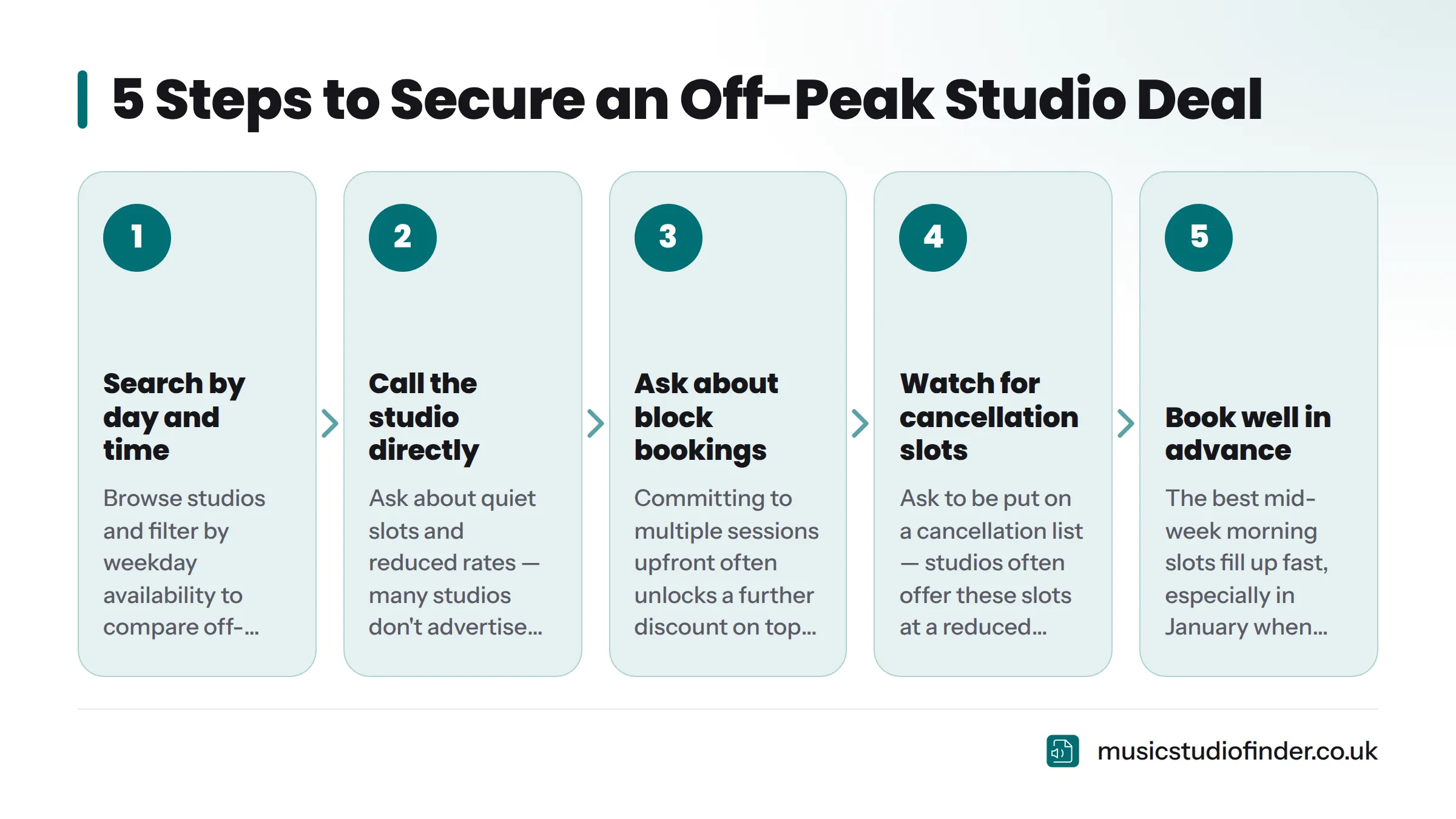
5 Steps to Secure an Off-Peak Studio Deal:
- Search specifically by day and time. Use Music Studio Finder to browse UK studios and filter by availability - you can see which studios have weekday slots open and compare their rates side by side, making it easy to spot the best-value off-peak options before you pick up the phone.
- Call or email the studio directly. Ask when their quietest times are and whether they have a different rate for those slots. Many studios don't advertise off-peak pricing publicly but will offer it when asked.
- Ask about block booking packages. Committing to multiple sessions upfront often unlocks a further recording studio discount on top of any off-peak rate - more on this below.
- Watch for cancellation slots. When a booked session falls through, studios will sometimes offer that slot at a reduced rate on short notice. If you can be flexible, ask to be put on a cancellation list.
- Book well in advance for popular off-peak windows. The best mid-week morning slots at well-equipped studios fill up - especially in January, when other budget-conscious musicians have the same idea. Early booking secures the rate and the room.
Ask the Studio Directly
This is worth repeating: most independent UK studios are run by people who would rather have the room occupied at a reduced rate than empty at the full rate. A polite, direct enquiry goes a long way. Try something like: "I'm flexible on timing - do you have any quieter mid-week slots where you'd offer a reduced rate? I'm looking to book X hours over the next few weeks."
That framing signals that you're a serious, recurring booking prospect - not someone fishing for a one-off deal.
Use a Studio Finder Platform
Music Studio Finder lists studios across the UK with pricing information, availability, and direct contact options. Rather than cold-calling studios one by one, you can compare off-peak availability across multiple rooms in your area and reach out to the most suitable options with confidence. It's the fastest way to find affordable recording studios in the UK without spending hours on Google.
Block Bookings and Packages
Block booking - paying for a set number of hours or sessions in advance - is one of the most reliable ways to cut studio costs. Studios benefit from guaranteed revenue; you benefit from a lower per-hour rate. A block of 10 hours booked in advance might come at a 10-20% discount on top of any off-peak pricing already in place. Combine the two and the savings compound quickly.
Last-Minute and Cancellation Slots
Cancellations happen at every studio. When a booked session falls through at short notice, the studio loses revenue on a room that is already set up and staffed. Many studios will fill that gap at a reduced rate rather than take the full loss. The trade-off is that you need to be ready to go at short notice - gear prepared, parts practised, and your schedule flexible. If your project allows for that kind of spontaneity, ask studios to alert you when cancellations come up.
Is Off-Peak Always the Right Choice? Trade-Offs to Consider
Off-peak bookings are genuinely cheaper, but they are not right for every musician or every project. Here's an honest look at the downsides.
Engineer and Producer Availability
This is the most common issue. Many studios roster their most experienced engineers during peak hours - evenings and weekends - because that's when most clients book. During mid-week mornings, the engineer available might be less experienced, or the studio might be staffed on a self-operated basis only. If you need a skilled engineer as part of your session, check explicitly who will be there and what their credits are before booking off-peak. Our guide to booking a recording studio without a producer is worth reading if you're considering self-operated sessions.
Session Quality: Does Time of Day Matter?
The room, the equipment, and the acoustics are identical at 10am Tuesday as they are at 7pm Friday. Your Digital Audio Workstation, the microphone preamps, the mixing desk - none of that changes with the clock. What can change is your own energy and preparation level. Some musicians find early morning sessions sharper and more focused; others take time to warm up and prefer afternoon slots. Know yourself before committing to a 9am start.
Flexibility vs. Cost Savings
If your project has a hard deadline - a release date, a tour rehearsal, a sync licence submission - the cheapest slot might not align with when you actually need the studio. Saving £150 on a session loses its appeal if it means missing a commercial opportunity worth ten times that. Off-peak booking works best when you have genuine flexibility over your creative timeline.
Should You Book Off-Peak? A Quick Decision Guide:
| Your situation | Off-peak likely a good fit? |
|---|---|
| Flexible schedule, no hard deadline | Yes |
| Need a specific senior engineer | Check availability first |
| Recording a demo or rehearsing | Yes - almost always |
| Recording a commercial release with a tight timeline | Assess carefully |
| Band all work 9-5 on weekdays | Probably not (evenings/weekends suit better) |
| Solo artist or producer with daytime availability | Strong yes |
| Budget is the primary constraint | Yes |
How to Negotiate a Better Studio Rate
Negotiating studio rates feels awkward to many musicians, but studios expect it - particularly from repeat clients or anyone booking in bulk.
What to Say When You Call a Studio
Be direct and friendly. Lead with your booking volume, not your budget constraints. Here's a simple approach:
"I'm planning to record over the next two months and I'm looking at several sessions. I'd prefer to come in mid-week during the day - do you have a rate for those slots? And if I book several sessions at once, is there any flexibility on the hourly rate?"
That framing positions you as a valuable, ongoing client rather than a one-time bargain hunter. Most studio managers respond well to it.
Leverage Block Bookings for Better Pricing
A studio offered 15 hours of guaranteed bookings across three sessions will almost always offer a better hourly rate than the same studio offered a single 5-hour session. When you know roughly how much recording you need - say, for a full EP - total up your estimated hours and present that as a block booking proposal. Even a 10% reduction in rate on 15 hours can save you £60-£100 depending on the studio. See our guide on how many hours to book in a recording studio to plan your sessions accurately before you negotiate.
Building a Relationship with Your Studio
The musicians who consistently get the best rates are the ones studios know and trust. Pay on time, respect the equipment, turn up prepared, and treat the studio's time as seriously as your own. Studios give their best deals to their best clients. That relationship is an asset - and it costs nothing except professionalism.
Off-Peak for Rehearsal Studios vs. Recording Studios
The off-peak dynamic plays out differently depending on the type of studio you're booking.
Differences in Pricing Dynamics
Rehearsal studios have simpler economics. The room contains a backline - amps, drum kit, PA system - but no specialist engineer. The cost of running the room is relatively fixed, so any occupied slot at any price above zero is better than an empty room. This makes rehearsal studio owners typically more open to off-peak pricing and negotiation than recording studio owners, whose overhead (engineer time, specialist equipment depreciation) is higher.
Recording studios carry more cost per session, which means their off-peak discounts are real but bounded - a 30-35% reduction is achievable, but deep discounts of 50% or more are uncommon outside of cancellation or overnight slots. For a full comparison of how these two studio types differ, see our Recording Studio vs Rehearsal Studio guide.
When Off-Peak Matters More for Rehearsals
For bands rehearsing regularly, the cumulative saving from switching to weekday morning slots is dramatic - as the weekly scenario above shows, nearly £1,900 saved over a year. If even two or three members of your band can rearrange their schedules, the financial case for mid-week rehearsals is compelling. This is one situation where the affordable rehearsal studio question answers itself pretty clearly.
When Off-Peak Matters More for Recording
Recording is typically booked in larger blocks - a full day or multiple half-days - so even a moderate percentage saving translates to a large absolute amount. A band recording an EP across four days saves more in absolute terms from off-peak pricing than a band doing four one-hour rehearsals. The bigger the session, the more the timing matters.
Frequently Asked Questions
An off-peak studio booking is a session scheduled during the times when demand for studio space is lowest - typically weekday mornings and afternoons, particularly Monday to Thursday. Studios offer these slots at a reduced rate compared to their standard (peak) pricing, which applies during evenings and weekends when demand is highest.
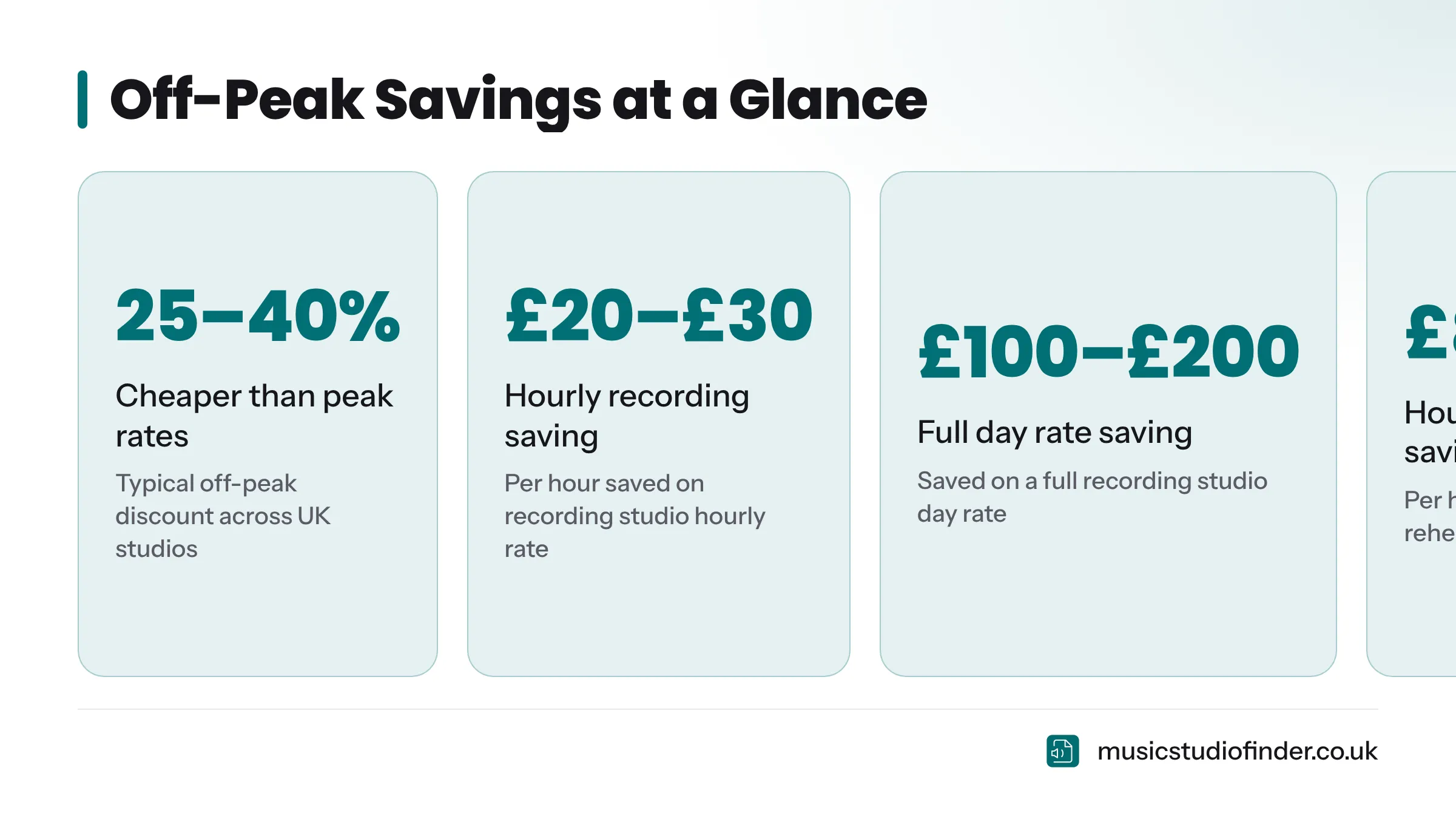
Off-peak studio sessions in the UK are typically 25-40% cheaper than peak-time rates. For recording studios, that often means saving £20-£30 per hour on the hourly rate, or £100-£200 on a full day rate. Rehearsal studios tend to offer savings of £8-£12 per hour during off-peak slots.
- Tuesday, Wednesday, and Thursday are consistently the cheapest days to book a recording studio in the UK
- Monday is usually quiet too, though some studios see a small bump in Monday demand from weekend creatives following up on ideas
- Friday afternoons and evenings begin to attract near-peak pricing
- Saturday is the most expensive day at virtually every UK studio
Yes. Weekday mornings - roughly 9am to 1pm, Monday to Thursday - are the cheapest window at most UK recording and rehearsal studios. Some studios apply their lowest rate specifically to this window, while others treat the whole weekday as off-peak. It's always worth asking.
Yes. Most independent UK studios are open to negotiation, particularly for block bookings, repeat clients, or sessions booked well in advance during their quietest periods. The clearest path to a negotiated rate is to offer something the studio values - volume, reliability, or advance payment. A polite, direct enquiry about their quiet-time availability is usually well received. Check the questions to ask before booking a music studio to make sure you're asking the right things.
Not all studios formally advertise off-peak rates, but most independent studios have them in practice - they just don't always list them publicly. Commercial and high-end studios in central London are less likely to discount significantly. Smaller independent studios outside London are most likely to offer genuine off-peak flexibility.
The room, equipment, and acoustics are exactly the same at any time of day. Quality of session output depends on your preparation, your engineer's experience, and how well you use the booked time - not on whether it's a Tuesday morning or a Saturday evening. Prepare thoroughly with our studio session prep checklist to make every hour count.
It depends on the studio. Some studios have their most experienced engineers available across all hours; others roster junior staff or leave the room self-operated during quieter sessions. Always confirm who will be engineering your session before booking off-peak - especially for recording rather than rehearsal.
The most cost-effective combination is: (1) book during mid-week daytime hours, (2) commit to a block of sessions rather than booking ad hoc, and (3) book during January or February when demand across the UK is at its annual low. Layering all three strategies together can produce savings well above 40% compared to a standard peak-time single-session rate. Our guide on how to save money on recording studio time covers additional strategies beyond timing alone.
Yes, and often more generously than recording studios. Rehearsal studios have lower running costs per session and a more competitive local market, which means their off-peak discounts tend to be proportionally larger. A band switching from Saturday to Thursday morning rehearsals at most UK rehearsal studios will see an immediate and meaningful drop in the hourly rate.
Sources
- Musicians' Union - musiciansunion.org.uk
- UK Music - ukmusic.org
- Digital Audio Workstation - Wikipedia
- Music Studio Finder - Recording Studio Cost UK: 2026 Pricing Guide
- Music Studio Finder - Rehearsal Studio Cost UK: 2026 Pricing Guide
- Music Studio Finder - How to Save Money on Recording Studio Time
- Music Studio Finder - Recording Studio Day Rate vs Hourly Rate
- Music Studio Finder - How to Find an Affordable Recording Studio UK
- Music Studio Finder - Book a Recording Studio Without a Producer
- Music Studio Finder - How Many Hours to Book in a Recording Studio
- Music Studio Finder - Recording Studio vs Rehearsal Studio
- Music Studio Finder - Questions to Ask Before Booking a Music Studio
- Music Studio Finder - Studio Session Prep Checklist